DNC Watch: Charlotte Businesses Play the Southern Card

As Charlotte inches closer to playing its role as host of the 2012 Democratic National Convention (DNC), stories of what makes it a southern city (or not) have been trickling in over the last month.  Many of the local news stories, and even stories appearing in other online news outlets, let us know that business owners in the Queen City are actively playing the southern card.
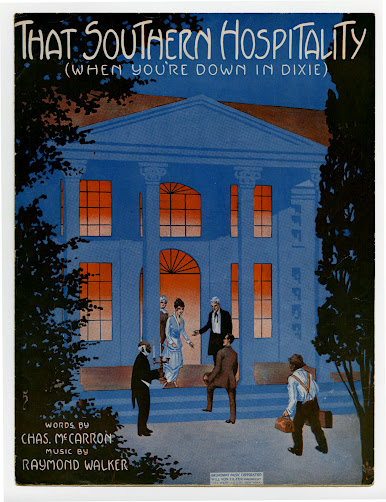
During the early part of the 20th century the musicians of Tin Pan Alley, many of them Jewish immigrants, wrote reams of sheet music about the South. The cover art lets you know exactly what is meant by “That Southern Hospitality.”

In this case, it usually means using phrases like “southern hospitality” or “southern charm” to describe what’s being sold.  As is often the case, these terms are tossed around without considering their historical antecedents in the plantation South.  Today, however, such terms are co-opted for purposes of profit, which is more in keeping with Charlotte’s identity as a “New South” city.

So, what does the “southern card” look like?

The Sacramento Bee (among many other news outlets) published the article “Fashion Travel Tips for the South” informing both RNC and DNC delegates what they should wear to their respective conventions.  “Whether you’re a first-timer or a convention pro, you may still be new to modern, Southern style,” says Arlene Goldstein, vice president of trend merchandising and fashion direction for Belk stores–headquartered here in Charlotte.  Now we know this was a Belk PR piece that was picked up in several news outlets and ties back into the company’s re-branding of itself as the store with “Modern. Southern. Style.” Still, what is “modern, southern style” except brand messaging with a nice ring to it.
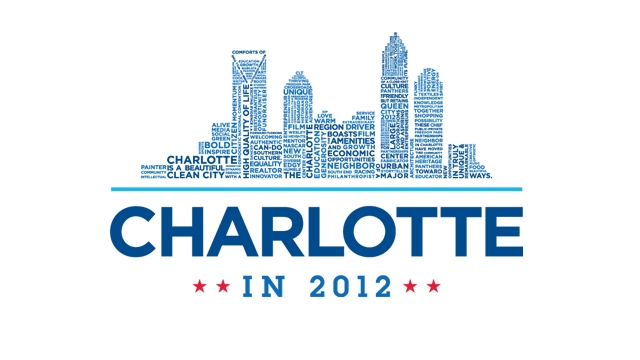
The DNC logo that Kelli Koepel describes, in part, as showing off Charlotte’s “southern hospitality.”

Then there’s Charlotte’s SouthPark magazine, which recently published the article “The DNC Means Big Business.”  In it, Kelly Koepel, owner of the branding agency that created the Charlotte DNC logo played the southern card this way: “Woven throughout the image is this message: ‘Charlotte is a beautiful, clean city with a high quality of life where you’ll find both the expected comforts of Southern hospitality and exciting evidence of a forward-thinking, can-do Southern culture.'” There’s the hospitality again, with some “can-do” thrown in.

African American business owners are also playing the southern card in ways that may surprise you.

Rhonda Caldwell, owner of The Main Event, is hosting a plantation party for DNC delegates from southern states. Photo credit: The Charlotte Observer

Rhonda Caldwell, owner of The Main Event, was hired to host a party at Rosedale Plantation for delegates from Florida, Mississippi and Alabama. “I’m such a history buff, and I wanted to take the history behind Rosedale Plantation and incorporate it in every detail,” Caldwell exlained. “I wanted to make the guests feel like they were back in time.”  Does this mean there will be slave interpreters waiting on folks?  It is a plantation, after all.

Local television station WCNC recently showcased another African American business owner in the news feature “Southern charm on Display at delegate welcome party,” focusing on a venue in the city they claimed “oozes southern charm.”  The Wadsworth Estate in Wesley Heights will be hosting a party for the DNC.  Historically, ideas of “southern charm” and “southern hospitality” have been associated with well-to-do white women–quintessential southern belles.  Yet, the Wadsworth estate is owned by a black woman, Shirley Fulton, and even she is playing up the southern card of old.

As she puts it “I think it’s going to be a lot of genteel southern hospitality because we want to show them Charlotte, [in] particular, and North Carolina in general,” adding “People know that they’re stepping back in time and if you look around at the furnishing, there is almost nothing modern here, so you get that feel of southern charm.”  Genteel. Southern hospitality. Southern Charm.  Stepping back in time.  Say what?

I wonder if she considered what “stepping back in time” means for African Americans like herself?  As a business owner Fulton is indebted to the southern civil rights movement such that I doubt she really wants to step back in time, because instead of owning the estate she’d be cleaning it.  Yet, it’s a savvy business move since most of the delegates to the convention are white, some of whom probably expect to experience a version of “southern hospitality.”  (The white reporter added, “no doubt they’ll be saying ‘y’all’ on their [the delegates] way out.”  Um, I doubt it.)

Clearly, Charlotte-area businesses believe that playing the southern card is good for their bottom line.  Still, as a historian, I know that what people believe is “southern” can cut both ways–and not just the way of hospitality and charm.  I’ll be looking at the flip side in a future blog post.
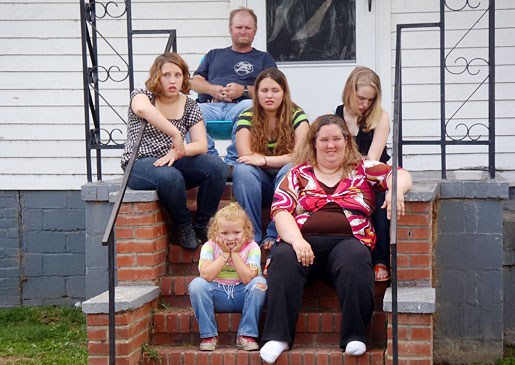
Honey Boo Boo and the Country Ghetto

After watching the first two weeks of “Here Comes Honey Boo Boo,” the tragic comedy reality show on TLC, it’s clear that some “hixploitation” is going on at the network.  The cast of characters–at the center of which are Mama June and her pageant queen daughter Alana–are what you might call “country ghetto.”  They rattle off phrases (“A dolla makes me holla” and “I’m all that and a pack of crackers”) that Helena Andrews writes makes them appear as if they channeled an “angry black woman” from a ’90s sitcom. (See her article in The Root, Aug. 15, 2012).

Alana and her family

Yet, Alana (a.k.a. “Honey Boo Boo”) and her family are firmly situated in rural Georgia, and what I see is more than just the language of the ghetto.  This family literally lives IN a country ghetto.  They are, as a friend suggested, like the Evans family on the sitcom “Good Times” because they have to laugh to keep from crying about the poverty which they can’t seem to escape.

I see the cycle of rural southern poverty on full display.  Underneath all that sass is a family that struggles to stay afloat financially, while also gambling on Honey Boo Boo.  If you listen closely, in between all the colloquialisms (ignoring the subtitles even when they aren’t needed), you’ll hear Mama June tell you that her “baby daddy” works 7 days a week and that she got pregnant at 15, which meant that her education was cut short, although to her credit she finished her GED.  And now her 17 year-old daughter is repeating the cycle of teen pregnancy, and there will be one more mouth to feed.  In addition to “extreme couponing,” June also goes to food auctions and her family happily accepts a deer carcass, even if it was roadkill, because the meat they preserve from it will save them money.  Her older daughters complain that their mother considers anything over $5 expensive.

People may find it irresponsible that Mama June would spend the money she’s scraped to save to invest in Alana’s pageants. But this is consistent with people who live in poverty who pin their hopes on a gamble they hope will pay off.  It’s no different than if they were playing Powerball or scratching off tickets–maybe one day they’ll hit the jackpot, although the odds are stacked against them.

This isn’t just moralizing on my part, because I’ve experienced poverty and can remember a time as a little girl when my Mom (a single mother who scraped by on a secretary’s salary) gave me $2 to purchase a raffle ticket in hopes of winning a new car since we didn’t have one. I still remember the look in her eyes that even she knew this was a long shot.  Of course, we didn’t win, but I hoped with everything we would because it might make life a little easier.  I can see this in little Alana.  She’s a sassy kid, to be sure, but underneath she’s vulnerable and still just six years old. She desperately wants to win that Miss Grand Supreme title and it hurts her a little more each time when she doesn’t.  It hurts June, too.  This is what makes it hard to watch, because I understand how poverty makes you feel “less than” and so I also hurt a little for them.

Maybe they have hit a small jackpot with their show (no doubt TLC has).  During commercials, you’ll see that the network is offering ringtones of Alana’s sayings like “a dolla makes me holla.”  I just hope TLC is cutting Alana a check for those ringtones, since it is profiting by exploiting her.  Maybe she will earn enough to fund a college education, break her family’s cycle of poverty, and escape the country ghetto.  I’m rooting for her.

Dear Jon: Let’s Talk “The South” when you’re in Charlotte

If you’re breathing, there’s a good chance you know that Charlotte, North Carolina, is hosting the Democratic National Convention (DNC).  This is an exciting time for the Queen City as we play host to conventioneers, politicians, and journalists.  There will also be a lot of kvetching over traffic and street closures, but I for one am very thrilled to see that The Daily Show with Jon Stewart will be setting up shop at Imaginon, home to the city’s Children’s Theatre and Library.

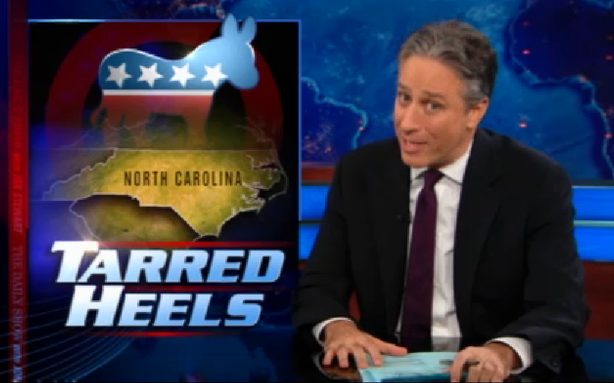
In fact, I’d really like to be on the show to discuss the media and its southern stereotypes.  I’ve written about it before here on Pop South (See posts on DNC Announcement and the one on Martin Bashir over at MSNBC), and I’m certainly scouting out other journalistic blunders on this score, but right now I am waging a campaign to be a guest on the Daily Show to talk about the subject.  And why not?  The Daily Show has numerous reports that have been tagged “the South.”  The earliest one, on Strom Thurmond, dates to 1999.  And the most recent?  On Chick fil A, of course.  I suppose the region is a gift that keeps on giving, as seen in the report on “Tarred Heels” (below), which led Jon Stewart to conclude that North Carolina is the Democrat’s “South Carolina.”  Ouch!

The Daily Show with Jon Stewart Mon – Thurs 11p / 10c
Tarred Heels
www.thedailyshow.com
Daily Show Full Episodes Political Humor & Satire Blog The Daily Show on Facebook
Tarred Heels (watch video above)

So, Jon, if you’re listening, I’ve got a book on the topic of the South in popular culture, this here blog, and hell, I’ve even written an op-ed for the New York Times. I’m also a fan of the show, if that helps.  And, I’d love to talk “the South” with you while you’re in Charlotte.

Pop South readers: Join me in my campaign and tweet to get @Sassyprof on the air.  Tweet this message:  Give @Sassyprof a guest slot to discuss the South and the media @TheDailyShow #CharlotteDNC

Remembering Jesse Owens–An Olympian from the Deep South

In this guest post, Barclay Key, Assistant Professor of History at the University of Arkansas-Little Rock, reflects on the meaning of race and commemoration in the Deep South through his personal recollections of growing up in Lawrence County, Alabama, the same county where Olympic great Jesse Owens was born.  Key has a poignant essay about Owens in a forthcoming volume Destination Dixie: Tourism and Southern History.

While I have the vaguest memory, perhaps concocted later, of Al Michaels asking in 1980 if I believe in miracles, the 1984 Summer Olympics figured most prominently in my childhood.  As an eight-year-old in rural northwest Alabama, I had already developed a passion for some sports, particularly Dixie Youth baseball and Alabama football, but I had little knowledge of the varieties of athletic competition on display in Los Angeles.

Carl Lewis, Mary Lou Retton, and John Williams clearly inspired something in me because I soon developed my own Olympic events and invited friends to participate.  We had the traditional sprints that measured the length of our front yard, but other events required more imagination.  The shot put contest consisted of heaving a brick, and my gymnastics routine was limited to hanging from our rusty swing set, swaying a bit, and dismounting letting go.  I also managed to incorporate an obstacle course and an Atari game or two.  Motivated in part by Red Dawn, I went undefeated versus the Soviets as my games extended into the fall and winter.

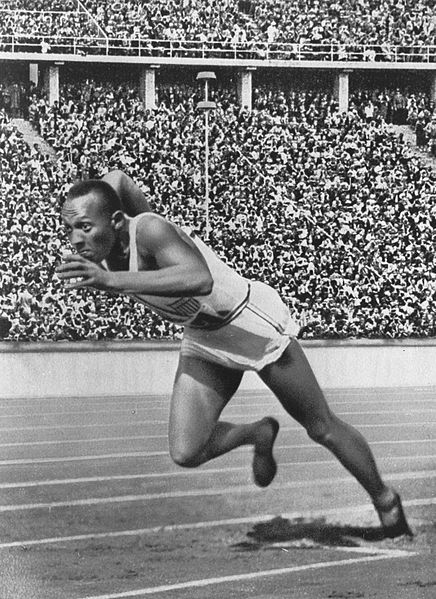
Jesse Owens, 4-time Gold Medalist at the 1936 Berlin Olympics

Imagine my delight the following summer when my mother offered to take me to the nearby Jesse Owens monument.  I had come to understand that Owens was an Olympic hero.  Lewis’s four gold medals in 1984 elicited comparisons to Owens, who had won four gold medals during the 1936 Olympics in Berlin, Germany.  And I had recently participated in the Jesse Owens Memorial Run, a new event in my hometown that acknowledged the track star’s local connection to Oakville, a community near our small town.

Even if he wasn’t technically from my town, I thought, he was from Lawrence County, just like me.  He became an Olympic hero; maybe I could, too.  Or at least I could start at wide receiver for the Univeristy of Alabama Crimson Tide.  In a place where one’s identity relates so closely to home and community, there is a sense in which Owens was becoming “one of us.”  Although I was naïve about this process and its abundant ironies, local people, particularly whites, were coming to embrace Owens as a hometown hero a few years after his death in 1980.

Owens had been a child—about nine years old, just like me—when he migrated with his family from Alabama to Ohio.  To the best of my knowledge, he never stepped foot in the county again.  In autobiographical accounts of his childhood, Owens wrote of the “terror of sharecropping in the South” and the “terror of Oakville,” a community he described as “more an invention of the white landowners than a geographical place.”  I don’t recall anyone explaining why the Owens family left “our home” or why Owens ran for Ohio State University instead of my beloved Crimson Tide.  I completely missed the significance of a black American from Alabama overcoming tremendous odds to represent his own country in an Olympiad often remembered for its Nazi hosts.

Mother’s offer was really more of a bribe.  She needed to run an errand near Owens’s birthplace, about ten miles away, and she did not want to leave me alone.  The promise of seeing the Owens monument convinced me to cooperate.  She provided no details, so my mind ran wild with possibilities.  At the very least, I imagined a large statue surrounded by beautiful flowers, or maybe even an elaborate fountain that would give me an opportunity to make a wish and toss a penny.

Twenty minutes into the drive, my mother exclaimed, “There it is!”

“Where?!” I shrieked, exasperated that I couldn’t immediately locate what must have been an amazing sight.

“Right there,” she replied.

I finally caught a fleeting glance of what looked like a tombstone.  “Is that all there is?” I asked.

A few years ago, I couldn’t resist an opportunity to write an essay about the commemoration of Owens in Lawrence County for Destination Dixie:  Tourism and Southern History.  Readers will learn how this modest monument provoked controversy that spilled into the state and national media and how the Jesse Owens Park and Museum later arose out of the same cotton fields that the Owens family picked before their migration.  This project was cathartic in several ways.  Having navigated the requirements of becoming a “professional historian,” I enjoyed sharing a local story that served as a microcosm of racial tensions and piecemeal efforts at reconciliation that have become more characteristic of the South in recent decades.

My recent interest in the commemoration of Owens illustrates how I too have embraced him as a Lawrence County native, not just an Olympic hero.  Although Owens’s experiences were in no way comparable to my own, I have come to appreciate that his story is indelibly tied to my own, to our own.  My grandfather was a sharecropper; my father started picking cotton at age five.  Their “whiteness” protected them from the racial discrimination that the Owens family faced, both in Alabama and beyond, but we share an ancestral relationship to the land, to work, to want.  We are from Alabama.  Jesse Owens is my people, just as notorious figures like George Wallace are.  Accepting both remains a work in progress for many.