
Pop South Goes North to Clark University in Worcester, MA

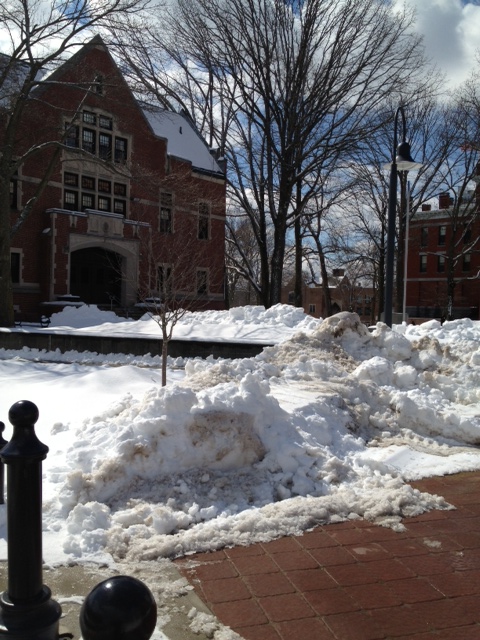
New England didn't get the memo that it was the second day of Spring.
New England didn’t get the memo that it was the second day of Spring.

What a thrill it was to be asked to come North to discuss my scholarship with the wonderful people at Clark University in Worcester, Massachusetts.  I was invited several months ago by Dr. Janette Greenwood of the History Department to speak with students and to deliver the annual Bland-Lee Lecture, which is supported by a generous donation from the Chester Bland family in honor of former history professor Dr. Dwight Lee.

My first talk was with students from two different classes, one on public history and one on collective memory and mass violence. We met in the Goddard Rare Book Room of the library, a room filled with beautiful volumes of books, perfect for a salon-like discussion. While there I talked with students about the work of the United Daughters of the Confederacy in preserving Confederate Memory in the era of the New South. Students asked terrific questions, many of which were based on their reading of my book Dixie’s Daughters.
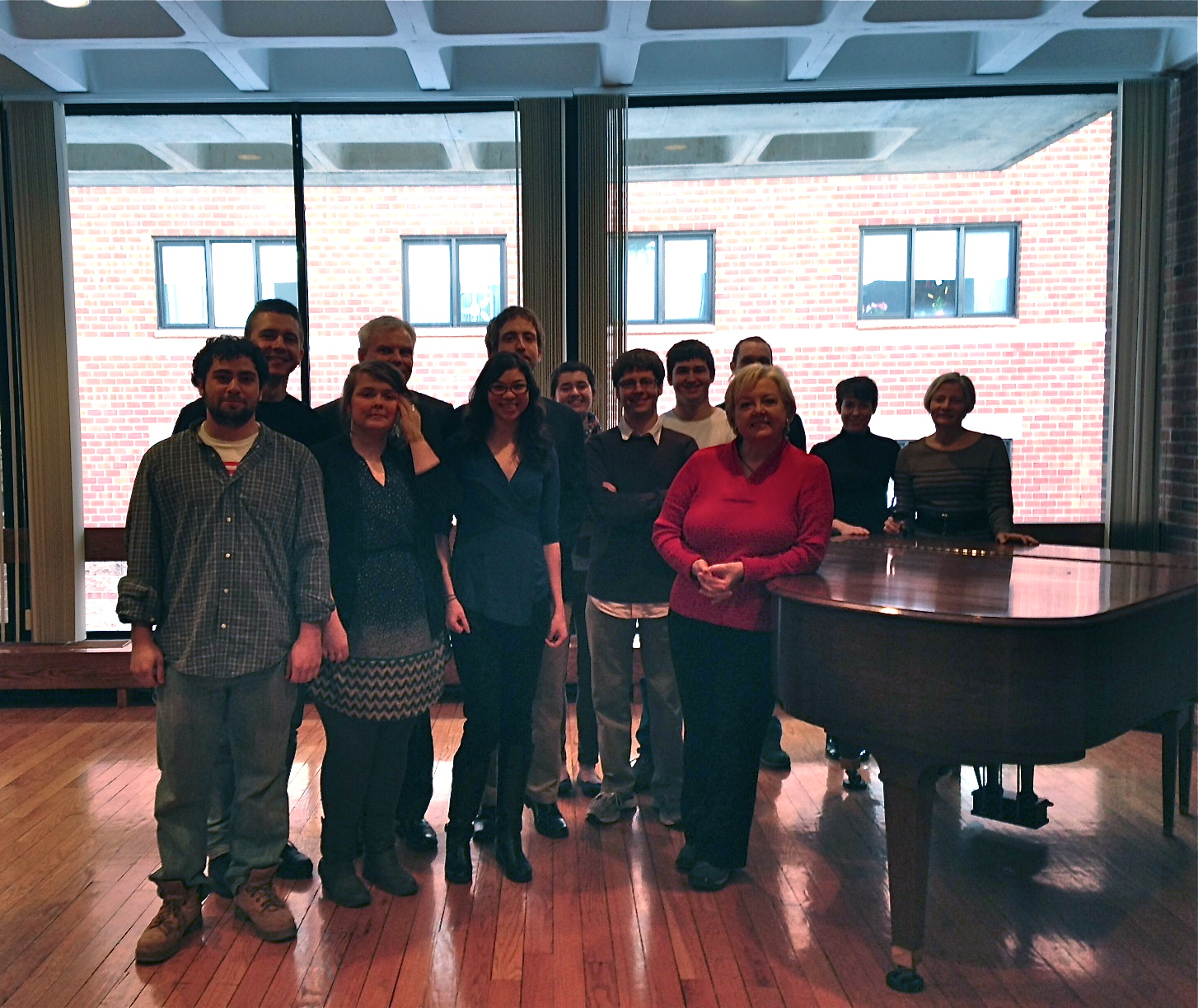
Me with the great students I met at Clark University.

Later in the day, after a very welcome plug by golocalworcester, I had the privilege of speaking before a crowd of close to 75 people about the northern origins of the romanticized South.  It was the first time I’ve had the opportunity to discuss my work with a northern audience, so I was pleased to hear their thoughts.

I began by asking those gathered (including Clark University President David Angel) if they had ever spent time in the South.  Many raised their hands, although I’m not sure how much time they had actually spent here. Then I asked, “how many of you have preconceived notions about the South?” A majority of the hands in the audience went up.  Then, I proceeded to illustrate the ways in which the North and northern purveyors of popular culture have been responsible for how we as a country perceive the South, including up to the present day. Afterward, I fielded questions for more than 30 minutes. To the point of exhaustion.  I realized that, to this day, northerners still don’t quite understand the South.  It is still regarded as a region of “others.” But to be fair, I imagine many southerners look askance at northerners as well.  And so it has been since we’ve been a nation.
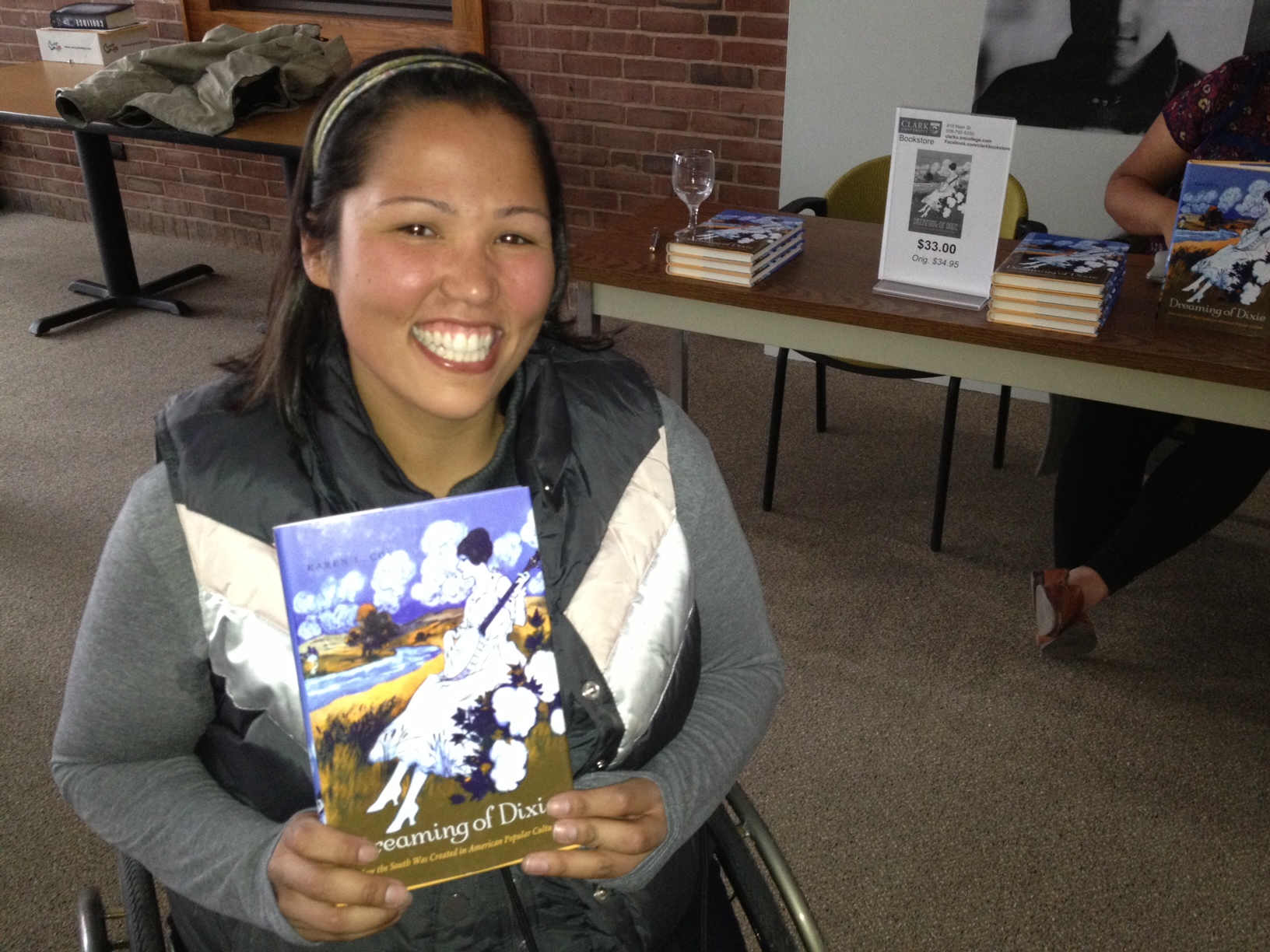
Jennifer Fitzroy, a student from nearby Boston College, surprised me by attending the talk.

One of the pleasant parts of my visit was the opportunity I had to speak with Clark students.  They were smart, engaged, community-minded, and all-around outstanding individuals.  All of them serve as reminders that a strong liberal arts education is an outstanding foundation upon which to build our future.
Thoughts on the Future of Civil War History

I had the pleasure of joining numerous historians at Gettysburg College this past weekend for The Future of Civil War History: Looking Beyond the 150th conference–a meeting that considered how we can better interpret the American Civil War to gain a fuller, more complex, and multilayered understanding of its impact on the nation and its people.  During this, the sesquicentennial of the war, the conference sought to set a far different tone than the celebratory centennial (1961-1965), which many scholars have noted was swathed in the rhetoric of the Lost Cause.

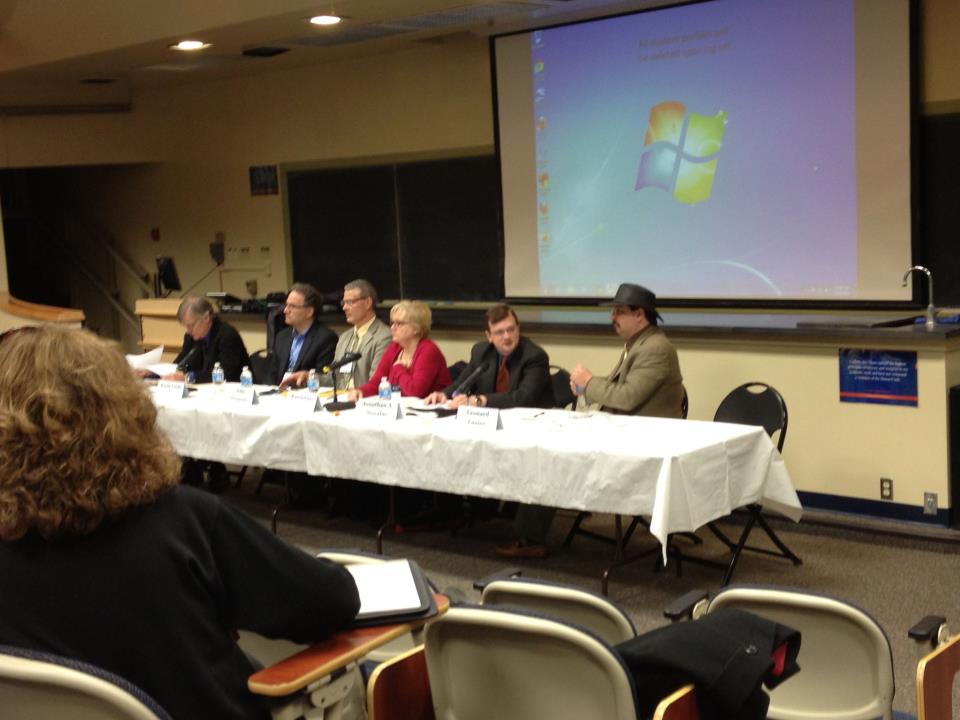
(L-R) David Blight, Kevin Levin, John Hennessy, Karen Cox, Jonathon Noyalas, and Leonard Lanier.

This gathering at Gettysburg certainly set a different tone as it brought together public historians and academic historians to tackle issues of memory and history, of slavery and gender, of trauma and even the smells and sounds of the battlefield.  I participated in the session “Interpreting Issues of Civil War memory for the Classroom and Museum Audiences,” alongside Kevin Levin, who maintains the very successful blog Civil War Memory, Jonathan Noyalas, an instructor at Lord Fairfax Community College, John Hennessey of Fredericksburg & Spotsylvania National Military Park, and Leonard Lanier, assistant curator at the Museum of the Albemarle (NC).  Our moderator was David Blight of Yale University and author of the very important and influential book Race and Reunion: The Civil War in American Memory.

One audience member asked us if we were doing a better job of interpreting the Civil War during the sesquicentennial.  Time will tell, but I’d like to think that given the vast array of subjects covered at this conference that we’ve more than improved on the discussions held during the centennial.

Double Divas or Our Cups Runneth Over with Southern-based Reality TV

As I’ve said many times, the explosion of southern-based reality television series make it difficult for me to keep up.  One of the more recent is Lifetime‘s Double Divas, starring Molly Hopkins and Cynthia Richards, owners of LiviRae Lingerie in Kennesaw, Georgia. Lifetime may refer to it as a “docu-series,” but that’s just a highfalutin term for reality show.

The premise of Double Divas is that Molly and Cynthia are out to help women, one bra at a time, who’ve been frustrated in their effort to find one that fits.  Their motto “no bust too big or too small” is the premise of their business, although there’s nothing particularly southern about that. Women from all over the country can appreciate a well-fitted bra.

While Lifetime describes the show as one that brings “southern charm and hospitality,” a claim made by many southern-based reality shows, what makes it “southern,” in my opinion, are Molly and Cynthia’s accents.  Having grown up in the South, I truly appreciate a southern accent, of which there are several variations.  Yet sometimes it seems that Cynthia lays it on a bit thick with hers, almost to the point where I have to hit the mute button.  Still, I can’t help but wonder if the production company is behind the exaggeration.

NorthSouth productions, with offices in New York, Los Angeles, (and Knoxville?), produces this show and others in the greater Atlanta area, including Say Yes to the Dress, where a strong southern accent seems to be a requirement. The company also produced You Don’t Know Dixie, a show that promoted southern stereotypes, as I’ve written about previously.

Despite the exaggerated accents, there is something very likeable about Molly who seems genuinely interested in helping women find a bra that boosts their confidence as well as their breasts.  And while Cynthia’s accent can get on my last nerve she, too, seems to really want to help women by creating the right bra for them.

I think women are watching this show (and heading to LiviRae Lingerie in droves) because so many of us are eager to get a bra that fits. That’s no joke. Even I might make the trip to LiviRae for that reason.  Still, you don’t really need a southern accent or characters to sell you on that simple truth, but in the world of reality TV it’s a big part of what sells the show.