The guys with the beards are back. On reality television that is. Duck Dynasty’s new season premiered last night and its legions of fans tuned in to see the latest happenings in the Robertson family, especially those of the hirsute men of the clan.
Duck Dynasty has become the most successful of the reality shows set in the South. It’s part of what I like to call the “Louisiana genre” of reality TV that includes other successful show like Swamp People and Billy the Exterminator. Though let’s not forget the lesser known Cajun Pawn or Cajun Justice.
What makes Duck Dynasty different, for me at least, is that the guys with beards are nobody’s fool. So much of southern-based reality TV seems geared toward stereotyping people from the region. Very often they are placed in ridiculous situations for comedic effect and their speech is accompanied by subtitles. This is most famously the case with the Thompson Family in Here Comes Honey Boo Boo. Not so with Duck Dynasty.
One gets the impression that Willie and the boys are very much in control of their show and while there’s humor, it’s the kind where we can laugh with them and not at them. Uncle Si might be the one in the family who’s picked on, but “hey,” he and the rest are in on the joke. Moreover, the show about these self-made millionaires, whose company Duck Commander makes duck calls among other products, seems more like a strategic move on the family’s part to further their brand. And it’s worked like a charm.
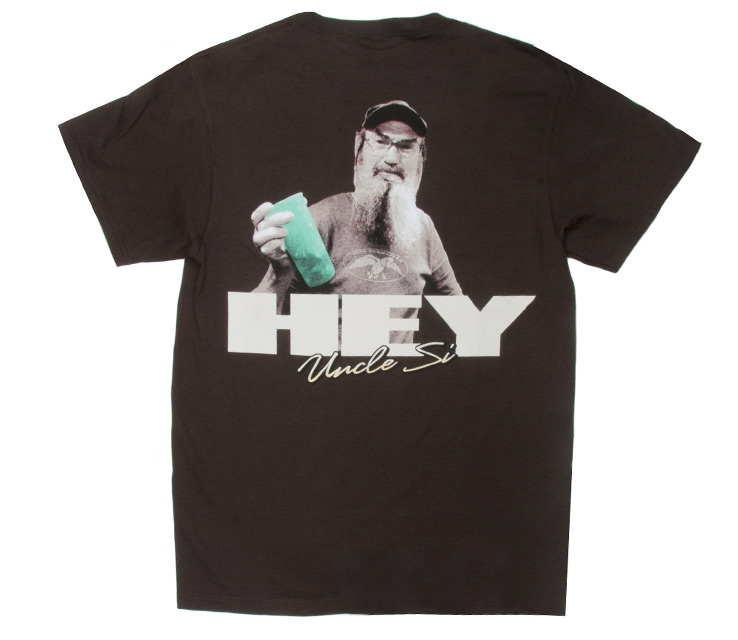
Uncle Si Robertson and his catch phrase on a T-Shirt
Now the brand includes the show itself. The success of Duck Dynasty has resulted in sales of all sorts of items that have less to do with duck calls and more to do with the family’s keen marketing sense. Products range from bobble heads of father Phil and his sons Willie and Jase to shirts and coffee mugs with Phil’s saying “Happy, Happy, Happy,” to images of Uncle Si and his catch phrase “Hey!” printed on t-shirts. The Robertson women are also in on the boondoggle with products of their own.
One of the reasons I enjoy the show is that I can see that the Robertsons are very grounded, self-aware, and clearly wise to the ways of the world. When their fame dissipates, they will still be doing well financially. Unfortunately, this is the exception to the rule when it comes to southern-based reality TV. True, many of those stars may temporarily be enjoying some windfall, but they are not as savvy as the beards. And that’s too bad.
The WordPress.com stats helper monkeys prepared a 2012 annual report for this blog.
Here’s an excerpt:
4,329 films were submitted to the 2012 Cannes Film Festival. This blog had 26,000 views in 2012. If each view were a film, this blog would power 6 Film Festivals
A year and a half after writing an op-ed for the New York Times about the South in reality television, I am here again with the latest installment of the trend. “Buckwild,” MTV’s newest “reality” program, is a look at the shenanigans of a group of young men and women from my home state of West Virginia. Set in Sissonville, just outside of the state capitol of Charleston, MTV tells us that this show and this group of 20-somethings is going to take over where “Jersey Shore” left off. My prediction: “Buckwild” dies a quick death after the first season and none of the show’s cast members will see the kind of money that Snooki or “The Situation” has enjoyed.
The cast of MTV’s “Buckwild”
So what do we have in “Buckwild?” After a first look at the show, what I saw was very contrived. The cast seemed a little nervous to be on film at all, and their conversations didn’t seem as organic as they likely are when the cameras aren’t on. There were also several places within the first episode where you could almost hear a producer telling cast members what to do next. “Okay, you two girls, jump in that mud hole and start wrestling.” Because that would seem natural for two hillbillies from West Virginia.
If you’re from the state, you have a right to be embarrassed. On the one hand, the antics of youth can be found anywhere. But there’s always a spin when the show is set in the South, or in this case, Appalachia.
First, you have the subtitles as most of these shows have, which indicates that the people in this place speak with a foreign tongue–but mainly foreign to urban ears. (I find I am distracted and annoyed by the subtitles in southern-based reality shows, because the speech and/or accents are often perfectly understandable.) Second, you have some activity that suggests to you that the place is a cultural backwater, literally. Cue the hoses to create a mud pit and send in trucks to splash through it or young women to roll around in it.
Now, some would say “these people really do exist.” Sure they do, but are they representative? I’m from West Virginia and my cousins and their children are all hardworking, decent and smart people. And they don’t get their kicks wallowing in mud. Why don’t we see THAT represented? Because then we wouldn’t have people we could laugh at.
You see, this hillbilly stereotype goes back for more than a century and has often been used for purposes of humor. Very often this stereotype highlights the urban and rural divide in American culture. The city slicker versus the country rube. So, “Buckwild” just continues to perpetuate that long held stereotype, so that urban dwellers can get a cheap laugh at hick culture and feel superior about it while they do. If MTV, or any other reality show (like “Moonshiners”) truly wanted to represent the diversity of Appalachian culture they would. But they are content to make money by striking the same note–over and over–much to the chagrin of so many people who live far richer lives there, in those same mountains, than what is presented. That’s a shame, but I doubt we’ve seen the last of shows like these.
Cue a toothless man holding a moonshine jug with XXX marked on the side.
This is an excellent guest post by Abigail Gautreau for Katie Stringer’s blog entitled “Something Old, Something New.” I suggest you read it and reconsider your views on Honey Boo Boo and the Thompson Family. Thanks, Pop South
I like to drive. My dad taught me how when I was seven or eight years old and turned me loose with his old one-ton flatbed truck. With the tattered bench seat pushed all the way forward, I toured the back roads around our South Georgia farm with my trusty co-pilot, a chihuahua named Scooter, perched on the seat next to me. When I was older (and legal), I ventured farther, this time with a stack of maps by my side. My best memories are from those road trips—my first solo long-distance drive to college; a cross-country journey with an old boyfriend; and speeding across the Tappan Zee Bridge at 4:00 AM on the 1000-mile trip home during grad school.
I got to know the South from behind the wheel of an automobile, just like the farmers and tourists I write about. But the South they encountered looked very different. At the turn of the twentieth century, a jumble of muddy roads covered the South like a bed of briars. Roads were not long-distance routes, but rather short paths that fed local traffic to the nearest railroad depot. Main roads branched outward from railroad towns, and thousands of miles of secondary roads linked them to farms. There were no road signs or mile markers to guide you. If you weren’t from around these parts, you’d have a hard time navigating the roads that linked isolated farms to nearby market towns but not much else.
These problems became the focus of a grassroots campaign called the Good Roads Movement. Though it began among urban bicyclists in the 1880s, by the 1910s the automobile craze had transformed it into a nationwide crusade to improve rural roads.
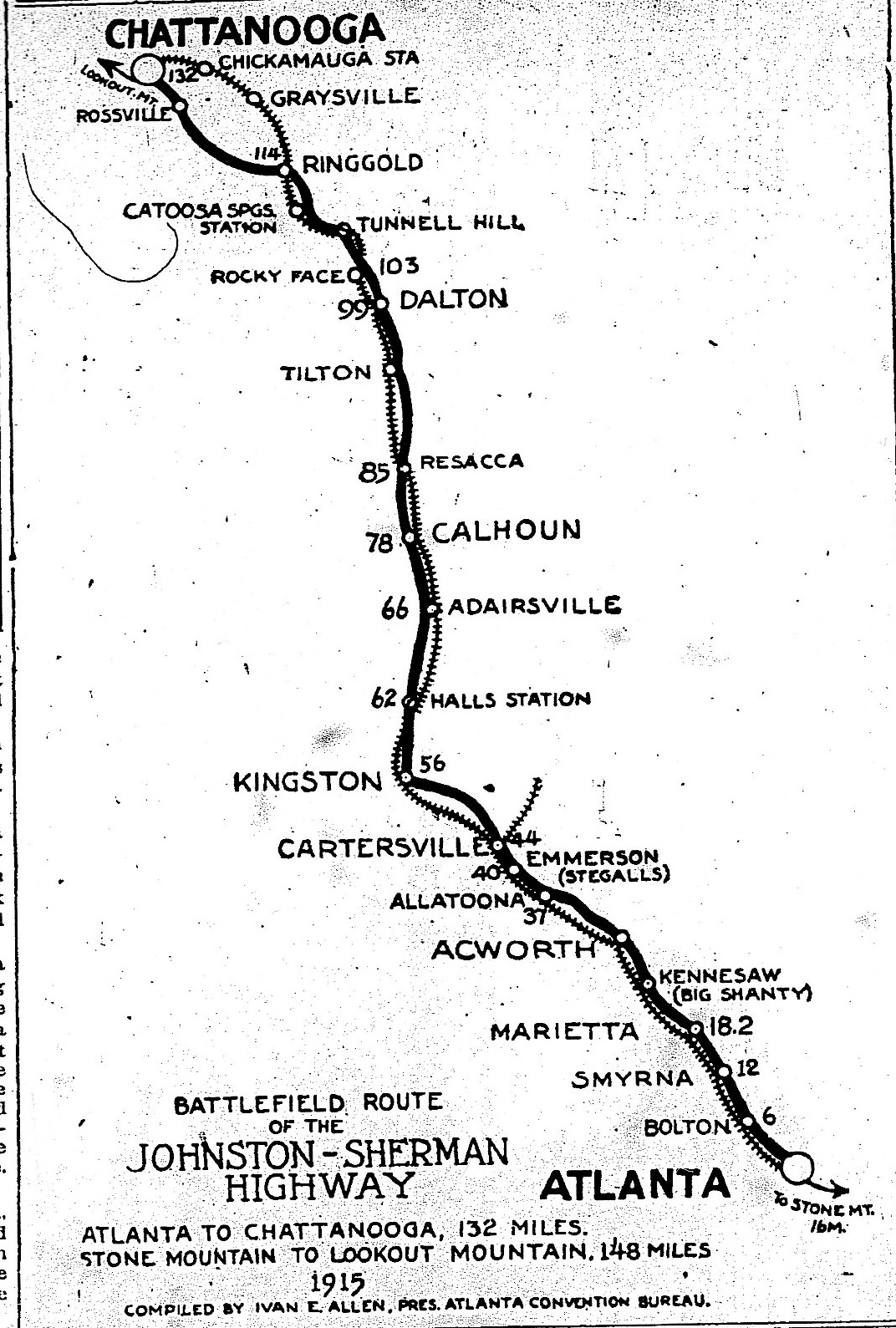
Section of the Dixie Highway from Chattanooga to Atlanta via Dalton (there was a rival routing option through Rome, as well) Atlanta Constitution, March 28, 1915
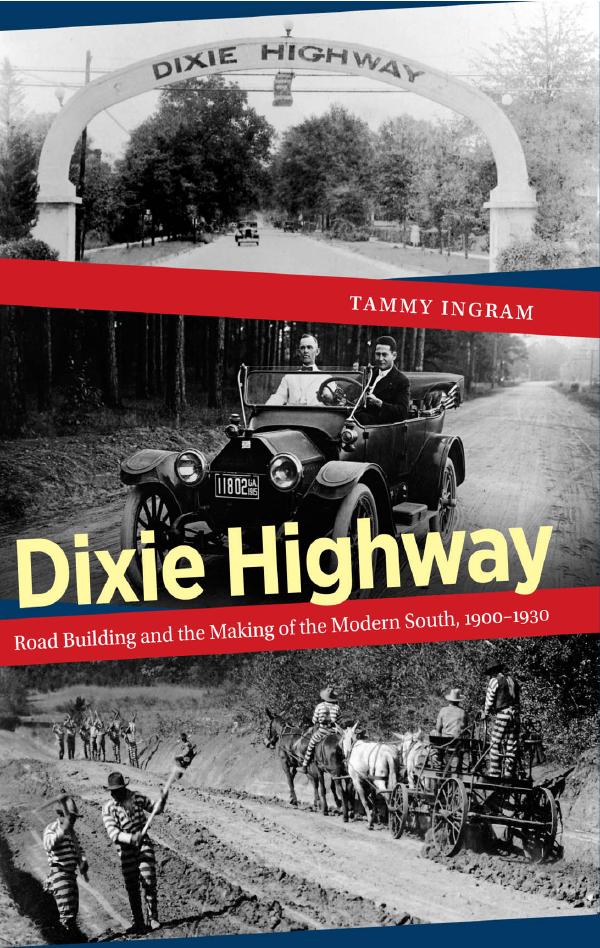
Between 1915 and 1927, the Dixie Highway served as the centerpiece the Good Roads Movement in the South. Made up of hundreds of local roads stitched together, the Dixie Highway looped 6000 miles from Lake Michigan to Miami Beach and back up again. It was originally planned as a tourist route to steer wealthy motorists from the Midwest to fancy vacation resorts in South Florida, but within a few years the Dixie Highway became a full-fledged interstate highway system—the first in the nation—and served tourists, businessmen, and farmers, alike.
The highway that helped to transform and modernize the South, however, reflected profoundly conservative ideas about the region’s place in the nation.
The Dixie Highway was the brainchild of Carl Fisher, an eccentric Indianapolis millionaire, and his wealthy friends in the auto industry. With the support of others in the Good Roads Movement, they used the highway to lobby for state and federal highway aid. Southern support was critical to this process. Yet in the Hoosiers’ imagining of the Dixie Highway route, the South was little more than an unavoidable place on the way to vacation paradise in South Florida.
In order to promote the highway to northern tourists, they had to market the South as a destination in and of itself, not just an obstacle separating Chicago snowbirds from the warm Florida sunshine. And in order to persuade southern voters and taxpayers to fund long-distance highways, which they derided as “peacock alleys” that served only wealthy motorists, they had to convince them that tourism in the South would pay.
They started with the name. Originally called the Cotton Belt Route, by early 1915 they had adopted a snappier sounding name that, as this blog’s author Karen L. Cox has argued, was not just a geographic reference but a brand that evoked popular nostalgia for the Old South. The Dixie Highway sounded like a road to the past as much as a road to a place. It presented the South as an exotic locale, and idea, to explore and exploit.
Although traffic would flow both ways along the Dixie Highway, its Hoosier boosters envisioned it as a path “leading down into the South,” where there existed “wonderful scenery that is most unusual and attractive” to Midwestern motorists. Some even believed the Dixie Highway could ease lingering sectional tensions. The New York Times dubbed it the “Dixie Peaceway” and mawkishly described it as “a memorial . . . symbolical of the accord between brethren which shall never again be broken.” In Illinois and Indiana, “Dixie” gas stations, restaurants, and hotels conjured up images of an unfamiliar but pleasant destination. Oil and gas companies capitalized on the interest in southern tourism, as well, by distributing road maps to guide tourists through the South.
But Yankee entrepreneurs were not the only ones who drew on stereotypes about the South. In Georgia, Dixie Highway boosters promoted Old South and Civil War tourism.
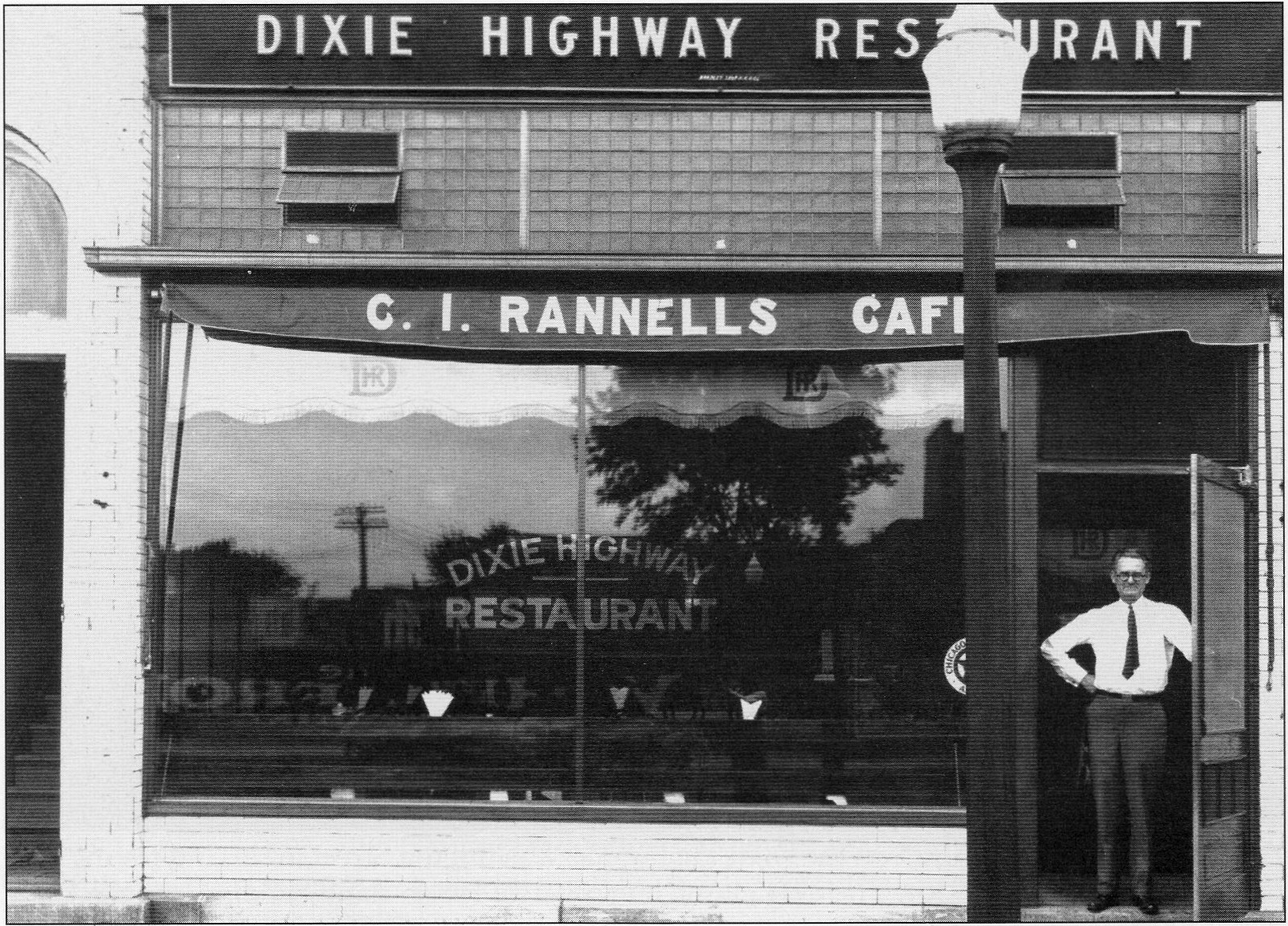
Dixie Highway restaurant in Illinois, courtesy Tammy Ingram.
Looking backward, however, proved incongruous with the challenges of building a modern highway system. Even while southern supporters of the Dixie Highway joined the campaign for state and federal aid, they clung to old social and political institutions that preserved local control.
The most ruinous was the county chain gang. Chain gangs were not unique to the South, but by the 1920s, when state- and federal-aid highways were beginning to take shape, most states outside the region had turned to contract labor. But not southerners. Chain gangs allowed local authorities to control black labor, so southerners preserved them long after other states had abandoned them.
As soon as modern highway building challenged their sacred institutions, southerners retreated. By the time state and federal highway markers began to replace Dixie Highway markers in the late 1920s, the Good Roads Movement was dead. The backlash against the emerging highway bureaucracy did not forestall road work altogether, but it delayed the development of a modern, integrated highway system in the South for decades. The construction of the Eisenhower system in the 1950s and 1960s transformed large parts of the South, but it had little impact on the quality of local roads and state highways miles away from the interstates. In the 1980s, when I was growing up in rural Georgia, a hard rain could wash out half of the county’s dirt roads.
A few years ago, I drove one of the few remaining sections of the original Dixie Highway, a narrow road that winds through peach country near Macon, Georgia. In some spots, you can see in your rearview mirror a stretch of Interstate 75, the modern, multi-lane, limited-access freeway that replaced the Dixie Highway. You won’t see much of the South driving eighty-five miles an hour along the latter route, but the former won’t take you where you need to go. If ever there was a fitting memorial to the Good Roads Movement, this might just be it.
I wish to take a few minutes, in the spirit of civility, to respond to Jonathan Capehart’s Washington Postcolumns (in spite of the condescension and the personal barbs) which have taken aim at my New York Times op-ed “We’re Here, We’re Queer, Y’all.” For the record, the idea of using Uncle Poodle’s appearance on Here Comes Honey Boo Boo as a hook (not an argument) was not my own, but that of an editor. The real argument was based on my own personal experience. I could have shared dozens of stories, because as he learned from my friend Helen, both she and I and all the other gays and lesbians I know living in the South are indeed consequential and not because we were or were not raised in an urban environment. I made it clear in my editorial that there was a real limit to acceptance in the region. The point was that being gay in the South should not be seen in black or white, all or nothing, because there are clearly shades of grey.
What I saw coming out of Capehart’s columns and also some messages I received was a disagreement with me for countering the narrative about the South as a cold, angry, place where gay people could not possibly want to live and would set out for New York, DC or San Francisco as soon as they got the chance. Some of them surely have, but many others have not. And the decision to leave may have to do with the limits of acceptance, and maybe not. Perhaps they simply want to experience a different part of the country. The decision to stay, however, is often (in my personal experience) that they don’t want to leave their families or communities. If they leave the small town South, they often move to larger cities in the South. New Orleans, Dallas, Atlanta, even Charlotte.
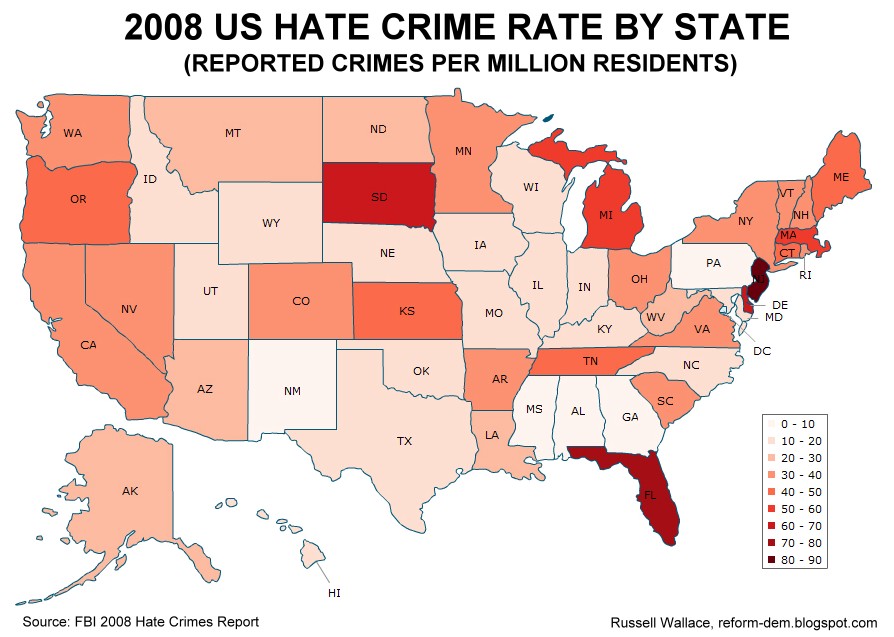
Capehart used the case of the gay Texas couple who was recently harassed by the local minister and received threatening messages from his followers to make his point “that this says more about the South than ‘Uncle Poodle’ ever will.” Really? Is this a southern phenomenon? To read his piece, you’d think it is. I know that it was timely in that it fit his argument, but hate crimes take place in the urban North (New York, DC, Minneapolis, etc) that don’t receive nearly the same amount of media attention. Yet when it takes place in the South, the national media makes hay of it, because it supports the narrative of a sinister South where such things must only happen here. This does not mean that I don’t condemn what happened to the couple in Texas because I absolutely do.
The Uncle Poodle reference–again, an editorial decision–was used because of it’s pop culture relevance, but is beside the point. I have lived a very rich and wonderful life in the South and wouldn’t choose to leave. Has it always been easy? No, but I could have said this had I been raised in another region of the country. Are there problems still? Yes, and here in my own state of North Carolina I voted against the marriage amendment and will support Equality NC in its efforts to derail it. I’d also have to do this in several other states, not all of which are in the South. However, neither that amendment nor a hateful evangelical minister (there is one who proselytizes in the free speech zone on the campus of UNCC with some regularity) is enough to make me flee because this is my home.
In the end, and despite the criticism, I am pleased that my editorial ignited a conversation about the South as a place where LGBT people can and do live happily, work, and have families, etc. because it’s a much more complicated and nuanced region than it’s given credit for being.
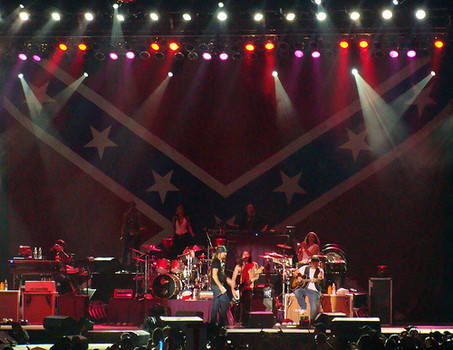
Wow, that was quick. Less than a week ago, members of the band Lynyrd Skynyrd were giving an interview on CNN in which lead guitarist Gary Rossington explained that the band had disassociated itself from the image with which it’s long been known – the Confederate battle flag. Just a few days later? Rossington, the last remaining member of the original band, all of a sudden got his Confederate memory back and told fans on the band’s website “The Confederate flag means something more to us, Heritage not Hate.” He needed to do something, because the band’s fans threatened to secede from Lynyrd Skynyrd nation and take their dollars with them.
Photo courtesy of examiner.com
Actually, he was right the first time when he told CNN that the image had “became such an issue, about race and stuff.” Yea, race and stuff.
That stuff, as he initially pointed out, was that groups like the KKK, skinheads, and let’s go ahead and say segregationists (please) had, in his words, “kidnapped the Dixie or rebel flag from the Southern tradition and the heritage of the soldiers.” Well, yes, but it’s more complicated than that.
THAT flag, as we know, is one of many Confederate flags, but it’s the one that draws the most ire. Yes, it was used by southern soldiers as they headed into battle, but let’s be clear: by 1863 the war was over the institution of slavery and the Confederate army was there to protect it. States’ rights? Yes, a state’s right to maintain slavery. There’s no getting around it.
So, let’s say you buy the idea that this was simply about southern soldiers and therefore the “Heritage, Not Hate” slogan works for you, because you don’t want to be thought of as a racist. Then what can you say about the heritage of that symbol since the Civil War? The war lasted 4 years, but the battle flag has often been used over the last 150 years as a symbol of racial hatred. What about THAT heritage?
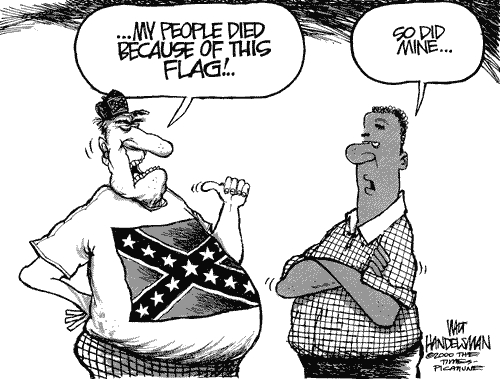
The flag’s heritage is indelibly tied to the institution of slavery. Courtesy: Times Picayune, 2000.
Lynyrd Skynyrd is free to do what is best for its fan base and especially its bottom dollar, but as the saying goes “don’t get it twisted”–in this case, the history. Gary Rossington was right the first time when he said that the negative connotations of the flag had to do with “race and stuff.” The vitriol with which the fans have responded over the band’s initial decision to quit using the flag is proof enough that race is still at issue.
And just because you say it’s about “heritage, not hate,” doesn’t make it so.
As Charlotte inches closer to playing its role as host of the 2012 Democratic National Convention (DNC), stories of what makes it a southern city (or not) have been trickling in over the last month. Many of the local news stories, and even stories appearing in other online news outlets, let us know that business owners in the Queen City are actively playing the southern card.
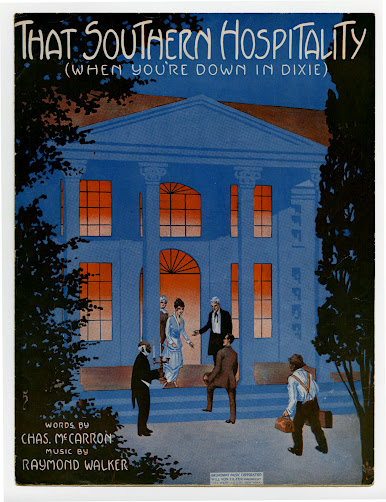
During the early part of the 20th century the musicians of Tin Pan Alley, many of them Jewish immigrants, wrote reams of sheet music about the South. The cover art lets you know exactly what is meant by “That Southern Hospitality.”
In this case, it usually means using phrases like “southern hospitality” or “southern charm” to describe what’s being sold. As is often the case, these terms are tossed around without considering their historical antecedents in the plantation South. Today, however, such terms are co-opted for purposes of profit, which is more in keeping with Charlotte’s identity as a “New South” city.
So, what does the “southern card” look like?
The Sacramento Bee (among many other news outlets) published the article “Fashion Travel Tips for the South” informing both RNC and DNC delegates what they should wear to their respective conventions. “Whether you’re a first-timer or a convention pro, you may still be new to modern, Southern style,” says Arlene Goldstein, vice president of trend merchandising and fashion direction for Belk stores–headquartered here in Charlotte. Now we know this was a Belk PR piece that was picked up in several news outlets and ties back into the company’s re-branding of itself as the store with “Modern. Southern. Style.” Still, what is “modern, southern style” except brand messaging with a nice ring to it.
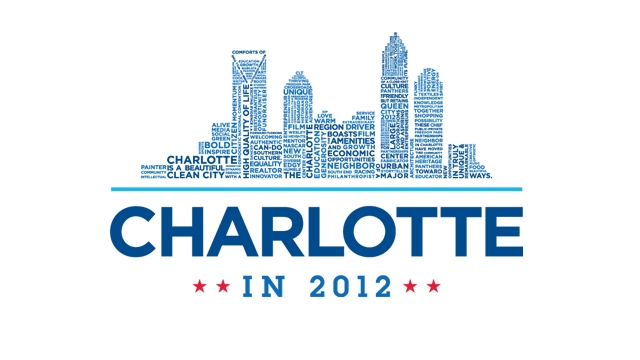
The DNC logo that Kelli Koepel describes, in part, as showing off Charlotte’s “southern hospitality.”
Then there’s Charlotte’s SouthPark magazine, which recently published the article “The DNC Means Big Business.” In it, Kelly Koepel, owner of the branding agency that created the Charlotte DNC logo played the southern card this way: “Woven throughout the image is this message: ‘Charlotte is a beautiful, clean city with a high quality of life where you’ll find both the expected comforts of Southern hospitality and exciting evidence of a forward-thinking, can-do Southern culture.'” There’s the hospitality again, with some “can-do” thrown in.
African American business owners are also playing the southern card in ways that may surprise you.
Rhonda Caldwell, owner of The Main Event, is hosting a plantation party for DNC delegates from southern states. Photo credit: The Charlotte Observer
Rhonda Caldwell, owner of The Main Event, was hired to host a party at Rosedale Plantation for delegates from Florida, Mississippi and Alabama. “I’m such a history buff, and I wanted to take the history behind Rosedale Plantation and incorporate it in every detail,” Caldwell exlained. “I wanted to make the guests feel like they were back in time.” Does this mean there will be slave interpreters waiting on folks? It is a plantation, after all.
Local television station WCNC recently showcased another African American business owner in the news feature “Southern charm on Display at delegate welcome party,” focusing on a venue in the city they claimed “oozes southern charm.” The Wadsworth Estate in Wesley Heights will be hosting a party for the DNC. Historically, ideas of “southern charm” and “southern hospitality” have been associated with well-to-do white women–quintessential southern belles. Yet, the Wadsworth estate is owned by a black woman, Shirley Fulton, and even she is playing up the southern card of old.
As she puts it “I think it’s going to be a lot of genteel southern hospitality because we want to show them Charlotte, [in] particular, and North Carolina in general,” adding “People know that they’re stepping back in time and if you look around at the furnishing, there is almost nothing modern here, so you get that feel of southern charm.” Genteel. Southern hospitality. Southern Charm. Stepping back in time. Say what?
I wonder if she considered what “stepping back in time” means for African Americans like herself? As a business owner Fulton is indebted to the southern civil rights movement such that I doubt she really wants to step back in time, because instead of owning the estate she’d be cleaning it. Yet, it’s a savvy business move since most of the delegates to the convention are white, some of whom probably expect to experience a version of “southern hospitality.” (The white reporter added, “no doubt they’ll be saying ‘y’all’ on their [the delegates] way out.” Um, I doubt it.)
Clearly, Charlotte-area businesses believe that playing the southern card is good for their bottom line. Still, as a historian, I know that what people believe is “southern” can cut both ways–and not just the way of hospitality and charm. I’ll be looking at the flip side in a future blog post.
After watching the first two weeks of “Here Comes Honey Boo Boo,” the tragic comedy reality show on TLC, it’s clear that some “hixploitation” is going on at the network. The cast of characters–at the center of which are Mama June and her pageant queen daughter Alana–are what you might call “country ghetto.” They rattle off phrases (“A dolla makes me holla” and “I’m all that and a pack of crackers”) that Helena Andrews writes makes them appear as if they channeled an “angry black woman” from a ’90s sitcom. (See her article in The Root, Aug. 15, 2012).
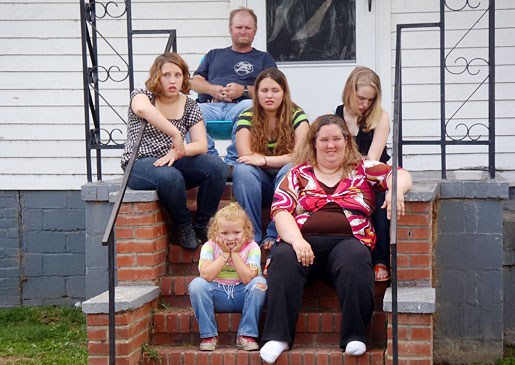
Alana and her family
Yet, Alana (a.k.a. “Honey Boo Boo”) and her family are firmly situated in rural Georgia, and what I see is more than just the language of the ghetto. This family literally lives IN a country ghetto. They are, as a friend suggested, like the Evans family on the sitcom “Good Times” because they have to laugh to keep from crying about the poverty which they can’t seem to escape.
I see the cycle of rural southern poverty on full display. Underneath all that sass is a family that struggles to stay afloat financially, while also gambling on Honey Boo Boo. If you listen closely, in between all the colloquialisms (ignoring the subtitles even when they aren’t needed), you’ll hear Mama June tell you that her “baby daddy” works 7 days a week and that she got pregnant at 15, which meant that her education was cut short, although to her credit she finished her GED. And now her 17 year-old daughter is repeating the cycle of teen pregnancy, and there will be one more mouth to feed. In addition to “extreme couponing,” June also goes to food auctions and her family happily accepts a deer carcass, even if it was roadkill, because the meat they preserve from it will save them money. Her older daughters complain that their mother considers anything over $5 expensive.
People may find it irresponsible that Mama June would spend the money she’s scraped to save to invest in Alana’s pageants. But this is consistent with people who live in poverty who pin their hopes on a gamble they hope will pay off. It’s no different than if they were playing Powerball or scratching off tickets–maybe one day they’ll hit the jackpot, although the odds are stacked against them.
This isn’t just moralizing on my part, because I’ve experienced poverty and can remember a time as a little girl when my Mom (a single mother who scraped by on a secretary’s salary) gave me $2 to purchase a raffle ticket in hopes of winning a new car since we didn’t have one. I still remember the look in her eyes that even she knew this was a long shot. Of course, we didn’t win, but I hoped with everything we would because it might make life a little easier. I can see this in little Alana. She’s a sassy kid, to be sure, but underneath she’s vulnerable and still just six years old. She desperately wants to win that Miss Grand Supreme title and it hurts her a little more each time when she doesn’t. It hurts June, too. This is what makes it hard to watch, because I understand how poverty makes you feel “less than” and so I also hurt a little for them.
Maybe they have hit a small jackpot with their show (no doubt TLC has). During commercials, you’ll see that the network is offering ringtones of Alana’s sayings like “a dolla makes me holla.” I just hope TLC is cutting Alana a check for those ringtones, since it is profiting by exploiting her. Maybe she will earn enough to fund a college education, break her family’s cycle of poverty, and escape the country ghetto. I’m rooting for her.
After writing several blogs, I thought it would be fun to check out the Pop South “wordle” to see the terms that I frequently use. Here’s what it looks like:






 Pop South