If you’re breathing, there’s a good chance you know that Charlotte, North Carolina, is hosting the Democratic National Convention (DNC). This is an exciting time for the Queen City as we play host to conventioneers, politicians, and journalists. There will also be a lot of kvetching over traffic and street closures, but I for one am very thrilled to see that The Daily Show with Jon Stewart will be setting up shop at Imaginon, home to the city’s Children’s Theatre and Library.
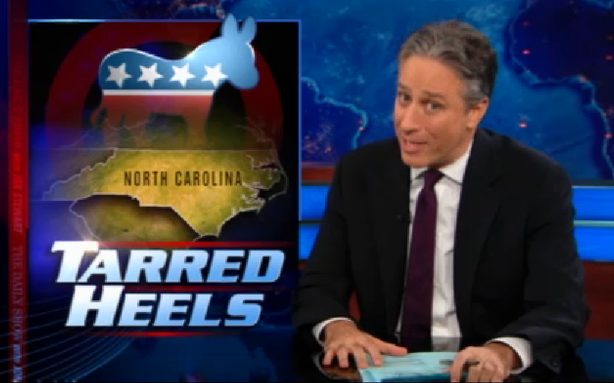
In fact, I’d really like to be on the show to discuss the media and its southern stereotypes. I’ve written about it before here on Pop South (See posts on DNC Announcement and the one on Martin Bashir over at MSNBC), and I’m certainly scouting out other journalistic blunders on this score, but right now I am waging a campaign to be a guest on the Daily Show to talk about the subject. And why not? The Daily Show has numerous reports that have been tagged “the South.” The earliest one, on Strom Thurmond, dates to 1999. And the most recent? On Chick fil A, of course. I suppose the region is a gift that keeps on giving, as seen in the report on “Tarred Heels” (below), which led Jon Stewart to conclude that North Carolina is the Democrat’s “South Carolina.” Ouch!
So, Jon, if you’re listening, I’ve got a book on the topic of the South in popular culture, this here blog, and hell, I’ve even written an op-ed for the New York Times. I’m also a fan of the show, if that helps. And, I’d love to talk “the South” with you while you’re in Charlotte.
Pop South readers: Join me in my campaign and tweet to get @Sassyprof on the air. Tweet this message: Give @Sassyprof a guest slot to discuss the South and the media @TheDailyShow #CharlotteDNC
In this guest post, Barclay Key, Assistant Professor of History at the University of Arkansas-Little Rock, reflects on the meaning of race and commemoration in the Deep South through his personal recollections of growing up in Lawrence County, Alabama, the same county where Olympic great Jesse Owens was born. Key has a poignant essay about Owens in a forthcoming volume Destination Dixie: Tourism and Southern History.
While I have the vaguest memory, perhaps concocted later, of Al Michaels asking in 1980 if I believe in miracles, the 1984 Summer Olympics figured most prominently in my childhood. As an eight-year-old in rural northwest Alabama, I had already developed a passion for some sports, particularly Dixie Youth baseball and Alabama football, but I had little knowledge of the varieties of athletic competition on display in Los Angeles.
Carl Lewis, Mary Lou Retton, and John Williams clearly inspired something in me because I soon developed my own Olympic events and invited friends to participate. We had the traditional sprints that measured the length of our front yard, but other events required more imagination. The shot put contest consisted of heaving a brick, and my gymnastics routine was limited to hanging from our rusty swing set, swaying a bit, and dismounting letting go. I also managed to incorporate an obstacle course and an Atari game or two. Motivated in part by Red Dawn, I went undefeated versus the Soviets as my games extended into the fall and winter.
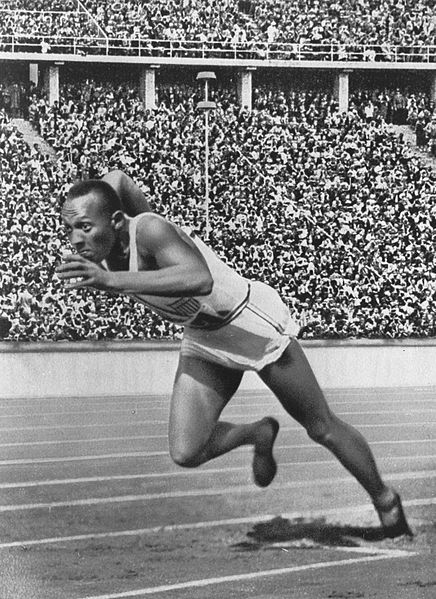
Jesse Owens, 4-time Gold Medalist at the 1936 Berlin Olympics
Imagine my delight the following summer when my mother offered to take me to the nearby Jesse Owens monument. I had come to understand that Owens was an Olympic hero. Lewis’s four gold medals in 1984 elicited comparisons to Owens, who had won four gold medals during the 1936 Olympics in Berlin, Germany. And I had recently participated in the Jesse Owens Memorial Run, a new event in my hometown that acknowledged the track star’s local connection to Oakville, a community near our small town.
Even if he wasn’t technically from my town, I thought, he was from Lawrence County, just like me. He became an Olympic hero; maybe I could, too. Or at least I could start at wide receiver for the Univeristy of Alabama Crimson Tide. In a place where one’s identity relates so closely to home and community, there is a sense in which Owens was becoming “one of us.” Although I was naïve about this process and its abundant ironies, local people, particularly whites, were coming to embrace Owens as a hometown hero a few years after his death in 1980.
Owens had been a child—about nine years old, just like me—when he migrated with his family from Alabama to Ohio. To the best of my knowledge, he never stepped foot in the county again. In autobiographical accounts of his childhood, Owens wrote of the “terror of sharecropping in the South” and the “terror of Oakville,” a community he described as “more an invention of the white landowners than a geographical place.” I don’t recall anyone explaining why the Owens family left “our home” or why Owens ran for Ohio State University instead of my beloved Crimson Tide. I completely missed the significance of a black American from Alabama overcoming tremendous odds to represent his own country in an Olympiad often remembered for its Nazi hosts.
Mother’s offer was really more of a bribe. She needed to run an errand near Owens’s birthplace, about ten miles away, and she did not want to leave me alone. The promise of seeing the Owens monument convinced me to cooperate. She provided no details, so my mind ran wild with possibilities. At the very least, I imagined a large statue surrounded by beautiful flowers, or maybe even an elaborate fountain that would give me an opportunity to make a wish and toss a penny.
Twenty minutes into the drive, my mother exclaimed, “There it is!”
“Where?!” I shrieked, exasperated that I couldn’t immediately locate what must have been an amazing sight.
“Right there,” she replied.
I finally caught a fleeting glance of what looked like a tombstone. “Is that all there is?” I asked.
A few years ago, I couldn’t resist an opportunity to write an essay about the commemoration of Owens in Lawrence County for Destination Dixie: Tourism and Southern History. Readers will learn how this modest monument provoked controversy that spilled into the state and national media and how the Jesse Owens Park and Museum later arose out of the same cotton fields that the Owens family picked before their migration. This project was cathartic in several ways. Having navigated the requirements of becoming a “professional historian,” I enjoyed sharing a local story that served as a microcosm of racial tensions and piecemeal efforts at reconciliation that have become more characteristic of the South in recent decades.
My recent interest in the commemoration of Owens illustrates how I too have embraced him as a Lawrence County native, not just an Olympic hero. Although Owens’s experiences were in no way comparable to my own, I have come to appreciate that his story is indelibly tied to my own, to our own. My grandfather was a sharecropper; my father started picking cotton at age five. Their “whiteness” protected them from the racial discrimination that the Owens family faced, both in Alabama and beyond, but we share an ancestral relationship to the land, to work, to want. We are from Alabama. Jesse Owens is my people, just as notorious figures like George Wallace are. Accepting both remains a work in progress for many.
As we get closer to the kickoff for the Democratic National Convention, I thought it would worthwhile to repost a blog I wrote in February 2011 when it was first announced that Charlotte, North Carolina, would host the convention. Look for more DNC-related posts in the near future. Here’s the link to that post:
Growing up in the South and having lived here my entire adult life, I have heard people who call themselves Christian say some of the most horrible things about their fellow man. White southern Christians I have known have referred to African Americans as “the blacks,” or if of an older generation, “the coloreds,” followed by some horrific generalization. Today, we might hear those same Christians say “the gays.” As in, “the gays are trying to redefine marriage.” Or worse. What I believe this reveals is that some Christians, including Chick fil A CEO Dan Cathy, see gays (like blacks before them) not as contributing members of their community, but as interlopers who are horning in on their sacred space and who they fundamentally do not respect.
Credit: Ted Kouklos’ artistic response to Chick fil A
My history with Chick fil A is a long one. I admit to having enjoyed their chicken sandwiches since high school when my friends and I would go shopping at the Four Seasons Mall in Greensboro, NC, when malls were the only place where you could get a Chick fil A sandwich. ( I prefer not to think about the fried roach that came with my fries that one time.)
Later in life, when I lived in Washington, DC, and worked for a heritage marketing firm, I had the opportunity to see the inner workings of the company up close. I was sent on a research mission to Chick fil A headquarters in Atlanta to learn more about its history since the company I worked for developed corporate museums and exhibits. I went there to review Chick fil A’s exhibit and consider ideas for updating the corporate narrative.
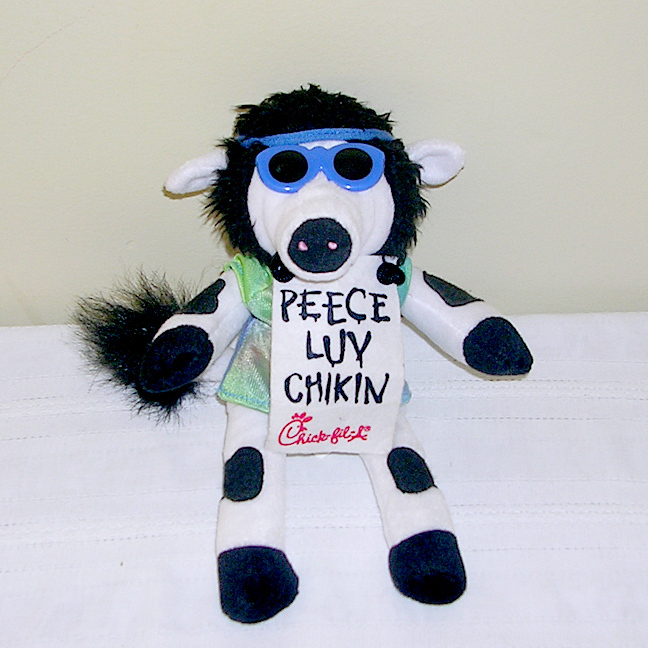
The company sent a car and driver to my hotel to take me to its headquarters. The car, like everything else Chick fil A, was branded with cows. (Imagine me sitting in the back seat, only instead of my head you see a Chick fil A cow head, appliqued over the window). After I arrived, I went through the exhibit, ate lunch in the company cafeteria (yes, they serve from their menu), and then toured the test kitchen. I eventually met Truett Cathy, the company’s founder, who I found to be a perfectly nice man. I even scored a cool, cow beanie baby–a groovy, hippie cow that carried with it the message “Peece, Luv, Chikin,” as only cows can spell these things.
Peece and Luv, ya’ll
I also learned about Chick fil A’s college scholarship program for employees, and that its WinShape Foundation supported several foster homes in Georgia whose purpose was not to separate siblings. Mr. Cathy’s foundation paid for their education, their clothing, and even paid salaries to couples who served as full-time parents in the home. You know, doing good works that was consistent with the company’s Christian beliefs.
Still, I had this gnawing feeling about the company’s philosophy–tied to the fact that stores are closed on Sundays. This, in and of itself, is nothing to criticize. Yet in the materials I was given to read, the company wanted to convey that this was a day for employees to “worship as they saw fit.” In other words, this was not necessarily about the company’s Christian values. At least in theory. But deep down, I knew that this was, indeed, part of a much more conservative philosophy tied to the founder’s evangelical Christian belief system.
Those beliefs, especially as expressed by company CEO Dan Cathy (Truett’s son), have been on full display this past week. Cathy’s comments and his company’s support of the “biblical definition of marriage,” have resulted in a firestorm of negative media, backlash from cities outside of the South where the company has attempted to set up shop, and a soiled relationship with The Jim Henson Company. Yes, he even ticked off the Muppets.
While Cathy’s comments on gay marriage have upset people, it is the company’s financial contributions to conservative, so-called “pro-family” organizations who actively lobby against gay rights, via the WinShape foundation, that many are questioning. Last year, when that point was made by LGBT organizations, Cathy responded that Chick fil A was not “anti-anybody.” His more recent comments suggest otherwise.
Companies and CEOs can believe what they want, but they operate in the marketplace where those beliefs are held up to public scrutiny. Chick fil A has alienated many customers with its stance, and not just gay ones. And why would any company, particularly in this economy, want to alienate customers?
As a southerner, a longtime Chick fil A customer myself, and one of “the gays,” it looks like I’m going to have to step away from the chicken sandwich and the waffle fries in hopes that the company might reconsider its stance. And while, for personal reasons, I’m no fan of the institution of marriage, I’m also not interested in supporting enterprises that seek to ban two loving people from legally formalizing their union. Peace, Love, and Chicken, y’all.
The Learning Channel (TLC) recently announced the upcoming premiere of its new series “Here Comes Honey Boo Boo,” featuring Alana, the “breakout star” of “Toddlers & Tiaras.” Alana, as some viewers will recall, is the little pageant queen whose mother June gives her “go-go juice,” a mixture of Mountain Dew and Red Bull, to give her that special energy she needs to perform. Doing so brought June severe criticism, but that hasn’t stopped her from placing her entire family in front of the camera for what TLC describes as “the unapologetically outrageous family life of the Honey Boo Boo clan,” from rural Georgia. Here’s a taste of what’s to come:
A quick read of the TLC press release lets me know that the most unapologetic people involved with this series, debuting in August, are the producers at Los Angeles-based Authentic Entertainment who developed the show, and The Learning Channel, its distributor. TLC, owned by Discovery Communications, claims it “celebrates extraordinary people.” So, the company is “celebrating” Alana and her family, is it?
What the folks at TLC are celebrating in this tragic production is that a ripe plum for exploitation fell right into their laps. It has all the elements of the depraved South, which production companies like Authentic Entertainment create for public consumption and profit. Rural Georgia? Check. Rednecks? Check. Do they roll around in the mud? Check. Are there people with nicknames (besides “Honey Boo Boo,” there’s “Sugar Bear,” “Pumpkin,” “Chickadee,” and “Chubb”)? Check, check, check, and check.
The kicker is this line in the press release, which says as much about the producers as it does the family: “When she’s not chasing after crowns, Alana’s with her family in rural Georgia doing what her family does best: four-wheeling through mud pits and picking up road kill for the family cookout.” Really, this is what they do best? And how about Authentic Entertainment and TLC?
“Here Comes Honey Boo Boo” is an unabashedly shameless series that scrapes the bottom of the reality television barrel, and it is unsurprising that the rural South is used to make it happen. Videos that parody this little girl and her mother already populate YouTube, an indication that the show may do well for TLC. Yet those parodies suggest something worse going on here, as they predict that Alana grows up to be a pathetic, drug-addicted adult. One can’t help but find a kernel of truth in this, and she may well have TLC to thank. I am not suggesting that Alana’s mother June get a pass for exploiting her child, but neither should TLC or its partner in crime, Authentic Entertainment.
Several of you followed my posts about the ad campaign for Glory Foods in which a woman named Shirley appeared in commercials and on the company website as a mammy-like character coming in to save the day in a white woman’s kitchen. Since that time, the ad campaign developed by the Brandon Agency of South Carolina has proven to be an epic fail–the television ads have been withdrawn and Shirley no longer walks across the company website with that “Lawd, honey” kind of persona that takes you back, WAY BACK, to the Aunt Jemima of old.
Shirley has returned, though, but now in a toned-down version of her former self. Instead of rushing in to help the white woman as she did in the original commercials, Shirley is actually demonstrating recipes in her own kitchen! The production levels of these videos, which are not commercials, suggest that they are clearly done on a smaller budget. This is too bad, because now Shirley is a much more respectable personality. Why didn’t the Brandon Agency (whose entire leadership team is white) show her that respect to begin with? I am left to wonder if it has something to do with the fact that McCall Farms (which now owns Glory Foods) and the Brandon Agency, who represents the company, are both located in South Carolina–probably the least progressive state in the Union when it comes to race. Let’s give them the benefit of a doubt and say that it is unfair to stamp them with the “they’re from South Carolina” stereotype. Then I’m still left to wonder, why? And, why not develop new commercials and give Shirley a second chance, but this time as the respectable woman she is meant to be?
It’s been several months since my last post on The South Will Blog Again. You’ll have to forgive me for my absence. I went and found a full-time job. Funny thing about blogging…you have a whole lot more time to do it when you don’t have much else to do. So in any case, it’s been about ten weeks on the new job and I’m pretty settled in. I do have less time to draw cartoons so I’ll be posting most likely only once or twice a month instead of weekly.
Nevertheless, I have resolved that the South will indeed blog again. In any event with new co-workers, many of whom are “sectionally challenged” (from the North that is), I have had a new batch of people to tell my Mississippi stories to. And that reminded me of this blog and that I have a worldwide forum for…
The passing of Andy Griffith last week prompted an outpouring of love and respect for the man and his life’s work in movies, television, and even gospel music. Yet it was his role as Sheriff Andy Taylor in The Andy Griffith Show (TAGS), which received the greatest response from media writers and fans alike. And how could it not? Andy Taylor was such an iconic television character it was as if Taylor and Griffith were one. Even if Griffith disagreed with that assessment, which he did on several occasions, it is what fans of the show believe.
Fans also want to believe that Griffith’s hometown of Mt. Airy, North Carolina, was the setting for the show. Certainly, there are numerous references to Mt. Airy and other towns in North Carolina. Yet whether it was or wasn’t doesn’t matter much, because diehard fans of TAGS believe it to be true. Mayberry is Mt. Airy and Mt. Airy is Mayberry.
A radio talk show host recently asked whether the show’s portrayal of the region was realistic or accurate. My response is that in some ways this question does not matter. Television is meant to entertain people, which TAGS did very successfully. But if we are going to go there, we can think about this from two different angles: one is Griffith’s, the other is about the reality that existed in Mt. Airy, upon which it is believed the show is based.
Most people associated with TAGS acknowledge that the show reflected Andy Griffith’s vision, which he has repeatedly said was to tell universal stories about goodness that reflected the values he grew up with. So, who are we to argue that what he presented was not an accurate representation of his own experience?
Then there is Mayberry, the setting for the show. Was it realistic in presenting a small southern town like Mt. Airy? Here, one could argue both for and against realism. On the one hand, it appears there are no African Americans living in Mayberry. Oprah Winfrey, a self-confessed fan of the show, once asked “Where are the black people?” Historically, Mt. Airy has had a black population, albeit a small one. Therefore, one could argue against realism. Yet it could be that Andy Griffith chose to write about the nostalgic South of his youth, in which he grew up in a primarily white community. If so, then one could say the show was realistic.
This map of Mayberry suggests it could be a real place. Note Andy’s residence on the map. Other places marked can be found on iMayberry.com. Courtesy, iMayberry.com
What we might all agree on is that Mayberry did not represent the South of the 1960s. Throughout its run on television, The Andy Griffith Show regularly ranked among the top ten most watched shows. It offered a nostalgic portrayal of the region—one that countered the negative images of the region present in the civil rights coverage also being watched by millions on the evening news. The sit-in movement began in Greensboro, North Carolina, just down the road from Mt. Airy. And in Mayberry, the worst thing to happen might be a prisoner on the loose from the state penitentiary who, by the end of the show, will be caught by Andy Taylor.
The point is that it was Andy Griffith’s intention to entertain people through the stories and characters who lived in Mayberry—not make a political statement about civil rights. Moreover, many of its fans, like Oprah Winfrey, are African American. The fact is, the show has universal appeal.
More importantly, especially given today’s reality television programs (a large number of which are set in the South), The Andy Griffith Show didn’t trade in negative stereotypes about the region or southerners. When there were hillbillies on the show, like the Darlings or Ernest T. Bass, they were fully developed characters with endearing, and likeable qualities. Female characters, particularly Andy’s girlfriends Ellie Walker and, later, Helen Crump were educated professional women who had their own homes. In some episodes, their dialogue suggests that they were well aware of the feminist movement of their day.
Television coverage of Griffith’s passing inevitably included interviews with residents of Mt. Airy, still a small southern town. Interestingly, one woman interviewed by a local station here in Charlotte was from New Jersey. She told the reporter that she loved TAGS so much that after attending Mayberry Days—the town’s annual celebration of the show—she moved to Mt. Airy so she could live in a place where people still maintained good values and looked after one another. What this woman sought via her love of The Andy Griffith Show was to return to a different time and place. It is a nostalgic craving for a bygone America, but as it turns out, it is in the South of Mayberry where she thinks it still exists.
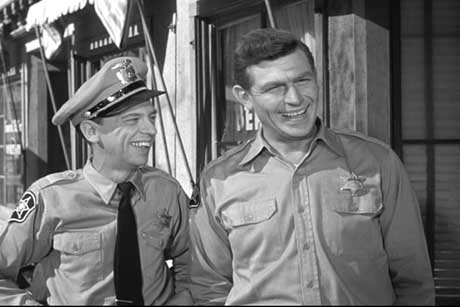
Andy Griffith as Andy Taylor, Sheriff of Mayberry.
I’m just going to speak off the cuff here and not go into any analytical piece about The Andy Griffith Show (TAGS for those in the know) in popular culture. You see, I love that show. I mean LOVE that show. My all-time favorite.
So, it is with some sadness that I write about the passing of Andy Griffith today. As a fellow North Carolinian, I have an appreciation for his humor and of the South that he represented. Yes, I know he had a much broader career than TAGS (starring in movies like Elia Kazan’s A Face in the Crowd, and having a second TV career with Matlock), but it’s my love of TAGS that I want to write about here.
I grew up in Greensboro, North Carolina, and it was my evening ritual to watch reruns of the show at 5pm and again at 5:30pm. Later, when I got to college, I met other fans of the show, even attending an Andy Griffith party dressed as a waitress at the diner. My date came as Malcolm Meriweather (Mayberry’s British visitor) and rode in on his bicycle. My graduate school pal and lifelong friend Kelli Logan and I often traded lines back and forth from various episodes and when we see each other, we still do. At some point, both of us even joined one of the first online discussion boards for TAGSRWC (The Andy Griffith Rerun Watchers Club), a place where we found others doing the same thing–trading lines. It was a testament to the fine writing on the show, half of which was written by Griffith himself. It was also a testament to our insane love of all things Mayberry.
One Christmas I received The Andy Griffith Show puzzle, which I happily completed. (Ca. 1998)
I’ve watched marathons of TAGS on TV Land and videotaped them (when that technology was around) and later traded them in for a much nicer DVD set. I purchased one of the earliest Andy Griffith trivia games, for which only my former neighbors–June Carraway and Gary Washburn–could ever really compete. We all took a trip to Mt. Airy for Mayberry Days one year where we joined thousands of others who shared our passion for the show. There, I got to see the original doors to the courthouse, ate at the Bluebird Diner, and sat for a brief moment in one of the chairs at Floyd’s Barbershop. The line to the Snappy Lunch for a pork chop sandwich was far too long. I also took a few photos with some of the folks who dress like characters from the show.
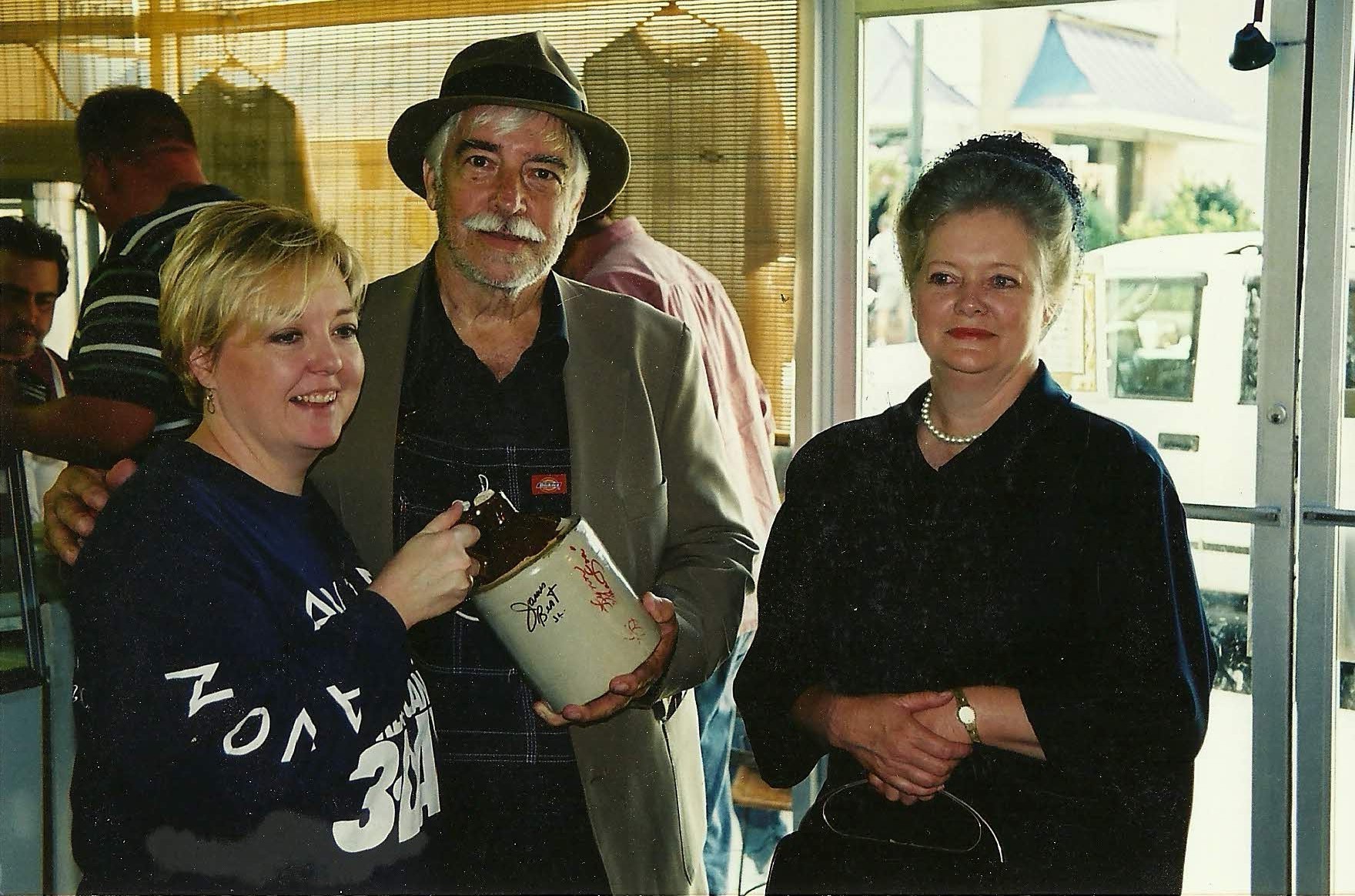
Me with Briscoe Darling and Aunt Bea look-alikes during Mayberry Days, ca. 2004.
A couple of years ago, I went to Mt. Airy for a doll exhibit (don’t ask) at the Gertrude Smith House in Mt. Airy. I was there for about a half an hour when all of a sudden there was a commotion because Betty Lynn, who played Thelma Lou, had arrived. You would have thought she was royalty, and in Mt. Airy, she is. It was then that I learned that she had moved to the town and makes her home in an assisted living facility. Even if Hollywood has long since forgotten her, the fans of The Andy Griffith Show still hold her in high esteem. And I must admit, I was a little star struck.
Even more recently, I met a man who works in maintenance at UNC Charlotte who shares my passion for TAGS. After completing some work in my office he noticed two books on my shelf were about the show. He lit up when he found this out and to this day, he leaves TAGS trivia questions posted to my office door. And when he passes me on campus in one of those tiny maintenance vehicles he gives me some sort of TAGS shout out. He’s far better at the trivia than I am, but I appreciate that he keeps me on my toes.
[Above: A clip from one of my favorite episodes “Arrest of the Fun Girls.” That would be Daphne and Skippy for those who might not know their names]
So, Andy Griffith, and particularly TAGS, has been with me through most of my life and his passing feels a little like seeing my own life pass before me. Thankfully, I can pull out those DVDs and watch the show again and again. I never tire of it. It makes me laugh no matter how many times I’ve seen any one episode. I can also engage in banter with others who share my passion. And that’s good for my southern soul.
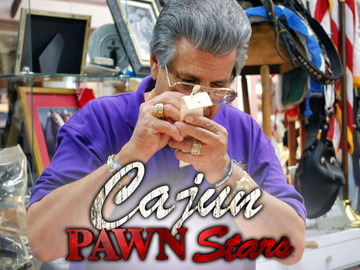
I’ve written a few blogs entries on Pop South about Louisiana-based reality television shows. There are so many that it’s hard to keep up. One of the more recent ones (I will have to blog about Duck Dynasty another time) is Cajun Pawn Stars, set in Alexandria, Louisiana. And, as those in the know will tell you, it isn’t even in Cajun country.
It seems that the abundance of the shows set in Louisiana often play the “Cajun card” in order to draw in viewers and to create some sense of authenticity. This particular show, which airs on The History Channel (boo, hiss), must strive for some authenticity if it’s going to get the thumbs up from The Big H, but as we all know by now the H stands for anything BUT history (hysterical, hokey, and hollow might do). In this case, Frances Coleman, a native of Alexandria and a writer for the Mobile Press-Register writes, it’s time to cry “foul.” She says it better than I can, so read her editorial here, and take all those “Cajun” shows with a grain of salt (or Tony Chachere’s.)




 Pop South