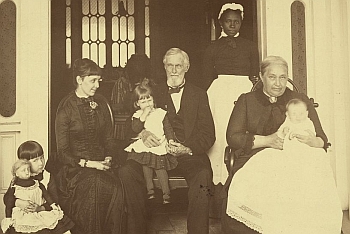
The Davis Family and unidentified servant, ca. 1885. Margaret sits to the far left. Varina holds little Jefferson Hayes. Courtesy: Library of Congress
Of the many bizarre stories about Jefferson Davis, the one about the renaming of his grandson takes the cake and gets a creep factor of 9 out of a possible 10.
The story of Davis’s death and subsequent funerals is made even more unusual by the reaction of the white South to the fact that once Davis died, there were no more direct descendents with the name Jefferson Davis. And this would not do. Junior died during the yellow fever epidemic of 1878. So responsibility for carrying on the name fell on the shoulders of little Jefferson Davis Hayes, the Confederate chieftain’s grandson by his daughter Margaret Howell Davis Hayes.
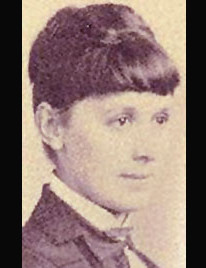
Margaret Howell Davis Hayes. Date unknown.
The story of his name change captured my attention, particularly when I read Margaret’s obituary, which described how the young boy “receiv[ed] the name in baptism over the coffin containing the body of President Davis.” Let me repeat. The name change occurred in a “baptism over the coffin” of the deceased Confederate president.
When Davis died in 1889, his body lay in state in New Orleans, and it was here that the name change was made. According to the account in the Confederate Veteran, Margaret Hayes “begged” Mississippi’s Governor Robert Lowry and other state officials to legalize the name change of her five-year old son to honor the Confederate president and preserve the name Jefferson Davis by changing his name from “Jefferson Davis Hayes” to “Jefferson Hayes Davis.” “The child was sent for,” the author wrote, “and the Governor, taking him on his knee, explained in simple language what he wished done.” The account suggests that little Jefferson understood what was being asked of him and, after a moment of silence, “burst into tears” and told the Governor “I specs I’ll dess have to be named for my poor dead dranpa, who isn’t dot anybody at all named for him.”
Jefferson Davis Hayes
What followed in this retelling reveals some of the more macabre aspects of the Lost Cause, as Governor Lowry took the young boy into his arms, and walked over to the “dead chieftain.” He then lifted the Confederate flag that draped the coffin and proceeded to swaddle the child with it before making his pronouncement: “I name you ‘Jefferson Davis.’” And, soon after, the State of Mississippi followed through on its promise to confirm the name change, doing so by an act of the state legislature.
You can’t make this stuff up, folks.
In part IV of the serial “Me and Jeff Davis,” I’ll discuss the significance of Confederate hair. Yes, hair.
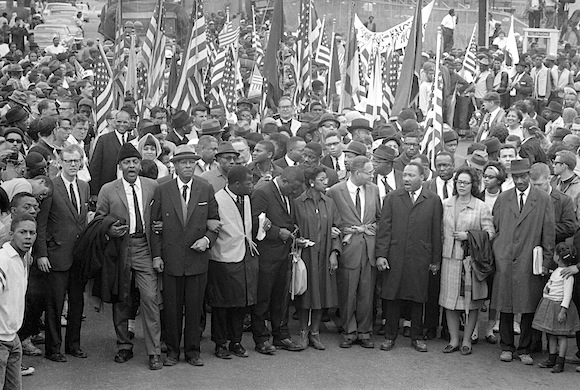
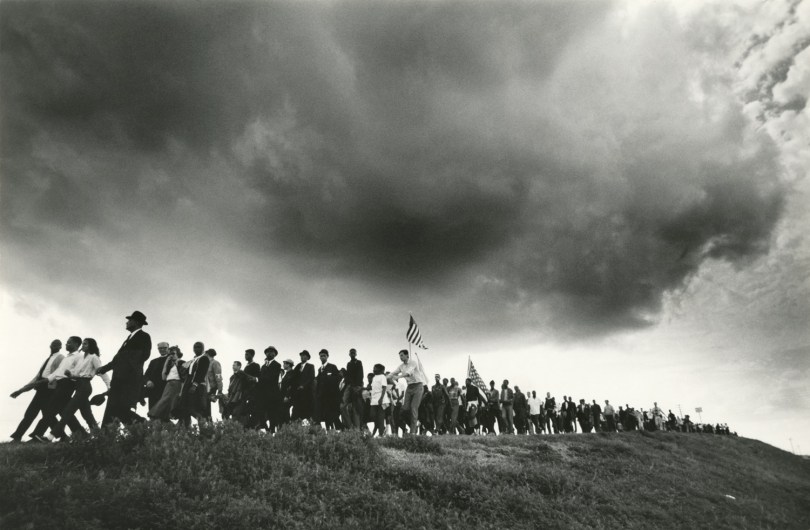
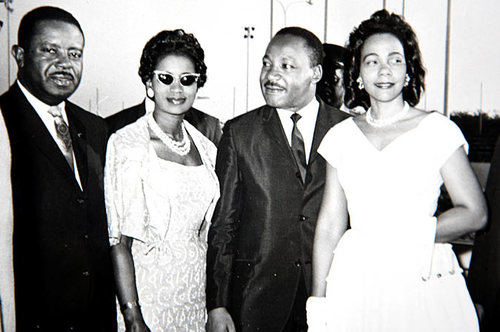
Photo from the Selma to Montgomery taken March 25, 1965. MLK, Jr. at center.
Lest we forget why we commemorate Dr. Martin Luther King, Jr.’s birthday today, we must understand that it is more than about one man, but about an entire movement for civil rights. King is recognized as its most significant leader, but the leaders were many and it took thousands of men, women, and children to effect change in our nation’s laws.
So often, college students of this generation do not truly understand what is meant when they are told “people gave their lives for the simple act of voting.” The new film Selma helps to illustrate that struggle for this generation, but today as we think about the meaning of the King holiday, it is worth being reminded that those risks were very real as seen in this original news clip from “Bloody Sunday,” the first of the Selma marches that took place on March 7, 1965.
In 1991, I moved to Hattiesburg, Mississippi, to begin work on my Ph.D. My advisor was Marjorie Spruill, a women’s history scholar who is now a professor of history at the University of South Carolina. Knowing that my research interests centered on the Lost Cause, she told me even before I arrived at Southern Miss that I “must” see Beauvoir, the last home of the Confederate President.
Early image of Beauvoir, the Last Home of Jefferson Davis
Officially known as the “Shrine of Jefferson Davis,” Beauvoir is located on Mississippi’s Gulf Coast and lives up to its name “beautiful view,” as it looks out on the Gulf of Mexico. What intrigued me, however, were the exhibits in the museum adjacent to the home. During my initial visit, I toured the museum, operated by the Sons of Confederate Veterans (SCV), and recall reading on one of the introductory exhibit panels the following: “During the dark days of Reconstruction. . .” The Lost Cause was alive and well.
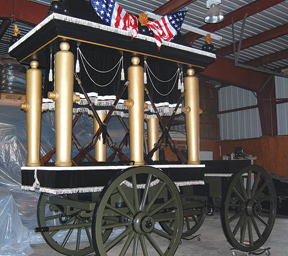
One of the Davis catafalques on display at Beauvoir is exhibited along with his death mask.
One of the fascinating artifacts on display in the museum was one of the catafalques that, in 1893, carried Davis’s body in parades following his disinterment from Metairie Cemetery in New Orleans, as it made its way to Richmond, Virginia, for reburial in the Capitol of the Confederacy. This was my first encounter (there would be others) with the macabre aspects of the Lost Cause, Victorian in its fascination with death. In fact, I learned, Davis didn’t have just one funeral, he had two. One following his death in New Orleans in 1889, and then a second four years later.
This wasn’t all. Because he was the “one and only” Confederate President, Davis’s body was taken to Richmond on a funeral train decorated with black bunting–similar to the one that carried Abraham Lincoln back to Illinois following his assassination. As the Davis train it made its way north, from New Orleans to Richmond, it was often interrupted by mourners in small towns along the route who gathered along the tracks to offer flowers to the Davis family.
The catafalque that carried Davis’s body through New Orleans for his first funeral in 1889. Courtesy: Louisiana State Museum
On the way to Davis’s final resting place in Richmond’s Hollywood Cemetery, there were designated stops in Birmingham, Alabama, and Raleigh, North Carolina. Beginning with New Orleans, Davis’s coffin was hoisted onto the catafalque and pulled through the streets of each city as part of a parade of men, women, and children who vied to be selected participants. (I have often thought about the unfortunate souls who rode in the wagon immediately downwind from the catafalque.) Then, on the day of this second burial–May 31st, 1893–75,000 people turned out to pay their respects. Mourning Davis’s death had clearly not been completed in 1889.
It was routine to cross paths with the memory of the Confederate president while living in Mississippi, the state he represented in the United States Senate. A year after my arrival I made a research trip to Tulane University, just two hours from Hattiesburg. Yet my most vivid memory of that time was not what I found in the archives, but what I saw on my drive there.
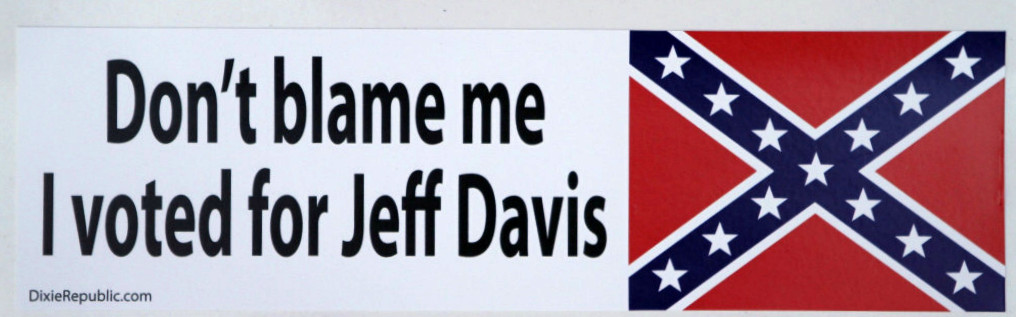
It was 1992, the year Bill Clinton became president, and bumper stickers with the phrase “Don’t Blame Me, I Voted for Bush,” were everywhere. But these Mississippians gave it new meaning with the message “Don’t Blame Me, I voted for Jeff Davis.” Here was another reminder of the hold the Lost Cause had on the Deep South.
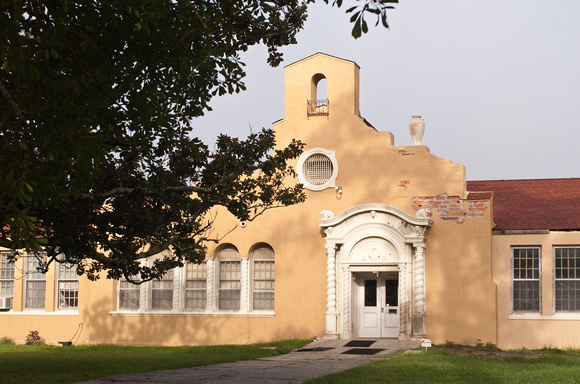
The former Jefferson Davis Elementary school and former site for a Head Start program in Hattiesburg, MS.
There was also the time, while driving around Hattiesburg, I noticed something quite spectacular when I drove past a defunct elementary school that now headquartered a Head Start program, which served a population that was largely minority. It was one of those moments when you do a double-take and rub your eyes, because across the front door of the building a banner read “Jefferson Davis Head Start Program.”
As I came to learn, public schools in Mississippi and across the South were named or renamed for Confederate heroes, often at the behest of the local UDC chapter. In this case, Jefferson Davis Elementary School. I’m sure, dear reader, that the irony of this is not lost on you when you consider that the name of the Confederate President, an advocate of slavery, became associated with a program that helped black children get a head start. Think on that.
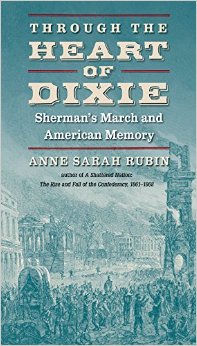
PS: What drew you to write a book about Sherman’s March?
It came from a confluence of events when I was back in graduate school: I read and loved Charles Royster’s The Destructive War, where he analyzed the ways that Americans become accepting of a different, more devastating to civilians, sort of war. I saw Ross McElwee’s Sherman’s March, which made me think a lot about the reasons that this one event continued to resonate. I also heard about and ultimately read James Reston’s Sherman’s March and Vietnam which didn’t ring true to me. And finally, the opportunity to really engage critically with Gone with the Wind, one of the great Southern novels, was irresistible.
Anne Sarah Rubin
PS: How is your book different from other books on the March?
I think my book is different because it doesn’t simply retell the story of the March, but rather tries to get at the ways that Americans ascribed meaning to this event. To that end I look at the March and its aftermath from a range of perspectives: Southern white civilians, African Americans, Union veterans, and travelers. I also see how perceptions and portrayals of the March changed over time, from 1864-65 up through the present day.
The other difference is broader, and more about the ways that historians talk about “memory.” I didn’t want this to be a book that argues that there is one story of Sherman’s March and that lots of the stories people told were false and here’s why. Rather, I was interested in why certain narratives persisted and others didn’t. So I consciously shifted away from the language of “memory” to the language of “storytelling.”
PS: For the readers of Pop South, can you talk about the various sources of popular culture that you drew upon? Is there anything specific that really grabbed your attention?
I had a great time doing that research—I looked at fiction, poetry, films, photography, art, and music. The novels about Sherman’s March were generally pretty formulaic—lots of 19th century “romance of reunion,” although some of the 20th century novels, like those by Cynthia Bass and E. L. Doctorow were very powerful.
I liked working with Herman Melville’s two poems about the March, “The March to the Sea” and “The Frenzy in the Wake.” He’s able to show two completely different views of the same events, and it tied in so well with what I was doing. I also became really interested in George Barnard’s photographs, and the ways he did—or didn’t—represent the March.
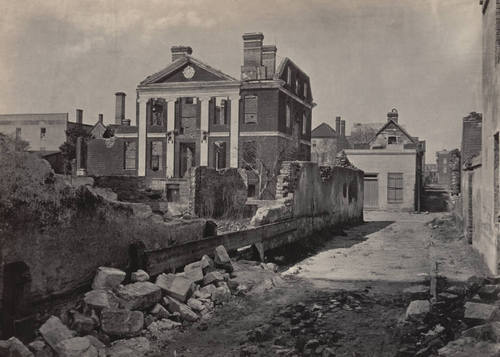
George Barnard (American, 1819–1902). Ruins of the Pinckney Mansion, Charleston from the album Photographic Views of Sherman’s Campaign. Credit: http://www.moma.org
PS: Your book explores some of the misconceptions surrounding Sherman’s March? What is the biggest misconception about this event?
I think the biggest misconception is that the March mowed down everything in its path, and left Georgia, South Carolina, and North Carolina as smoking ruins. It was much more narrowly focused. Whenever I give talks I always say the same thing: “It’s a mistake to imagine the March as mowing down everything in its path; rather it’s better to think of it as rows of stitches, with untouched spaces in between.”
I wanted to explore new innovations in digital history—I had worked on a large digital project in Grad school, and wanted to get back to it. Specifically, I wanted to use digital media in historiographical ways, making the same kind of arguments in my book, making ideas about memory visible. Fortunately, we have an amazingly talented group of visual artists/animators at the IRC who have been working on some of these kinds of projects or questions for years. Through a collaboration with Dan Bailey, and especially Kelley Bell, a professor in Visual Arts, we came up with a scheme for all of this, funded by an ACLS digital innovation grant and then UMBC.
We decided to use maps as our guiding metaphor and interface. The maps would be a way into the myriad strands of memory. But I didn’t want just one map—I wanted several, in order to represent the different kinds of accounts I was using. Then I could get the multiple perspectives across in a visual and intuitive way. The idea of a journey seems a natural metaphor for the kind of exploration and excavation I’m doing in the larger project. We ultimately settled on five different maps, each with a different look and feel:
The Sherman or Fact Map, which lays out the basic events of the march.
The Civilians Map, for events involving African Americans and Southern civilians.
The Soldiers Map, for events told from the perspective of veterans.
The Tourism Map, which is about tourism and travel accounts.
Finally, the Fiction Map, which plots places both real and imagined.
Each map then has around 15 or 20 significant points marked. The idea is that you can toggle between the maps, and see how different people remembered or wrote about different places or events. Not every place appears on every map, but most of them are on two or three, and Atlanta, Savannah, and Milledgeville are on all five. But of course the maps alone can’t really tell the story, or make the kinds of arguments about the uses and possible abuses of memory. So what we decided to do was to create an animation or a mini-movie for each one of the map points. We pretty quickly realized that wouldn’t be feasible—too much work. So, we decided on 3-5 films per map, the rest done with single screens.
Finally, for the Georgia campaign I created a day-by-day blog of primary sources, which is now being updated less frequently for the Carolinas Campaign.
Followers of Pop South are encouraged to read Rubin’s book and to explore the terrific website that explores the March in greater depth. Check it: http://www.shermansmarch.org
This week, and for the next several weeks, Pop South will offer a serial called “Me and Jeff Davis,” based on an essay I wrote for fun but for which I never found the right publishing venue. Now that I have a blog and we are still in the midst of the Civil War sesquicentennial, why not? What follows is Part 1.
As scholars we often develop a personal relationship with our work, feeling as if we know the people we study even though they have long since died. Early in my career, my research involved a study of the Lost Cause, more specifically, those women who helped to preserve it for generations—the United Daughters of the Confederacy (UDC).
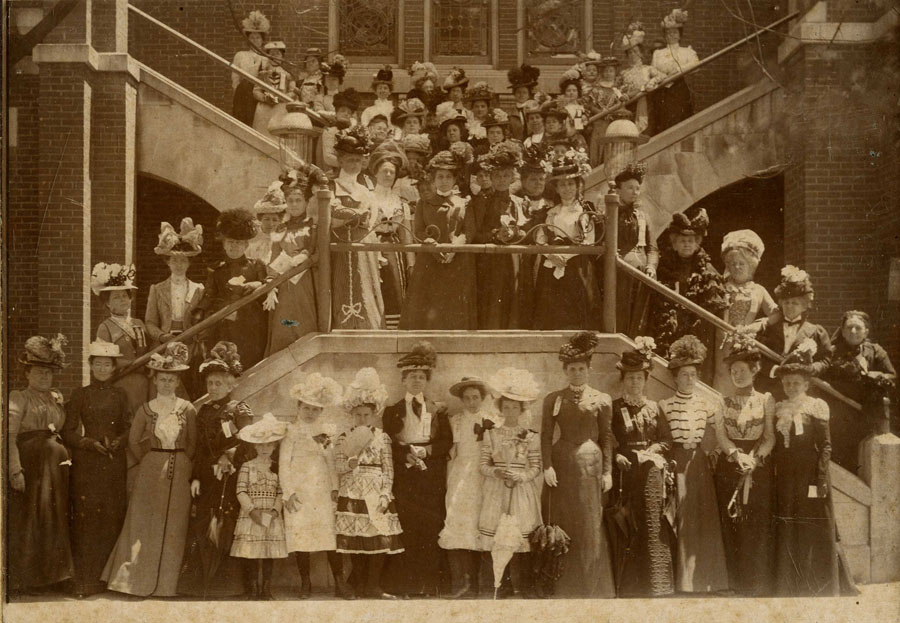
UDC members in Jackson, Tennessee. 1900.
Through these women, and my fascination with the Confederate tradition in the New South, I became very familiar with Jefferson Davis, or “Jeff,” as I like to call him.
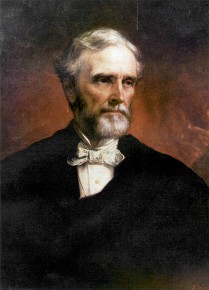
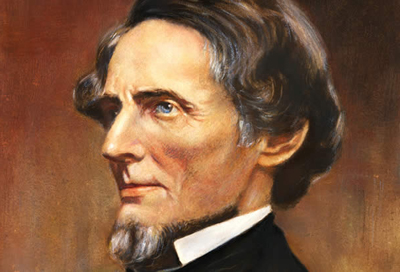
Lost Cause Jeff.
Jeff Davis of the Lost Cause was quite different from Jefferson Davis, one and only Confederate President. The postwar Davis is a man whose journey from despised loser to sacred martyr is the man I came to know through my research.
The UDC made sure of it, even if Davis had never participated in the resurrection of his own image, which he did. They built grand monuments to him in New Orleans and Richmond, and smaller places in between. His image is one of three Confederate leaders carved into Stone Mountain in Georgia. There’s even a highway named for him, compliments of these Daughters of the Confederacy.
And while Robert E. Lee may have been the South’s most beloved hero, Jefferson Davis was the Daughters’ “Man.” He symbolized the South in her loss, defending the cause of states’ rights and his, as well as the region’s, reputation. Moreover, for the devotees of the Lost Cause, especially women, he was THE martyr of a defeated southern nation.
In fact, he was often likened to Jesus Christ; just as Christianity’s martyr died for the sins of humanity, the South’s martyr—Jefferson Davis—was regarded as self-sacrificing, a man who went to prison and suffered in behalf of the entire region.
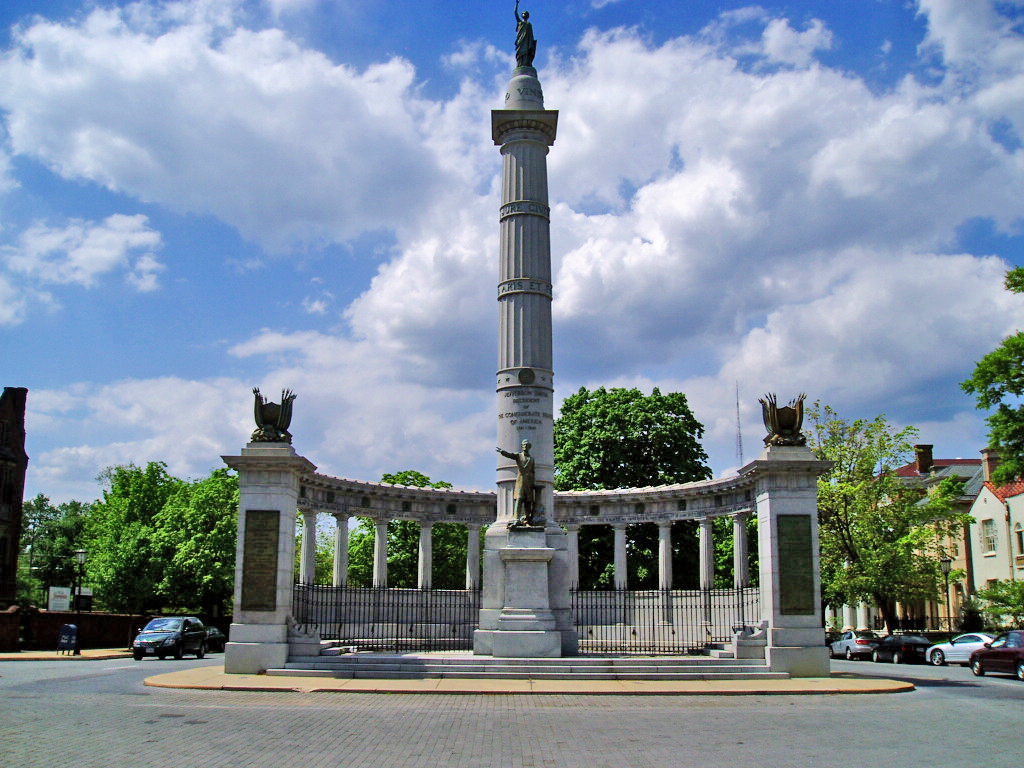
The Jefferson Davis Monument on Monument Avenue in Richmond, VA, was a result of UDC fundraising efforts.
How did Davis’ reputation as a martyr play itself out in the South?
In fascinating, costly, and even bizarre ways. In fact, I often liken my own experience with Lost Cause Jeff as something like going to a sideshow at the annual fair—you don’t want to look, but you can’t help yourself. Indeed, from the first time I came to study the Lost Cause and the UDC, it was Jeff Davis who kept revealing himself to me, and not in the most conventional ways.
The new civil rights film Selma opened on Christmas Day and by January 9th will appear in theaters across the country. In Selma, director Ava DuVernay examines what the film’s official website describes as “the story of a movement [that] chronicles the tumultuous three-month period in 1965, when Dr. Martin Luther King, Jr. led a dangerous campaign to secure equal voting rights in the face of violent opposition. The epic march from Selma to Montgomery culminated in President Johnson signing the Voting Rights Act of 1965, one of the most significant victories for the civil rights movement.”
As previously discussed in this blog, the American South has consistently provided Hollywood with dramatic material since the dawn of film. For much of that history, movies have romanticized the Old South and often portrayed slavery as a benevolent institution. Last year’s Best Picture winner, 12 Years a Slave, helped to right that ship by showing the brutality of slavery in all its forms.
Hollywood has also tried to “do” civil rights films before, though not very successfully. Films like Mississippi Burning (1988) or The Long Walk Home (1990) presented a civil rights story where the heroes were white men and women.
This is not the case with Selma where DuVernay has focused her lens not only on well-known black heroes like Martin Luther King, Jr., but on the real heroes of the movement–local people whose grassroots organizing and willingness to march and subject themselves to violence resulted in changes to our nation’s laws.
Early reviews of the film are either glowing (see the NYT review) or have criticized how the film misrepresented President Lyndon B. Johnson’s role. Joseph Califano, LBJ’s top assistant for domestic affairs from 1965-1969 argues that the Selma march was Johnson’s idea and in his review of the film takes DuVernay’s version to task. DuVernay has responded with vehemence, tweeting that the suggestion that the Selma march was LBJ’s idea is “jaw dropping and offensive to SNCC, SCLC and black citizens who made it so.”
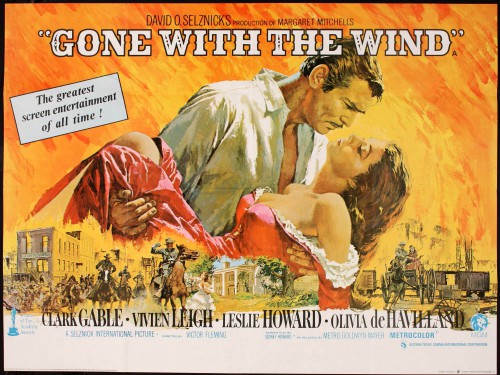
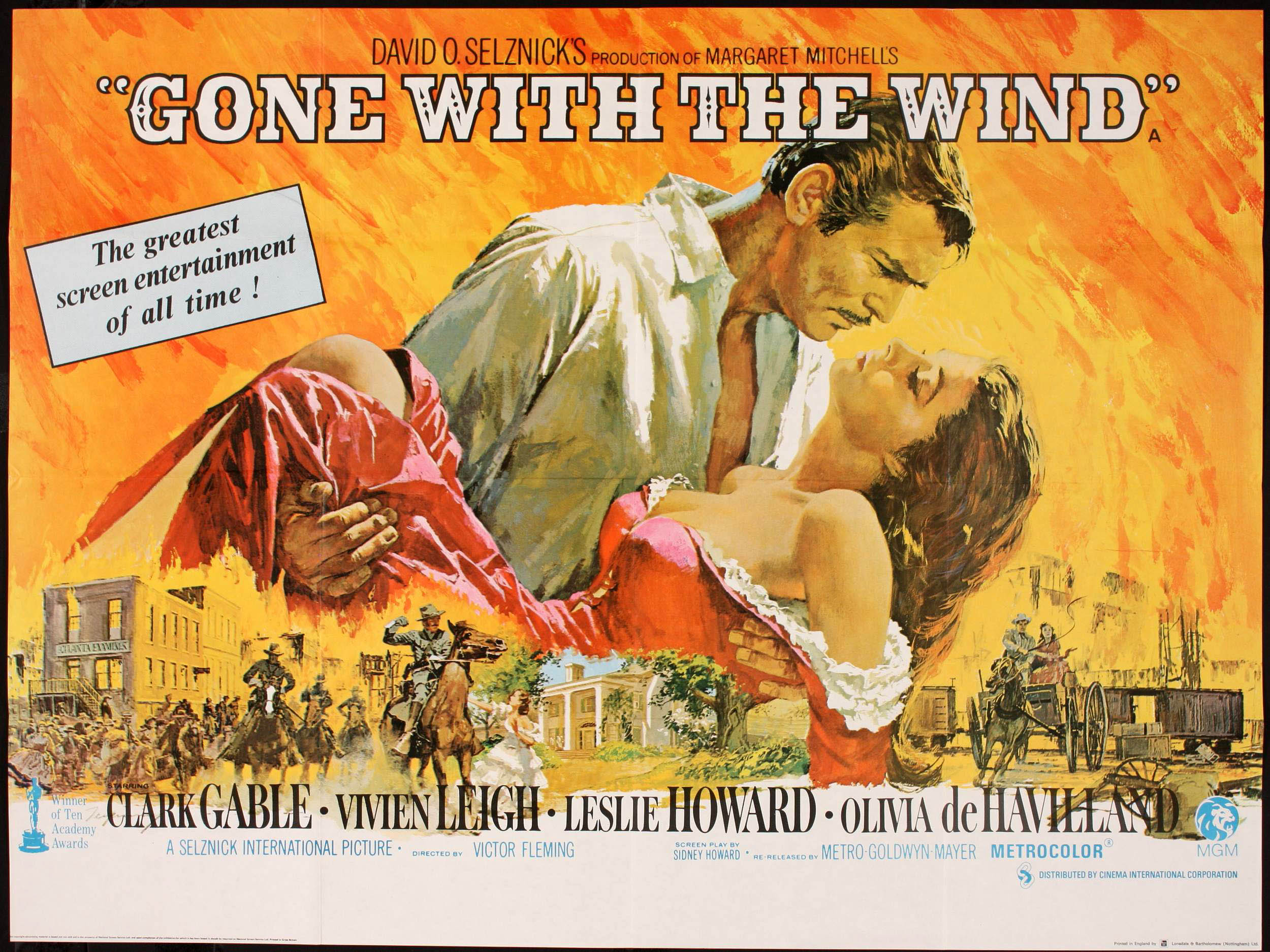
A few days ago, stories on the 75th anniversary of the premiere of Gone with the Wind (GWTW) on December 15, 1939 circulated in the news media. A new anniversary edition of the film has been released, one of many that have appeared as different anniversaries of the film have been celebrated. It is a testament to the staying power of the film David Selznick produced when he brought Margaret Mitchell’s book to the big screen.
Gone with the Wind is a story that holds the “land of Cavaliers and cotton” on a pedestal, and when it arrived in theaters in 1939, it fed America’s nostalgia for the Old South then and for decades to come.
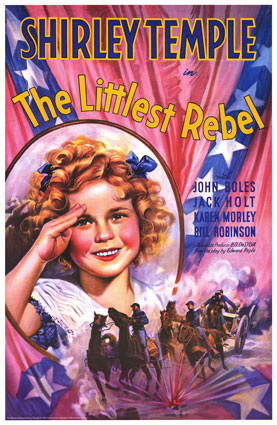
Shirley Temple was box office gold during the Depression.
Hollywood already had terrific success with antebellum stories set against plantation backdrops. Throughout the 1930s there had been numerous films set in the Old South, many of which were successful. Some, not so much.
But it didn’t matter. Old South nostalgia was a Hollywood staple.
Among the successes were The Littlest Rebel and The Little Colonel which appeared in 1935, both of which starred child star Shirley Temple. In 1938, the most successful pretender to the GWTW throne was Jezebel, starring Bette Davis who won an Oscar as Best Actress for her performance as a “scarlet spitfire.” (The GWTW reference was intentional.)
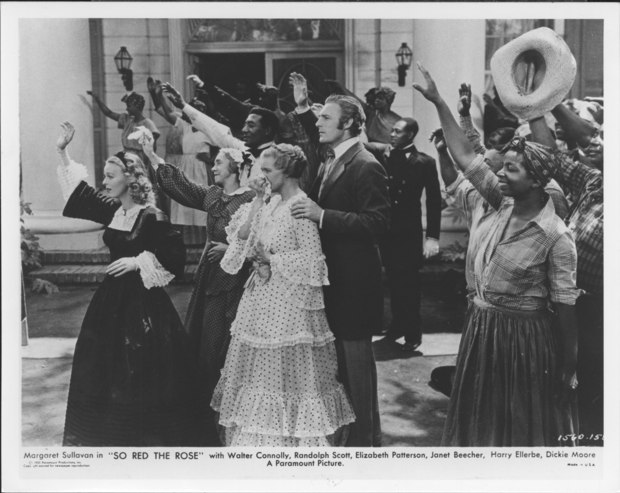
So Red the Rose (1935)
Surprisingly less successful was So Red the Rose, a film based on the best-selling plantation novel of the same name written by Stark Young. Young’s novel, set in Natchez, Mississippi, might have been the most important plantation novel of the decade had it not been for Gone with the Wind.
This is all of way of saying that Hollywood had primed the Old South pump for years, so that by the time GWTW premiered, a lot of the groundwork for the film’s success had already been laid. Still, there can be no doubt that GWTW eclipsed all that had come before.
From the opening scenes and first few minutes of dialogue, moviegoers were whisked into the mythical South of faithful slaves, southern belles, cavalier gentlemen, cotton fields and beautiful mansions. American popular culture fed this nostalgia, too, particularly during the 1930s, and not just on the big screen. It could be found among advertising icons like Aunt Jemima, radio shows such as the Maxwell House Showboat, and through the revival of Stephen Foster’s music and the “Dixie songs” of Tin Pan Alley. The film version of Gone with the Wind had all of that helping it succeed, too.
As the film is being celebrated on its 75th anniversary, it is interesting to note the ways in which Americans are still nostalgic for the Old South represented in GWTW. In Georgia, there are tours of the facade of Tara (the film set), there are online fan clubs, a website dedicated to Scarlett touted as “the most comprehensive Gone with the Wind site on the Internet,” and you can still eat at Aunt Pitty Pat’s Porch in Atlanta.
It is important to note that Gone with the Wind is also reviled for its racism, and yet despite this it is easy to predict that when the film turns 100, there will be another anniversary edition for sale.
America’s nostalgia for the Old South is a hard thing to shake, thanks in large part to the cultural imprint this film has made.
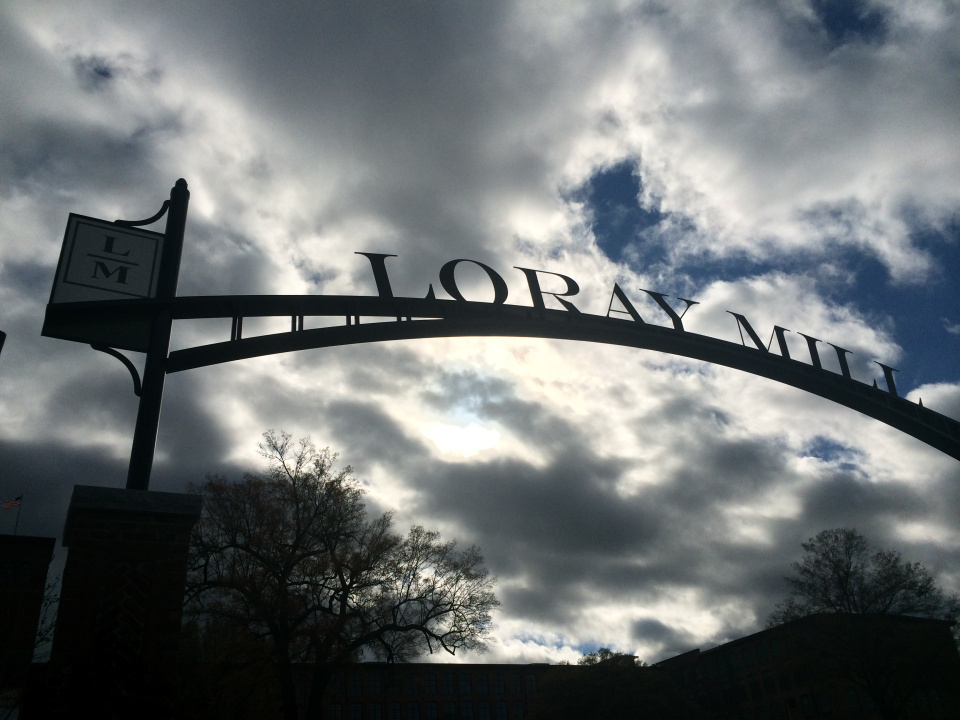
When developers try to employ history and heritage as a marketing tool, they often get it very wrong. This is the case with the former Loray Mill now being repurposed into lofts in the town of Gastonia, North Carolina, just west of Charlotte. Alex Cummings, who grew up there, offers his own personal history with the town as well as poignant reminders of Gastonia’s economic and labor struggles.
My family moved to North Carolina in the late 1980s, having left a stagnant and hopeless West Virginia in search of greater economic opportunities. My mom and grandparents and I first tried Indiana for a few years, but eventually left for the greener shores of the Sunbelt. We came to Gastonia, a modest-sized former textile town (it once boasted of having “more looms and spindles within its hundred-mile radius than… any other southern city”) in the greater Charlotte metropolitan area. An aunt and uncle had already paved the way for us, in a sort of internal chain-migration, leaving WV for NC several years before. I once asked my mom why Suzy and Jim had settled on Gastonia as a place to live, and I’ll never forget her answer:
It’s about as far as you can get from Charleston on a tank of gas.
This weekend in Atlanta, the city “too busy to hate,” there will be a meeting of the Southern Historical Association. Men and women, professors and graduate students will attend to learn about the latest scholarship on the American South, buy the latest books in the field, and visit with old (and new) friends.
Please make sure you exercise your right to vote today! You can find out where to vote in your vicinity by going to this link, compliments of the League of Women Voters.










 Pop South