Kanye West, Neo-Confederate, and 12 Years a Slave

Since Pop South isn’t a paying gig, I don’t always post items as quickly as I’d like. I’ve got a real job that needs attending to, which means that I’m a little slow to blogging about those stories that are on my mind.  Like rapper Kanye West sporting a Confederate battle flag on his jacket.  And, 12 Years a Slave.
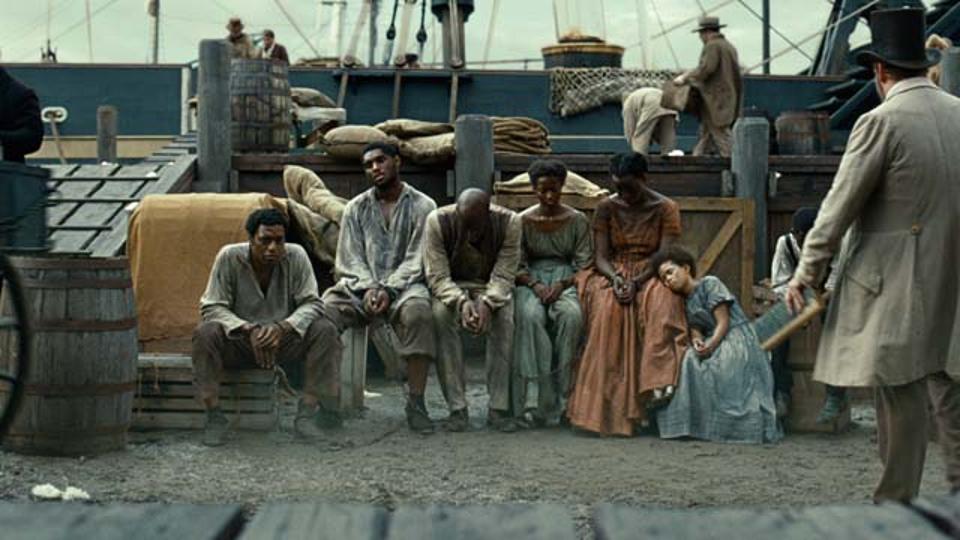
From the film, 12 Years a Slave

Speaking of which, what a powerful film.  The movie, directed by Steve McQueen, is based on true events in the life of Solomon Northrup, a free black man who was captured and sold into slavery.  But it is so much more.  Based on Northrup’s narrative, the story itself is an amazing tale of survival. Yet the greater story is how the brutality of slavery damages the humanity of everyone associated with the system–from the slave owners to the enslaved, the slave catchers and the slave buyers, men and women.  This is the institution that the Confederacy sought to preserve.

Which brings me back to Kanye and that flag.  Not just any ol’ Confederate flag, of which there are several, but the Confederate battle flag.  Because we know Kanye enjoys a battle, especially when his ego is involved or, more importantly, his wallet. Some have called this move “genius.”  He would agree. Controversy = publicity = $$$.

Kanye West, Neo-Confederate

What I find disconcerting is how willfully ignorant West is about the flag’s meaning. His public response to using it is to say: “You know, the Confederate flag represented slavery in a way—that’s my abstract take on what I know about it… So I took the Confederate flag and made it my flag! It’s my flag! Now what are you going to do?”  Yea, Kanye, it represented slavery “in a way,” and it’s also been co-opted by the Ku Klux Klan, segregationists, and Neo-Nazis. In essence, you’ve cast your lot with them, too.

But, wait. He doesn’t care about that. In a more recent interview he said as much. “You don’t ever know what I’m trying to do. Black people stopping other black people from getting checks. . .Don’t nobody care about the Confederate flag on that type of level.”  Perhaps, but I don’t think we’re out of the (pecker)woods yet.

This brings me back to 12 Years a Slave.  Kanye West needs to see this film. Over and over again. Perhaps then, he’ll get why he’s wrong about the meaning of the Confederate flag.  He may never admit to it publicly, but in his heart, he will know.

This is the South, NOT the Confederacy

As the government shutdown dragged on, journalists everywhere, on the left and the right, raised the level of their rhetoric in search of what they believed to be the appropriate scapegoat for their wrath. The American South, it turned out, was one of their favorites.

Enough of this.
Enough of this.

The Washington Post’s Colbert King offered a sardonic editorial in which he used the metaphor of the Confederacy to describe today’s Tea Party.  Over at Salon.com, Stephen Richter of The Globalist wrote that the shutdown was a reminder that the Civil War never ended.  Richter argued that “the South is once again rebelling against modernizing shifts in American society” and makes the analogy that “Southerners and white conservatives everywhere” fear that offering healthcare to Americans is akin to “freeing the slaves.” Of course, the article would not have been complete without illustrations of the Confederate battle flag.

Well, thanks for nothing.

The quagmire in Washington, DC, cannot be explained by simply tossing it into the lap of the South since just as many states outside of this region are being represented in Congress by members of the Tea Party caucus. When Ari Berman wrote in The Nation that the GOP has a “white southern Republican problem” by noting the high numbers of southerners in the Tea Party caucus, he failed to address the reality that the shutdown would have been impossible if only GOP conservatives from the South were involved.  The fact is that this southern faction has co-conspirators across the country. (See the list.)

Not only do these comparisons perpetuate the idea of a monolithic South, it keeps alive regional divisiveness (to say nothing of continued stereotyping) as the comments section of these articles attest. It also ignores the changing demographics of the region, which over the last few decades has included a considerable migration of people from North to South.

Moral Monday protest

More importantly, this Neo-Confederate rhetoric does nothing more than embolden Tea Party leaders and their acolytes, while at the same time it undermines the efforts of southern progressives. All the anti-South commentary illustrated with battle flags damages any inroads that are being made through grassroots efforts like those of the Moral Monday protesters here in North Carolina who are doing their damnedest to hold the GOP’s feet to the fire.

The real power struggle is not inside the Beltway, but in individual states. Conservative Republicans have gerrymandered districts to insure their power, but southern progressives in the state are not taking it lying down.

Wendy Davis, Democratic candidate for Texas Governor

Sen.Ted Cruz (R-TX) may still be a Tea Party darling (and a shoe-in for Joseph McCarthy), but State Senator Wendy Davis is offering a change to politics as usual with her candidacy for governor. And in Georgia, Democrat Michelle Nunn is off to a strong start to replace Republican Saxby Chambliss in the U.S. Senate.

The point here is that progressives nationally need to support southern progressives. (Apparently, Sen. Bernie Sanders (I-VT) agrees.)  It makes no good political sense to dismiss an entire region as a “lost cause” behind the drumbeat of Civil War rhetoric.

What’s happening in Washington is not a result of the return of the Confederacy. It might make good hay to allude to the South as the “Old South” or to suggest that it lacks the diversity (and by suggestion, education) to accept “modernizing shifts,” or insinuate that all southerners are conservative.  But this kind of commentary only serves to inspire southern conservatives, while placing yet another obstacle in the path of those seeking change.

Yes, conservatives appear to have a stranglehold on the region, but throughout the South there are strong progressive voices that need to be heard. So here’s a novel idea: rather than bolstering conservatism in the South by pointing fingers to its Confederate past and discouraging progressive voters, which is what the Tea Party wants, how about shining more light on candidates and grassroots efforts and give Progressivism a fighting chance?

And, by the way, I live in the South, NOT the Confederacy.

Southern progressives could learn a lesson from Julia Sugarbaker

sugarbaker
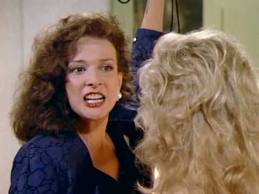
Designing Women’s Julia Sugarbaker, played by Dixie Carter.

Sometimes I feel like a lone voice in the wilderness when I write essays in an effort to counter some of negative images of the South that permeate popular culture or to contest the drivel that national journalists churn up in order to take swipes at a region they’ve never visited, much less know.

With the government shutdown, writers from The Nation to Salon to the Washington Post have all pointed their fingers at the South, especially conservative Republicans from the region, the most intransigent of which are members of the Tea Party caucus. Here, they say, the Civil War has not ended.  Here, they say, are nothing but a bunch of “Neo-Confederates.” I’m not suggesting that these journalists don’t have a point to make, but in making it, they are using a fairly broad brush that hits me and other southern progressives like a slap in the face.

This is when I wish I could muster up a rant that would make Julia Sugarbaker proud.  In the 1980s television series Designing Women, Julia Sugarbaker, played so well by the late actress Dixie Carter, knew how to rip someone a new one. In one particular episode, she lashed out at a writer from the New York Times for printing an article about dirt eating in the South.

Today, the articles about dirt eating may have subsided, but the stereotypes of the region remain.  The use of banjo music for television programs, illustrations of the Confederate battle flag for articles about the South, and so on. In one week John T. Edge might write a nice food article for the New York Times that gets all sorts of compliments (southerners do okay when it comes to food), but the next week a comedy-news show (The Daily Show or perhaps Real Time with Bill Maher) will interview a hillbilly type to make a point.

It’s tiresome and I wish Julia Sugarbaker were here to let them all know.

The Daily Show and Tired Southern Tropes

Al Madrigal
Al Madrigal

I love The Daily Show, I really do.  But when it comes to segments about the South, they often do a piss poor job of it. The latest example came from correspondent Al Madrigal who did a story on the dispute between Georgia and Tennessee regarding state borders and the water supply. (Watch the segment here.)

Georgia essentially wants and needs access to the water provided by the Tennessee River, and in typical Daily Show fashion, the actual story was less important than Madrigal’s effort to highlight the stupidity of local officials.  This is nothing new, because the show’s correspondents are often satirizing politicians.  Where it fails is in its pitiful attempt to poke fun at the South, which can be done, but with more intelligence.

Instead, it’s so lame, it’s as if the writers dialed this one in. Want to discuss the South? Incorporate banjo music and, these days, mention Honey Boo Boo.  Want to suggest that rural southerners are inbred? Incorporate a clip from Deliverance. Need to establish that people are ignorant? Mock their accents to their face or include “man on the street” interviews with people who fit the stereotype.  It was on this last point where The Daily Show showed its hand, because it was clear to anyone with a keen eye that a couple of those interviews were plants, what I’ll call “hicks for hire”.

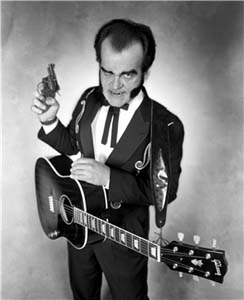
Unknown Hinson
Unknown Hinson

First, there were the two men in camouflage: one held a shotgun, while his friend offered a bug-eyed look. These two were obviously playing to the camera. Second, there was the guy who had mutton chop sideburns, slicked back hair, and sunglasses circa-1970s Elvis. The tip off that this guy was playing to the camera was his Unknown Hinson t-shirt.  While the studio audience in New York was laughing at this guy, I knew that he was saying things Al Madrigal needed to pull the piece off. And he was probably having his own laugh at Madrigal’s expense.  Like Unknown Hinson, he was portraying a character.  Everything he said played to stereotype on purpose.

So, suffice it to say, I’m disappointed with The Daily Show’s latest attempt at satirizing the South.  As usual, the writers relied on worn out tropes about the South and not only was it not amusing, it wasn’t even funny.

About “Ask A Slave”

This is a thoughtful response to the video sensation “Ask a Slave.”

edabney's avatarInterpretive Challenges

This past week I received approximately 20 people sending me a YouTube web show called “Ask a Slave” by Azie Dungey who portrayed an enslaved maid at Mount Vernon. Through this medium of YouTube she shares some insensitive and not very thoughtful questions asked by people at Mount Vernon (and at a host of other sites that deal with slavery). Like others I appreciate the explanation and intent behind the project. My friends want to know “What do you think?”

The problem I have with this show is that interpreting enslavement in eighteenth and nineteenth century contexts must be taken seriously by the presenter and also by the receiver. Poking fun at visitor inquiries is not the best method of interpreting (to be fair this web show is not claiming to interpret). However, the questions posed by visitors are their (albeit often poorly worded) way to find some information…

View original post 1,388 more words

The Bitter Southerner: Writing with an eye for nuance

bitterFolks who write about the South, think about its history and culture, and bristle at negative assumptions about the region from those who really don’t know diddly about it, will likely enjoy a new online magazine called The Bitter Southerner. This isn’t the fluff you’ll find in Southern Living or Our State, though certainly there’s a considerable readership for nostalgia illustrated with Bob Timberlake paintings and photographs of iced tea in mason jars.

No, this is a weekly online magazine that offers thoughtful, erudite articles that consider the South in its complexity. It also does what I’ve sought to do with some of my posts on Pop South, which is to enlighten the ill-informed by showcasing a region that is far more nuanced than it is often presented in popular culture.

The Bitter Southerner comes to us from Atlanta and to date has begun a series on original southern cocktails (The B.S. Cocktail Series) and published an essay by Patterson Hood of the Drive-By Truckers. This week the magazine hands over the reins to Ray Glier who has recently published a book on the SEC‘s dominance in college football.

Chuck Reece, the editor-in-chief, talked about the magazine in a recent radio interview and of how quickly word has spread about “The BS.”  Apparently, dozens of people from across the country (many of them ex-pat southerners) have “come out of the woodwork” offering to write essays, and for good reason. The Bitter Southerner is a smart magazine that appeals to the readers’ intelligence. So far, it recognizes that stereotypes, positive or negative, are not necessary in order to have a conversation about the South. That being said, it will be interesting to watch the direction the magazine takes in the coming weeks and to see how well it covers the region’s diversity.

New essays are published every Tuesday. I recommend you give it a try. And, if Chuck Reece is reading this, I’m available.

American Roadside: The Mammy of Natchez

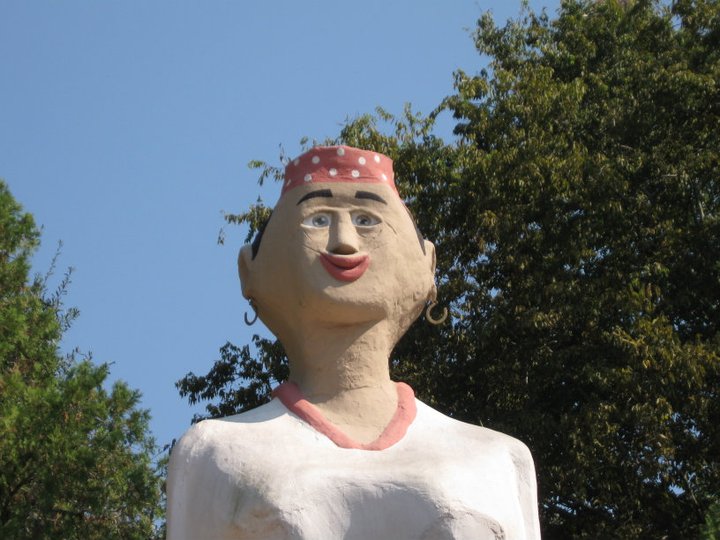
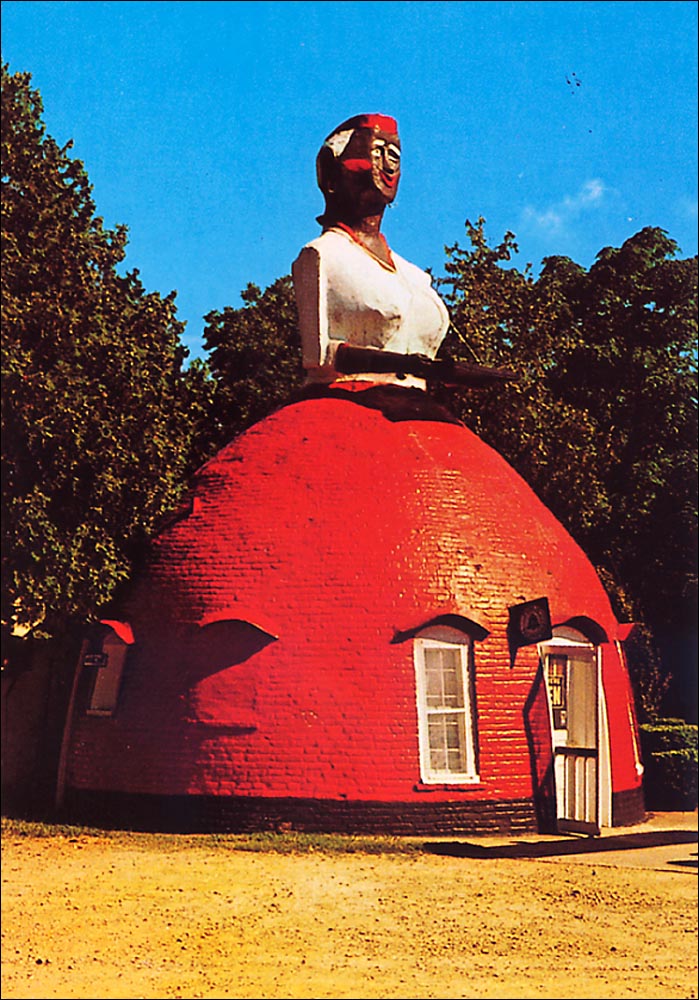
Mammy's Cupboard is located on Highway 61 on the outskirts of Natchez, MS
Mammy’s Cupboard, Natchez, MS

mammyhead

Visitors who travel to Natchez, Mississippi, by way of Highway 61 will be able to see an interesting relic of roadside architecture known as Mammy’s Cupboard. While some visitors just want to stop and photograph the building, locals go there because it’s a great place to get a meat and three and a slice of banana caramel pie that by itself is worth the five-mile drive from town.  For others, the building’s association with a “southern mammy” is enough for them to keep on driving.

Built in 1940, Mammy’s Cupboard originally operated as a family-owned Shell Gas station and convenience store.  It was a good investment at the time. The Natchez Pilgrimage, the spring tour of the town’s antebellum mansions, had grown exponentially since it began in 1932. Tourism to the town exploded following the enormous success of Gone with the Wind, which premiered in 1939. Many Americans who saw the film later went in search of houses like Tara;Natchez offered them that and more.

Today, the gas pumps at Mammy’s have been closed off, but it remains a family-owned restaurant that is primarily open for lunch.

White tourists, of course, were drawn to the Natchez mammy from the beginning.  By 1940, Aunt Jemima–a marketing figure based on a southern mammy–was already the most recognizable advertising icon in the country.  She reminded whites that this kind of happy servitude was still within reach.  For African Americans, mammy icons were a reminder of their second-class status.

Former Howard University Professor Sterling Brown wrote about the figure while traveling through the region in the early 1940s.  In A Negro Looks at the South, he observed:

Weston
Edward Weston’s photo, 1941.

“Outside of Natchez, as a come-on for tourists, is the Mammy Gas Station and Barbecue Stand. With clean-cut features, a trim waist, and an elegant hoopskirt, a tall erect statue of a Mammy stands there, fronting the highway so proudly that her bandana seems out of place.  My host explained why: the yarn goes that she was intended to be a Southern belle, but when the bodice was poured, the bust filled past all planning.  Natchez objected to the breasts being so pendulous, and the statue’s complexion was colored to a deep chocolate.  Hoopskirt and waist and features still belong to the belle, but it is a colored girl, Egyptian-like, who welcomes the tourists to Natchez and invites the white natives to barbecue.”

In the more than seventy years that Mammy’s has been open, her skin tone has grown lighter in appearance–more white than black. She was still rather dark in the early 1990s, but has since become very fair–perhaps a tacit acknowledgement by the owners that the dark skin was at best inappropriate, and worse, an offensive reminder of the not-too-distant past.

mammypostcard
Postcard, 2013

Yet if you were to stop by Mammy’s Cupboard today, you’d still be able to get a postcard of the restaurant from the days when she was still dark.  It’s a small reminder of William Faulkner‘s oft-quoted line from Requiem for a Nun. “The past is never dead. It’s not even past.”

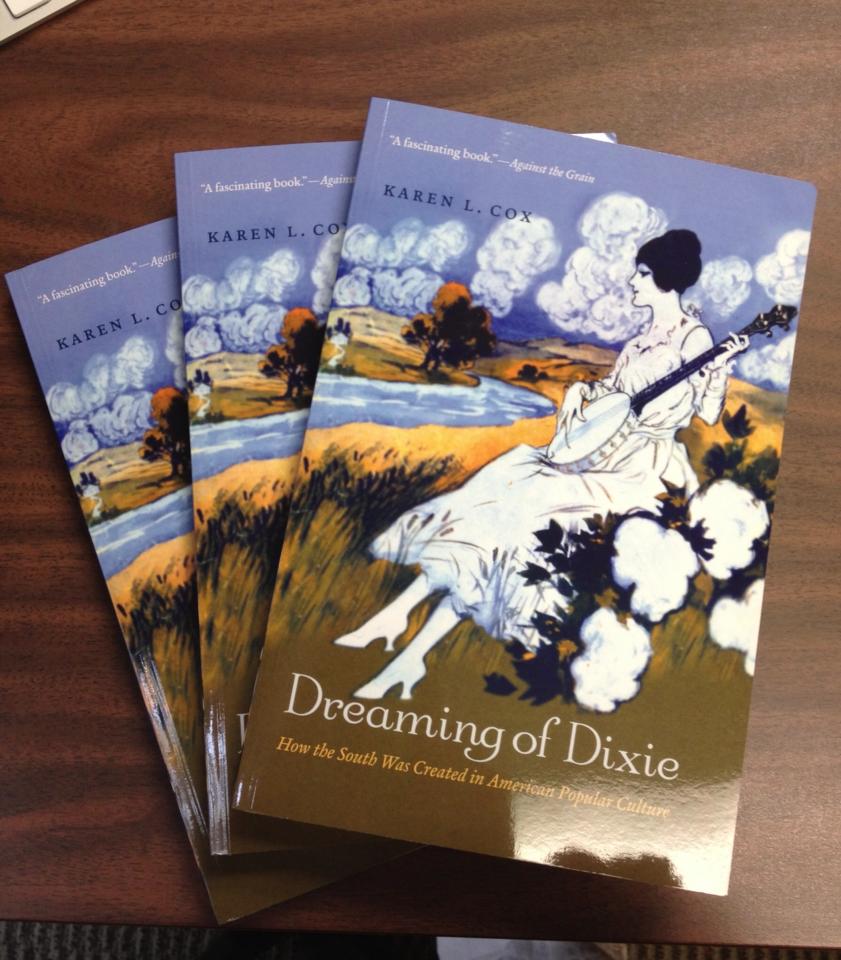
Dreaming of Dixie is now in paperback

paperbacksWell, that didn’t take too long.  Dreaming of Dixie, the paperback version, is now available from online bookstores and through the publisher, the University of North Carolina Press. In fact, if it weren’t for the press, there’d probably be no Pop South.

Another Kind of Southern Pride: What we can all learn from the town of Vicco, KY

Facebook and Twitter were all aflutter this week about Vicco, Kentucky, thanks to a wonderful segment on The Colbert Report about “People Who Are Destroying America.” The segment zeroed in on Mayor Johnny Cummings, the openly gay major of Vicco, which also happens to be the smallest town in the country to pass an LGBT fairness ordinance.  In typical Colbert fashion, the segment exposes the hypocrisy of the idea that if the LGBT community is offered any kind of equality then we are all going to hell in a handbasket.

One would assume that Vicco, a coal-mining town in eastern Kentucky, would be repressive on such issues.  It’s in a conservative southern state and we all know that gays and lesbians cannot possibly live openly in the South–at least that’s what mainstream media usually tells us.  But as I argued in an op-ed in the New York Times last October, the South is far more nuanced about LGBT issues than its often given credit for. A few months later, the Times concurred with its own piece on Vicco from which the Colbert Report probably got the idea.

This is not to say there isn’t room for improvement.  Here, in North Carolina, citizens voted to amend the state constitution to make doubly sure that there would be no such thing as gay marriage in the Tarheel State.  It was already illegal, but conservatives felt the need to batten down the hatches in order to protect traditional marriage.

And yet, today marks the beginning of Charlotte Pride Week celebrating all things LGBT.  It will culminate with a two-day festival in Uptown, which last year attracted more than 20,000 people and is increasing its number of corporate sponsors.  This South exists, too.

We could all learn something from Johnny Cummings, his friends, and the town of Vicco–namely, that the South is not a monolith and while religious, right-wing zealots within the region may push their own agendas, they don’t always win.

Snake Salvation: Praise the Lord and Pass the Snakes

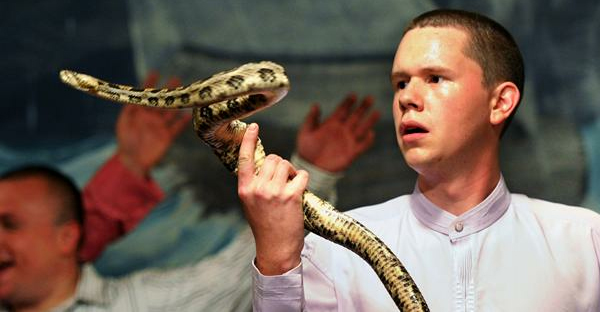
Snakes alive.  We’ve got us another southern-based reality television show.  “Snake Salvation” focuses on a small Pentecostal sect in Appalachia that takes the Gospel of Mark 16:18 to heart: “They shall take up serpents; and if they drink any deadly thing, it shall not hurt them; they shall lay hands on the sick, and they shall recover.”  Essentially, they prove their faith in God by handling poisonous snakes–mostly rattlers–and if they’re bitten, they believe in the healing power of their Lord to keep them alive.  They also believe that if they don’t handle snakes, well, hello Hell!

Pastor Andrew Hamblin is one among a new generation of snake-handling ministers.

The show, which premieres on National Geographic on September 10th, features Jamie Coots (did they have to choose a man named “Coots?”) of Full Gospel Tabernacle in Jesus Name church of Middlesboro, Ky. and Andrew Hamblin of Tabernacle Church of God in LaFollette, Tenn.  According to the show’s description, “Hunting the surrounding mountains for deadly serpents and maintaining their church’s snake collection is a way of life for both men.” Not many churches can say they have a snake collection.

The earliest years of my life, just to age 6, were spent at the Rock of Ages Church in Huntington, West Virginia.  When I watch the video below, I recognize a similar type of preaching and inflection among the snake-handlers that I witnessed as a young child. They minister to their flock using a singsong kind of expression. “I belieeeeve-ha. In Jesus Chriiiiist-ha.” That sort of thing.  At Rock of Ages, I didn’t have to fear snakes, just that giant portrait of Jesus wearing a thorny crown with blood dribbling down his forehead. THAT terrified me.

I do remember, though, my Maw Maw Cox telling me about some snake handlers that showed up at the funeral home where my Uncle Roger worked. As it turns out, one of the members of the snake-handling church had died and when it came time for visitation the church members came to pay their respects, but they weren’t alone. They brought their snakes with them and asked to slip a few into the coffin.  This caused the staff at the funeral home to scatter, and eventually, the police arrived and forced them to take the snakes away.

Rev. Coots and Rev.Hamblin hope that the show will allow the public to see that their lives revolve around more than hunting and handling snakes, though I’m not so sure viewers will notice much more.

I’m going to try to reserve judgement until I’ve seen the show, but I can’t help but wonder about this latest attempt to examine the white underbelly of the South. And I emphasize white, because nearly all southern-based reality shows focus on whites who are generally, from the lower class or outright poor.  In fact, Andrew Hamblin falls into this category. According to an article in the Christian Posthe is struggling to support his wife and five children and is doing the show to attract more followers.  It will be interesting to see if the show takes off or simply slithers away.

(Note: If people really want to understand this particular religious group and their beliefs in a serious way, I’d recommend reading Dennis Covington’s book, Salvation on Sand Mountain: Snake Handling and Redemption in Southern Appalachia.)