Chick fil A and “The Gays”

Growing up in the South and having lived here my entire adult life, I have heard people who call themselves Christian say some of the most horrible things about their fellow man.    White southern Christians I have known have referred to African Americans as “the blacks,” or if of an older generation, “the coloreds,” followed by some horrific generalization.  Today, we might hear those same Christians say “the gays.”  As in, “the gays are trying to redefine marriage.”  Or worse. What I believe this reveals is that some Christians, including Chick fil A CEO Dan Cathy, see gays (like blacks before them) not as contributing members of their community, but as interlopers who are horning in on their sacred space and who they fundamentally do not respect.

Credit: Ted Kouklos’ artistic response to Chick fil A

My history with Chick fil A is a long one.  I admit to having enjoyed their chicken sandwiches since high school when my friends and I would go shopping at the Four Seasons Mall in Greensboro, NC, when malls were the only place where you could get a Chick fil A sandwich. ( I prefer not to think about the fried roach that came with my fries that one time.)

Later in life, when I lived in Washington, DC, and worked for a heritage marketing firm, I had the opportunity to see the inner workings of the company up close. I was sent on a research mission to Chick fil A headquarters in Atlanta to learn more about its history since the company I worked for developed corporate museums and exhibits.  I went there to review Chick fil A’s exhibit and consider ideas for updating the corporate narrative.

The company sent a car and driver to my hotel to take me to its headquarters. The car, like everything else Chick fil A, was branded with cows. (Imagine me sitting in the back seat, only instead of my head you see a Chick fil A cow head, appliqued over the window).  After I arrived, I went through the exhibit, ate lunch in the company cafeteria (yes, they serve from their menu), and then toured the test kitchen.  I eventually met Truett Cathy, the company’s founder, who I found to be a perfectly nice man.  I even scored a cool, cow beanie baby–a groovy, hippie cow that carried with it the message “Peece, Luv, Chikin,” as only cows can spell these things.
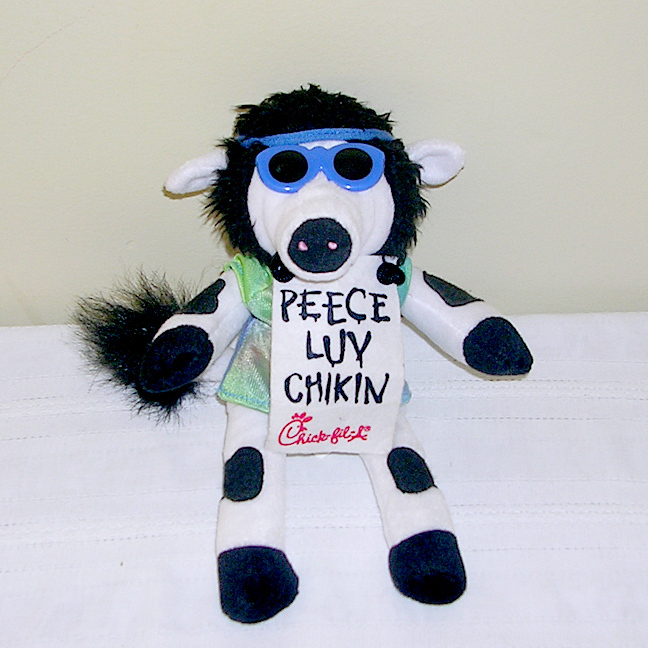
Peece and Luv, ya’ll

I also learned about Chick fil A’s college scholarship program for employees, and that its WinShape Foundation supported several foster homes in Georgia whose purpose was not to separate siblings.  Mr. Cathy’s foundation paid for their education, their clothing, and even paid salaries to couples who served as full-time parents in the home.  You know, doing good works that was consistent with the company’s Christian beliefs.

Still, I had this gnawing feeling about the company’s philosophy–tied to the fact that stores are closed on Sundays.  This, in and of itself, is nothing to criticize.  Yet in the materials I was given to read, the company wanted to convey that this was a day for employees to “worship as they saw fit.”  In other words, this was not necessarily about the company’s Christian values.  At least in theory.  But deep down, I knew that this was, indeed, part of a much more conservative philosophy tied to the founder’s evangelical Christian belief system.

Those beliefs, especially as expressed by company CEO Dan Cathy (Truett’s son), have been on full display this past week.  Cathy’s comments and his company’s support of the “biblical definition of marriage,” have resulted in a firestorm of negative media, backlash from cities outside of the South where the company has attempted to set up shop, and a soiled relationship with The Jim Henson Company.  Yes, he even ticked off the Muppets.

While Cathy’s comments on gay marriage have upset people, it is the company’s financial contributions to conservative, so-called “pro-family” organizations who actively lobby against gay rights, via the WinShape foundation, that many are questioning.  Last year, when that point was made by LGBT organizations, Cathy responded that Chick fil A was not “anti-anybody.”  His more recent comments suggest otherwise.

Companies and CEOs can believe what they want, but they operate in the marketplace where those beliefs are held up to public scrutiny.  Chick fil A has alienated many customers with its stance, and not just gay ones.  And why would any company, particularly in this economy, want to alienate customers?

As a southerner, a longtime Chick fil A customer myself, and one of “the gays,” it looks like I’m going to have to step away from the chicken sandwich and the waffle fries in hopes that the company might reconsider its stance. And while, for personal reasons, I’m no fan of the institution of marriage, I’m also not interested in supporting enterprises that seek to ban two loving people from legally formalizing their union.  Peace, Love, and Chicken, y’all.
Glory Foods introduces the new Shirley

Several of you followed my posts about the ad campaign for Glory Foods in which a woman named Shirley appeared in commercials and on the company website as a mammy-like character coming in to save the day in a white woman’s kitchen.  Since that time, the ad campaign developed by the Brandon Agency of South Carolina has proven to be an epic fail–the television ads have been withdrawn and Shirley no longer walks across the company website with that “Lawd, honey” kind of persona that takes you back, WAY BACK, to the Aunt Jemima of old.

Shirley has returned, though, but now in a toned-down version of her former self.  Instead of rushing in to help the white woman as she did in the original commercials, Shirley is actually demonstrating recipes in her own kitchen!  The production levels of these videos, which are not commercials, suggest that they are clearly done on a smaller budget.  This is too bad, because now Shirley is a much more respectable personality.  Why didn’t the Brandon Agency (whose entire leadership team is white) show her that respect to begin with?  I am left to wonder if it has something to do with the fact that McCall Farms (which now owns Glory Foods) and the Brandon Agency, who represents the company, are both located in South Carolina–probably the least progressive state in the Union when it comes to race.  Let’s give them the benefit of a doubt and say that it is unfair to stamp them with the “they’re from South Carolina” stereotype.  Then I’m still left to wonder, why? And, why not develop new commercials and give Shirley a second chance, but this time as the respectable woman she is meant to be?

Here’s the new Shirley:

The Glory Foods Campaign Revisited: An issue of both race and gender

An image of “Shirley” is unavailable as are the television ads.

Recently, I wrote about the poorly-conceived marketing campaign for Glory Foods by The Brandon Agency (see: Black Domestic in a Can), a campaign that introduced a new generation to the stereotypical “black woman as mammy,” and reminds us of the Aunt Jemima of old.  If this weren’t bad enough, the campaign also works as a critique of white women’s abilities in the kitchen.  Miss White Lady, in one Glory Foods commercial, is a frustrated failure until a black woman (known as “Shirley” in radio ads and on the company’s website) shows up to save her in time to impress dinner guests.  In another commercial, Miss White Lady also fails to satisfy her bratty children.  And once again, she must be saved by the modern day mammy.

Does any of this sound familiar?  It should.  Fans of The Help will recognize in Shirley two different characters from the book.  In one commercial, Shirley is essentially Minnie who rescues the bumbling, naive, and helpless character Celia Foote who cannot cook to save her life.  In the second commercial, Shirley is something of a mix between Minnie and Abilene.  She’s sassy like Minnie, but like Abilene she also fills the role of surrogate parent–taking charge and getting the children to “eat their vegetables.”  Clearly excited about this campaign, Dan Charna, vice president of operations for Glory Foods is quoted as saying, “We hope everyone will invite Shirley into their kitchens via Glory Foods products.” (See, The Businesses Journal, April 11, 2012)

Thank goodness Dan Charna didn’t get his wish. The television campaign for Glory Foods, while it fails to understand the complex history of mammy in the kitchen, also insults white women by suggesting that they can’t cook and need help with their children.  As one woman of color suggested in a discussion of these ads on Facebook, “It serves nobody to depict a ‘hapless white woman in the kitchen’ nor a ‘buxom black cook in the kitchen.’ It’s demeaning not only to each race but to women in general.”  And from another woman of color, “There are [many] other ways you can sell Glory Foods without the maid/Jemima/mammy aspect. And I fail to believe that only white women are helpless when it comes to soul food.”

So, in sum, the campaign strikes a nerve on issues of both race and gender.  And that’s too bad, because if Glory Foods makes a good product–and I have no reason to believe it doesn’t–then why resort to southern stereotypes of both black and white women?

The Latest:  Since posting and tweeting about this ad campaign, the Brandon Agency has pulled the ads from television and YouTube, and “Shirley” no longer walks out onto the Glory Foods website to introduce herself. So, what does this mean?  Neither the agency nor the company were able to “see” what I and others saw before rolling out this new campaign, and seem caught off guard by the criticism.  To its credit, the agency is reassessing the campaign.  So, we shall see.