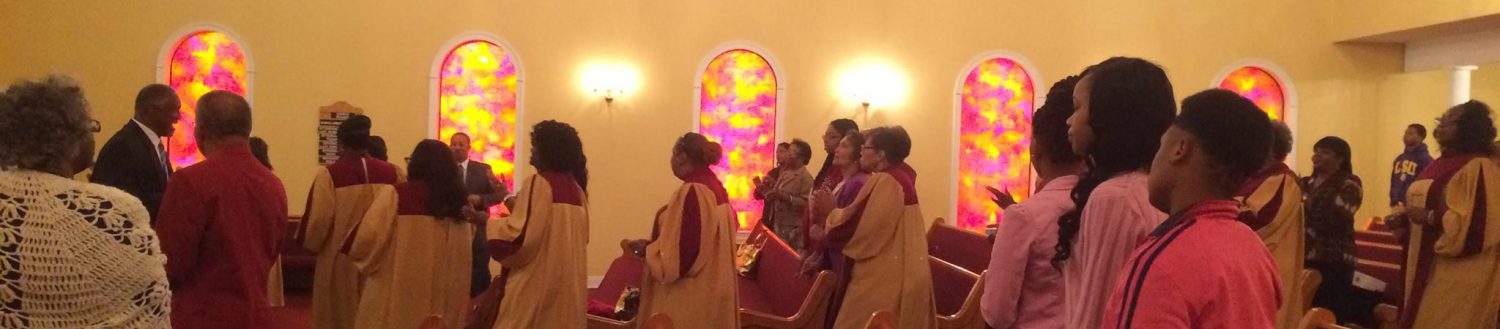
After writing several blogs, I thought it would be fun to check out the Pop South “wordle” to see the terms that I frequently use. Here’s what it looks like:

After writing several blogs, I thought it would be fun to check out the Pop South “wordle” to see the terms that I frequently use. Here’s what it looks like:
If you’re breathing, there’s a good chance you know that Charlotte, North Carolina, is hosting the Democratic National Convention (DNC). This is an exciting time for the Queen City as we play host to conventioneers, politicians, and journalists. There will also be a lot of kvetching over traffic and street closures, but I for one am very thrilled to see that The Daily Show with Jon Stewart will be setting up shop at Imaginon, home to the city’s Children’s Theatre and Library.
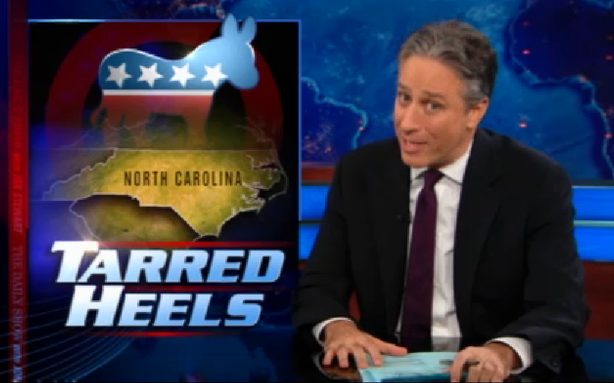
In fact, I’d really like to be on the show to discuss the media and its southern stereotypes. I’ve written about it before here on Pop South (See posts on DNC Announcement and the one on Martin Bashir over at MSNBC), and I’m certainly scouting out other journalistic blunders on this score, but right now I am waging a campaign to be a guest on the Daily Show to talk about the subject. And why not? The Daily Show has numerous reports that have been tagged “the South.” The earliest one, on Strom Thurmond, dates to 1999. And the most recent? On Chick fil A, of course. I suppose the region is a gift that keeps on giving, as seen in the report on “Tarred Heels” (below), which led Jon Stewart to conclude that North Carolina is the Democrat’s “South Carolina.” Ouch!
| The Daily Show with Jon Stewart | Mon – Thurs 11p / 10c | |||
| Tarred Heels | ||||
|
||||
So, Jon, if you’re listening, I’ve got a book on the topic of the South in popular culture, this here blog, and hell, I’ve even written an op-ed for the New York Times. I’m also a fan of the show, if that helps. And, I’d love to talk “the South” with you while you’re in Charlotte.
Pop South readers: Join me in my campaign and tweet to get @Sassyprof on the air. Tweet this message: Give @Sassyprof a guest slot to discuss the South and the media @TheDailyShow #CharlotteDNC
 As we get closer to the kickoff for the Democratic National Convention, I thought it would worthwhile to repost a blog I wrote in February 2011 when it was first announced that Charlotte, North Carolina, would host the convention. Look for more DNC-related posts in the near future. Here’s the link to that post:
The DNC and the National Media—Bringing Southern Stereotypes to a City Near You.
The Learning Channel (TLC) recently announced the upcoming premiere of its new series “Here Comes Honey Boo Boo,” featuring Alana, the “breakout star” of “Toddlers & Tiaras.” Alana, as some viewers will recall, is the little pageant queen whose mother June gives her “go-go juice,” a mixture of Mountain Dew and Red Bull, to give her that special energy she needs to perform. Doing so brought June severe criticism, but that hasn’t stopped her from placing her entire family in front of the camera for what TLC describes as “the unapologetically outrageous family life of the Honey Boo Boo clan,” from rural Georgia. Here’s a taste of what’s to come:
A quick read of the TLC press release lets me know that the most unapologetic people involved with this series, debuting in August, are the producers at Los Angeles-based Authentic Entertainment who developed the show, and The Learning Channel, its distributor. TLC, owned by Discovery Communications, claims it “celebrates extraordinary people.” So, the company is “celebrating” Alana and her family, is it?
What the folks at TLC are celebrating in this tragic production is that a ripe plum for exploitation fell right into their laps. It has all the elements of the depraved South, which production companies like Authentic Entertainment create for public consumption and profit. Rural Georgia? Check. Rednecks? Check. Do they roll around in the mud? Check. Are there people with nicknames (besides “Honey Boo Boo,” there’s “Sugar Bear,” “Pumpkin,” “Chickadee,” and “Chubb”)? Check, check, check, and check.
The kicker is this line in the press release, which says as much about the producers as it does the family: “When she’s not chasing after crowns, Alana’s with her family in rural Georgia doing what her family does best: four-wheeling through mud pits and picking up road kill for the family cookout.” Really, this is what they do best? And how about Authentic Entertainment and TLC?
“Here Comes Honey Boo Boo” is an unabashedly shameless series that scrapes the bottom of the reality television barrel, and it is unsurprising that the rural South is used to make it happen. Videos that parody this little girl and her mother already populate YouTube, an indication that the show may do well for TLC. Yet those parodies suggest something worse going on here, as they predict that Alana grows up to be a pathetic, drug-addicted adult. One can’t help but find a kernel of truth in this, and she may well have TLC to thank. I am not suggesting that Alana’s mother June get a pass for exploiting her child, but neither should TLC or its partner in crime, Authentic Entertainment.
Several of you followed my posts about the ad campaign for Glory Foods in which a woman named Shirley appeared in commercials and on the company website as a mammy-like character coming in to save the day in a white woman’s kitchen. Since that time, the ad campaign developed by the Brandon Agency of South Carolina has proven to be an epic fail–the television ads have been withdrawn and Shirley no longer walks across the company website with that “Lawd, honey” kind of persona that takes you back, WAY BACK, to the Aunt Jemima of old.
Shirley has returned, though, but now in a toned-down version of her former self. Instead of rushing in to help the white woman as she did in the original commercials, Shirley is actually demonstrating recipes in her own kitchen! The production levels of these videos, which are not commercials, suggest that they are clearly done on a smaller budget. This is too bad, because now Shirley is a much more respectable personality. Why didn’t the Brandon Agency (whose entire leadership team is white) show her that respect to begin with? I am left to wonder if it has something to do with the fact that McCall Farms (which now owns Glory Foods) and the Brandon Agency, who represents the company, are both located in South Carolina–probably the least progressive state in the Union when it comes to race. Let’s give them the benefit of a doubt and say that it is unfair to stamp them with the “they’re from South Carolina” stereotype. Then I’m still left to wonder, why? And, why not develop new commercials and give Shirley a second chance, but this time as the respectable woman she is meant to be?
Here’s the new Shirley:
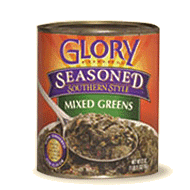
Recently, I wrote about the poorly-conceived marketing campaign for Glory Foods by The Brandon Agency (see: Black Domestic in a Can), a campaign that introduced a new generation to the stereotypical “black woman as mammy,” and reminds us of the Aunt Jemima of old. If this weren’t bad enough, the campaign also works as a critique of white women’s abilities in the kitchen. Miss White Lady, in one Glory Foods commercial, is a frustrated failure until a black woman (known as “Shirley” in radio ads and on the company’s website) shows up to save her in time to impress dinner guests. In another commercial, Miss White Lady also fails to satisfy her bratty children. And once again, she must be saved by the modern day mammy.
Does any of this sound familiar? It should. Fans of The Help will recognize in Shirley two different characters from the book. In one commercial, Shirley is essentially Minnie who rescues the bumbling, naive, and helpless character Celia Foote who cannot cook to save her life. In the second commercial, Shirley is something of a mix between Minnie and Abilene. She’s sassy like Minnie, but like Abilene she also fills the role of surrogate parent–taking charge and getting the children to “eat their vegetables.” Clearly excited about this campaign, Dan Charna, vice president of operations for Glory Foods is quoted as saying, “We hope everyone will invite Shirley into their kitchens via Glory Foods products.” (See, The Businesses Journal, April 11, 2012)
Thank goodness Dan Charna didn’t get his wish. The television campaign for Glory Foods, while it fails to understand the complex history of mammy in the kitchen, also insults white women by suggesting that they can’t cook and need help with their children. As one woman of color suggested in a discussion of these ads on Facebook, “It serves nobody to depict a ‘hapless white woman in the kitchen’ nor a ‘buxom black cook in the kitchen.’ It’s demeaning not only to each race but to women in general.” And from another woman of color, “There are [many] other ways you can sell Glory Foods without the maid/Jemima/mammy aspect. And I fail to believe that only white women are helpless when it comes to soul food.”
So, in sum, the campaign strikes a nerve on issues of both race and gender. And that’s too bad, because if Glory Foods makes a good product–and I have no reason to believe it doesn’t–then why resort to southern stereotypes of both black and white women?
The Latest: Since posting and tweeting about this ad campaign, the Brandon Agency has pulled the ads from television and YouTube, and “Shirley” no longer walks out onto the Glory Foods website to introduce herself. So, what does this mean? Neither the agency nor the company were able to “see” what I and others saw before rolling out this new campaign, and seem caught off guard by the criticism. To its credit, the agency is reassessing the campaign. So, we shall see.
IMPORTANT UPDATE: After tweeting Scott Brandon of the Brandon Agency about these offensive commercials, they have been removed from YouTube. Coincidence? I think Pop South as well as viewer comments must have gotten their attention. (4/19/2012)
I wonder if you have seen these commercials by Glory Foods? It’s a company out of Columbus, Ohio, that specializes in canned goods they call “Southern food with a soulful heritage.” In one, there’s a frustrated white housewife in the kitchen and she’s having trouble in preparing dinner for her guests. What’s she going to do? Not to worry, a black woman (known as “Shirley” on the company’s website) busts through the door to help! As she prepares the food, a can of Glory collard greens, the white woman can relax. Not only does she have a black woman working it out for her in her kitchen, she’s got food that already has its southern seasoning. Even better, Shirley plans to stay hidden in the kitchen as she shouts to the white woman “Now get on out there, and take all the Glory!”
I thought this was an unfortunate commercial, until I saw a second and related commercial. It’s the same white woman, although this time her two children are involved, shouting and banging their forks and knives on the table. Who’s going to rescue Miss White Lady now? You guessed it, the canned black domestic.* She’s going to set those mouthy children straight, make sure they eat their vegetables, and guess who gets to take “all the glory?” Miss White Lady.
I wonder what is going on here, because it looks like Glory Foods is taking its cues from The Help. But this isn’t 1960s Jackson, Mississippi. I went to the website of the company and that’s where I discovered that this is a black-owned business with an African American CEO who has an MBA from Duke University. So what gives?
Who is the company trying to reach with these commercials except, perhaps, all those white women who read The Help and are looking to recapture some of that for themselves? It’s certainly an interesting marketing ploy. Perhaps that is the point. And guess what?
The Brandon Agency, a South Carolina-based advertising agency with offices in Myrtle Beach, Charleston, and even Charlotte, North Carolina are behind the TV commercials. The agency was hired by Glory Foods back in February, which explains why these commercials have recently appeared in Charlotte. Take a look at the agency’s website and you’ll find something very interesting–the entire leadership team is white. That’s right. White “originalists” (the term the agency uses to describe company leaders and probably found in the bottom of a cocktail glass) from South Carolina came up with the Glory Food campaign featuring a modern-day Aunt Jemima.
However, this shouldn’t let Glory Foods off the hook. If this company were run by whites we’d be all over it with this analogy to The Help, which is why I don’t understand why Glory Foods and The Brandon Agency aren’t being called out for perpetuating this particular southern stereotype.
Maybe not enough people have seen these commercials or realize the underlying assumption (or history) of mammy in the kitchen. If they had, they’d be as concerned about this image of black women as I am.
Oh, for goodness sake! The Republican candidates for president went South and the next thing you know Mitt Romney touted “cheesy grits” and practiced saying “ya’ll,” and Rick Santorum adopted a hick accent and told people “I got kin here in Mississippi. I’m not sure. . . (don’t say “what I think about it!”). . .I’m very proud of it.” Shew! That was a close one.
I think that Kathleen Parker hit the nail on the head in her opinion piece in the Washington Post that southerners deserve better from their candidates. The one thing that she missed, however, is that Santorum, Romney, and even Newt Gingrich aren’t speaking to black southerners (or Latinos who represent the fasting growing population in the South) AT ALL.
What made it worse, for me at least, was how MSNBC covered the Republican campaigns in Mississippi and Alabama–particularly Martin Bashir and company–as they chuckled their way through a discussion of the candidates. Believe me, there is a lot to chuckle about when you hear the gems that fall from Romney’s mouth, but that shouldn’t let Bashir off the hook. His show began with the banjo theme song from Deliverance followed by his opening statement “Oh, my goodness, it is a deep fried primary day down in Dixie.” Really? Hush yo’ mouth! And then, between the graphic about Good Ol’ Boys (with the faces of Romney, Santorum, and Gingrich superimposed over a former Dukes of Hazzard logo), describing the Deep South as the “Cracker Barrel circuit” and then pondering what will happen “down in Faulkner country,” Bashir did as much to perpetuate an image of the South as moonshine-swilling, varmint-eating, backward region as did the candidates themselves. In sum, the national media is often no better than the candidates themselves in understanding the complexities of the South and the people who live here.
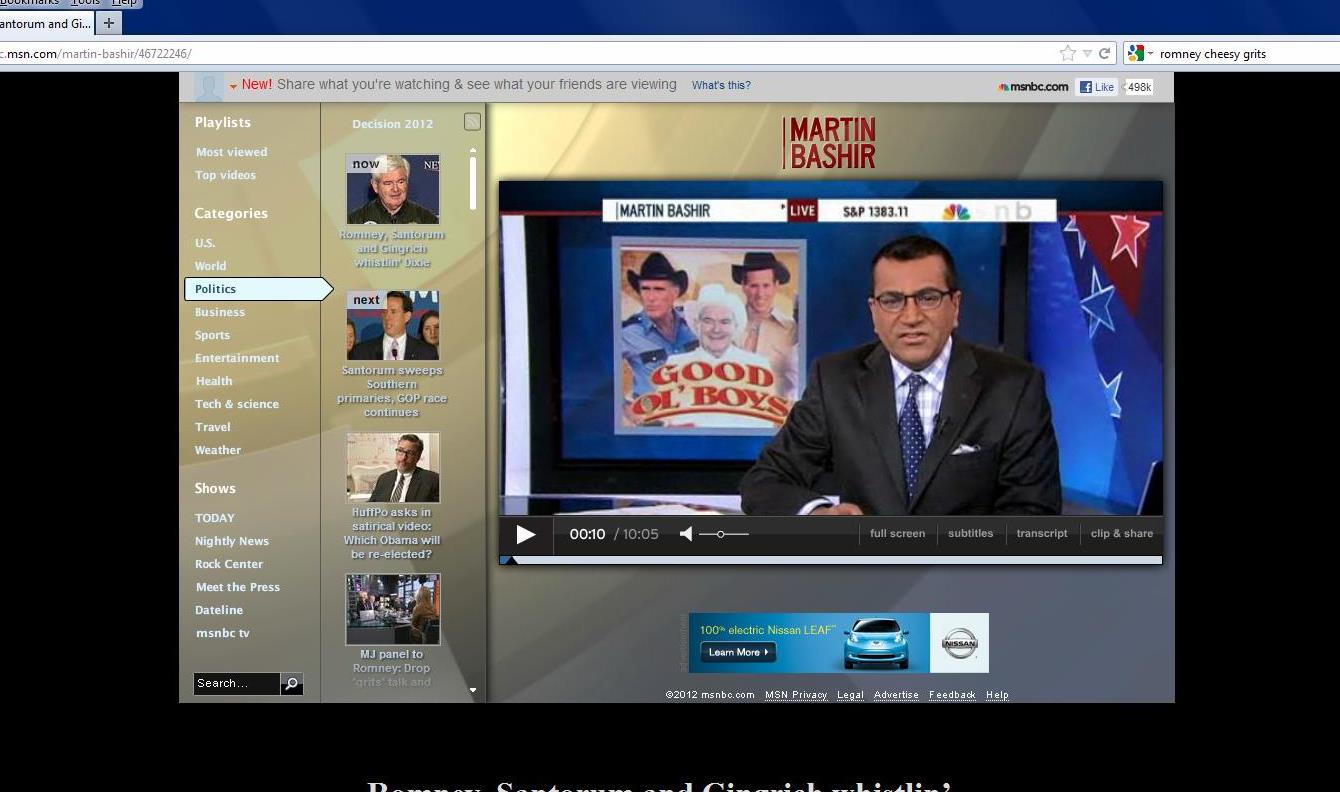
And this is what we are in for people, when the Democratic National Convention comes to Charlotte. Because the media pundits, who are supposed to be “informed,” will be looking for what makes this a southern city, and will likely miss what makes it as American as apple pie.
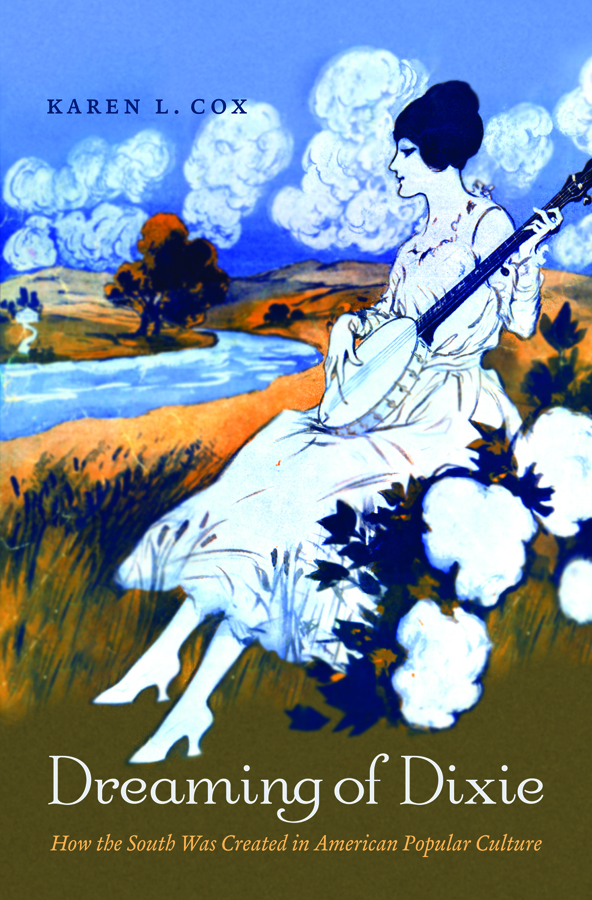 The Center for The Study of the New South will convene a panel discussion of Dreaming of Dixie: How the South Was Created in American Popular Culture, by Dr. Karen Cox, on Tuesday, February 21, 2012 at 3:30 in the Halton Reading Room, in the J. Murrey Atkins Library.
Participants will include David Goldfield (history), Richard Leeman (communication studies), Debra Smith (Africana Studies), and Mary Newsom (Urban and Regional Affairs). Sonya Ramsey (History) will serve as moderator.
This campus event will be the precursor to the Center for the Study of the New South’s annual lecture, on Tuesday, March 13, at the Levine Museum of the New South. This year’s distinguished speaker will be Dr. Cox.
As I’ve written about before, I found the “history” reflected in the film “The Help” to be problematic on many levels. I agreed with the Association of Black Women Historians in their criticism of the film’s message about black women in the era of Jim Crow. I also found Melissa Harris-Perry’s review of the film to be on point when she described it as “ahistorical and deeply troubling.” More recently, an alternate reading of “The Help” came in the form of this revised movie poster that bitingly states what many of us think about the film.
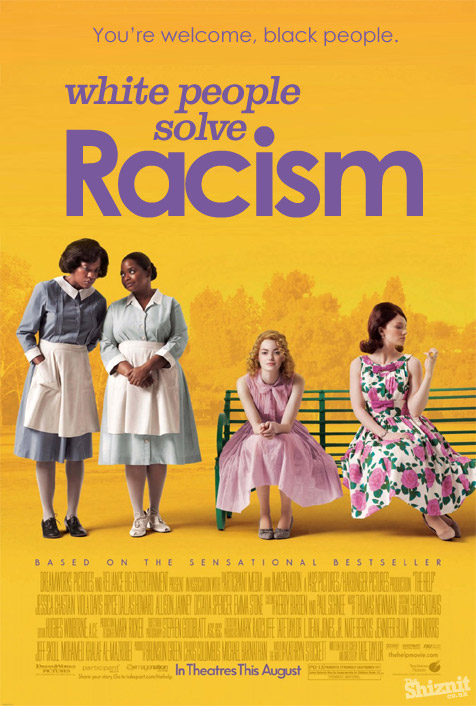
Then, what the hey is the NAACP thinking by nominating the film for Outstanding Motion Picture for one of its 2012 Image Awards? More importantly, why did they give Bryce Dallas Howard a nod for Outstanding Supporting Actress? Hilly? She’s not exactly a person of color (at least not in the tradition of these awards). As the Washington Post stated, this is one of the most awkward nominations the organization made. I can understand Viola Davis’ nomination for Outstanding Actress–even Melissa Harris-Perry recognized her talent. Still, I agree with her that it’s a shame that Davis will probably win for playing a maid. Hattie McDaniel, anyone?
As a historian, I often find myself combating popular media’s misrepresentations of the past in the classroom. However, it is often an uphill battle and the success of films like “The Help,” make it even more difficult. So, like my cohorts in the profession, I plod along and try to educate my students by having them read some honest-to-goodness history. I only wish filmmakers would do the same. It’s not as if the historical truth doesn’t make for good drama.
 Pop South