I’m writing to you from “the most Southern place on earth,” the state of Mississippi in the midst of the cotton picking season. I am sleeping in a house that was built 160 years ago, looking out a window at an equally old slave quarter/outside kitchen. I’ve waited three weeks to say something about the “Thug Kitchen,” debacle but now I feel I have the spiritual grounding to say what I need to say. As my hero August Wilson once said, “I stand myself and my art squarely on the self-defining ground of the slave quarters, and find the ground to be hallowed and made fertile by the blood and bones of the men and women who can be described as warriors on the cultural battlefield that affirmed their self-worth.” It’s time to get real about Thug Kitchen…
Pop South welcomes this post by Joshua Rothman, professor of history at the University of Alabama.
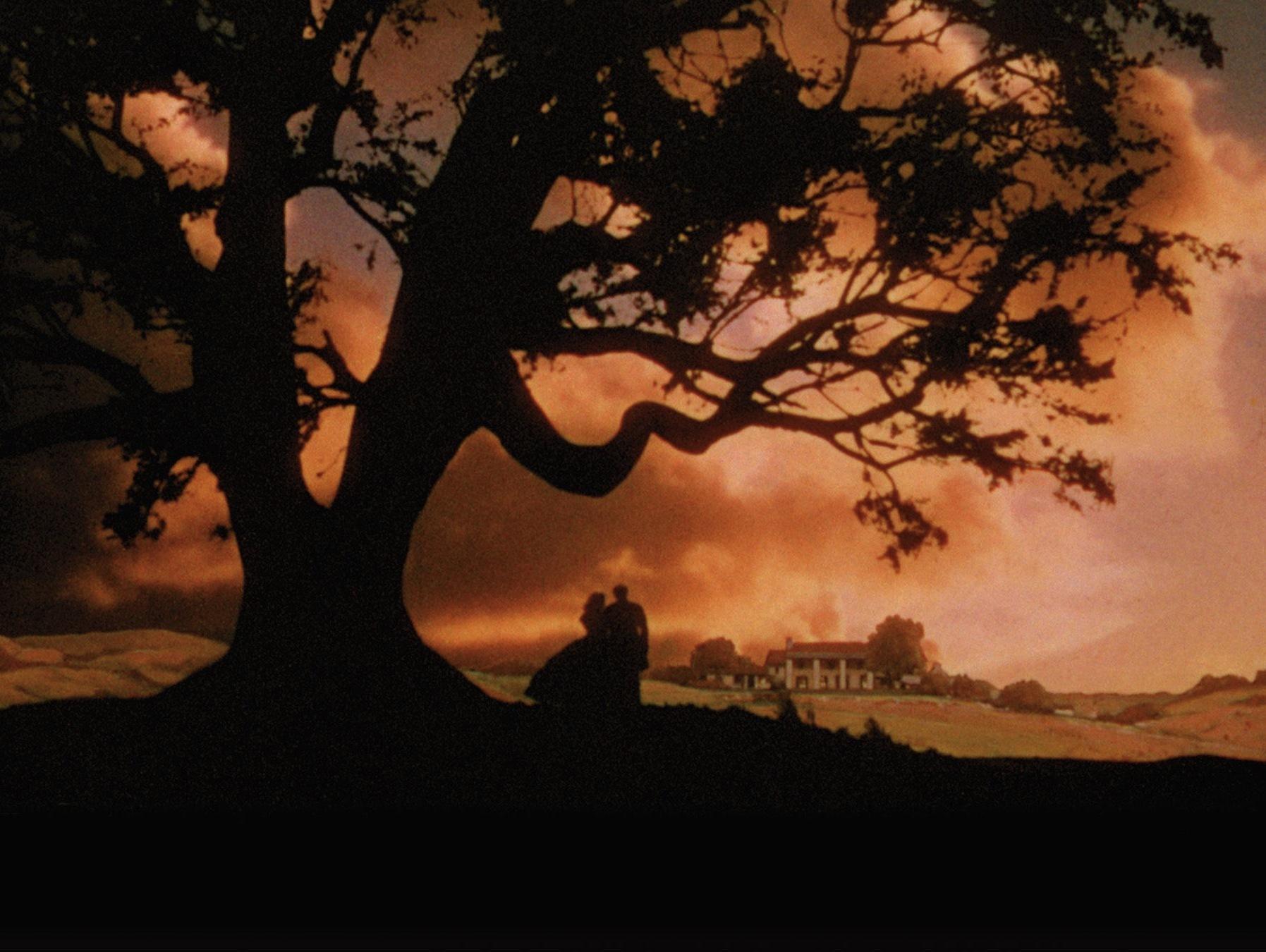
Still shot from Gone with the Wind.
Although I feel very fortunate to have a job where I actually get paid to teach courses on the American South, slavery, and memory to college students, there is one thing about being a professor of southern history that gets more grating every time I do it. Roughly once a year, I make myself (and my students) watch Gone with the Wind (GWTW). I could assign the book, of course, but the film really is the elephant in the room where American popular cultural memories of slavery reside.
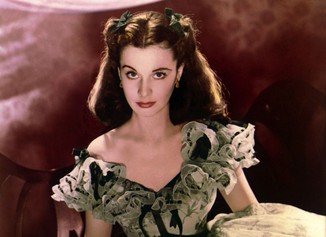
Even now, seventy-five years after its release in 1939, the images of the intrepid belle Scarlett O’Hara, the embattled and torched city of Atlanta, the sympathetic scoundrel Rhett Butler, and the heartless Yankee invaders form the core of how a significant number of Americans, and particularly white Americans, imagine the South to have looked and operated during the era of the Civil War. And in my more generous moments, I concede that it’s not hard to understand why.
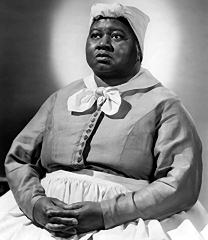
Hattie McDaniel as “Mammy” in GWTW.
The film is sweeping and epic in its scope, drenched in color, and filled with so many iconic lines of dialog, characters, and screenshots that after a while it simply washes over you. It becomes beautiful, seductive and, superficially at least, nearly immune to critical engagement. There’s just one problem, of course. The film is racist as hell. The legendary performances of Hattie McDaniel and Butterfly McQueen notwithstanding, a clear-eyed viewer recognizes GWTW as a fantastical reading of the lives of the richest people in the antebellum South that one can only believe and fall in love with by denying how the real life O’Haras collectively subjected millions of black people to cruel violence and systematic exploitation to make their lives possible.
Fiddle-dee-dee indeed.
Blake Lively
Which—and here I’m making a transition that I never thought I would make and did not actually think was possible—brings me to Blake Lively, a 27 year-old actress. I am uncertain of whether I ought to be proud or embarrassed to admit that before the other day I was not entirely sure who or what a Blake Lively was. Apparently she is in some television shows and movies that I have never seen, and she has parlayed that into running a “lifestyle” website called Preserve whose goals are things like “support[ing] the America we’ve always known, and the one we haven’t yet met.” It’s a site, in other words, that sells $80 t-shirts, $45 jars of sugar, and $325 floral teepees for children, all of which are “curated” for the consumer who doesn’t have enough overpriced and precious things in his or her life. It parodies itself, really, and is usually easy to ignore.
But this fall, Preserve proudly brings you the “Allure of Antebellum,” a fashion collection inspired by the “southern charm” and the “authenticity” of the “Southern belle.” These were the women, the website observes, who possessed “inherent social distinction [that] set the standards for style and appearance” and “epitomized Southern hospitality with a cultivation of beauty and grace, but even more with a captivating and magnetic sensibility.” Want a piece of that? Well, then, “embrace the season and the magic below the Mason-Dixon with styles as theatric as a Dixie drawl.”
The Allure of Antebellum. Photo credit: preserve.us
The problem here isn’t the clothes. Indeed, how exactly stiletto heels, triangular earrings that look strikingly like the Star Trek insignia, and a leopard print skirt evoke belles or the antebellum South is a complete mystery, though the site claims it has something to do with “artful layering,” and I regret to inform you that that skirt is currently sold out. The problem is not even necessarily that Preserve proffers fashion purportedly inspired by a historical ruling class that sat atop its world by preying upon and slowly draining the life out of those they deemed inferiors, as arguably many fashions across time and space owe themselves to similar inspirations.
The problem is that at our current historical moment, the failures of the United States to reckon effectively with its particular legacy of slavery, and its seeming determination to perpetuate elements of that legacy in its public policy a century and a half after slavery’s demise, as evidenced most alarmingly in our criminal justice system, are glaringly on display. To glom onto that legacy culturally and materially, and to sell it back to American consumers—not merely with a total lack of self-awareness but as an aspirational virtue—may be a longstanding tradition in its own right.
But it is more than in bad taste. It’s rubbing it in.
Historical sensibility does not seem to be the strong suit of Preserve, and I would venture that whoever conceived the “Allure of Antebellum” campaign and wrote its insipid ad copy had no malicious intent. But even casual ignorance and unintentional callousness deserve to be called out. It’s long past time to leave Scarlett O’Hara behind.
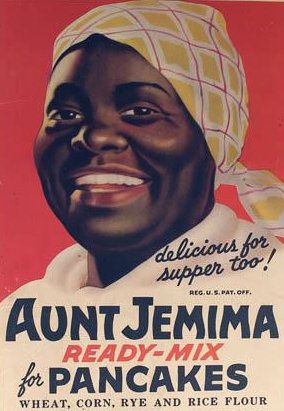
One of the most iconic advertising images of the twentieth century is Aunt Jemima, and recently the heirs of Nancy Green and Anna Harrington, just two of the women whose portraits were used as the “face” of the brand, are suing Quaker Oats for $2 billion and future revenues, claiming that not only did Green and Harrington portray Aunt Jemima, they were influential in shaping the recipe. Attorneys for Quaker Oats are saying “hold on a minute,” Aunt Jemima might be the brand, but she was “never real.”
Yes and no.
The “biography” of Aunt Jemima was the creation of the J. Walter Thompson Agency based in New York. More specifically, it was the creation of James Webb Young, a native of Covington, Kentucky. According to internal documents of the agency, the story of Aunt Jemima was that she came from Louisiana. So, yes, the story is a creation.
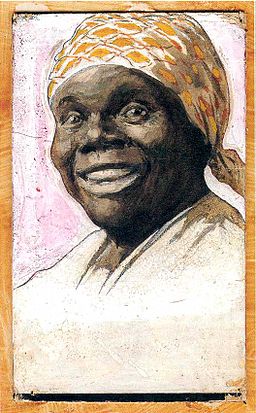
Portrait of Nancy Green by Arthur Burdette Frost.
Yet it is also true that Nancy Green, then a Chicago domestic, portrayed “Aunt Jemima” at the 1893 World’s Fair and made a career of doing so for nearly twenty years after the fair. More to the point, Green’s face was, in fact, the first image of Aunt Jemima to appear on the pancake box. The Thompson Agency hired Arthur Burdette Frost, better known for his illustrations of Uncle Remus tales, to paint Green’s portrait.
If she contributed to the recipe, we may never know, but we do know that white women often took their maids’ recipes and passed them off as their own, a tradition that even Paula Deen maintained when she co-opted recipes from Dora Charles, a black woman who had worked in Deen’s Savannah restaurant for years.
It is true that several black women portrayed Aunt Jemima at various state fairs during the early decades of the twentieth century. They greatly assisted the brand by lending an authenticity to the product as being a particularly “southern” recipe. This was in keeping with the character created by the Thompson Agency, whose story was that Aunt Jemima had been a slave and that she created the recipe that brought her such fame that it caused jealousy among other mammies.
But on radio, it was a different story. In a short program called Aunt Jemima Radio, which ran from 1930 to about 1942, she was portayed by several white women who were essentially doing a radio minstrel act. One of those women was Tess Gardella, an Italian-American actress from Wilkes-Barre, Pennsylvania. Gardella had played “Queenie” in the stage version of Show Boat, and she parlayed that experience into performing as Aunt Jemima on the radio. She also played Aunt Jemima in a film short. It is even on her gravestone.
Gardella’s gravestoneTess Gardella as Aunt Jemima, early 1930s
Tess Gardella is also interesting because she filed a lawsuit against NBC for allowing an “imposter to broadcast as ‘Aunt Jemima,’ when as a matter of fact she [Gardella] had been using that name for years on stage and air.” The actress further claimed that she had the right to use the name “by virtue of authority from the Quaker Oats Company.” She won her lawsuit and nearly $116,000 in damages.
The heirs of Nancy Green and Anna Harrington may have a difficult time in the courts because, unlike Gardella, they did not have a contract. Still, their lawsuit brings into sharp relief the ways American companies have profited by using images of African Americans to brand their products.
*Some of the ideas expressed in this post are drawn from Dreaming of Dixie: How the South was Created in American Popular Culture (UNC Press, 2011), 40-41.
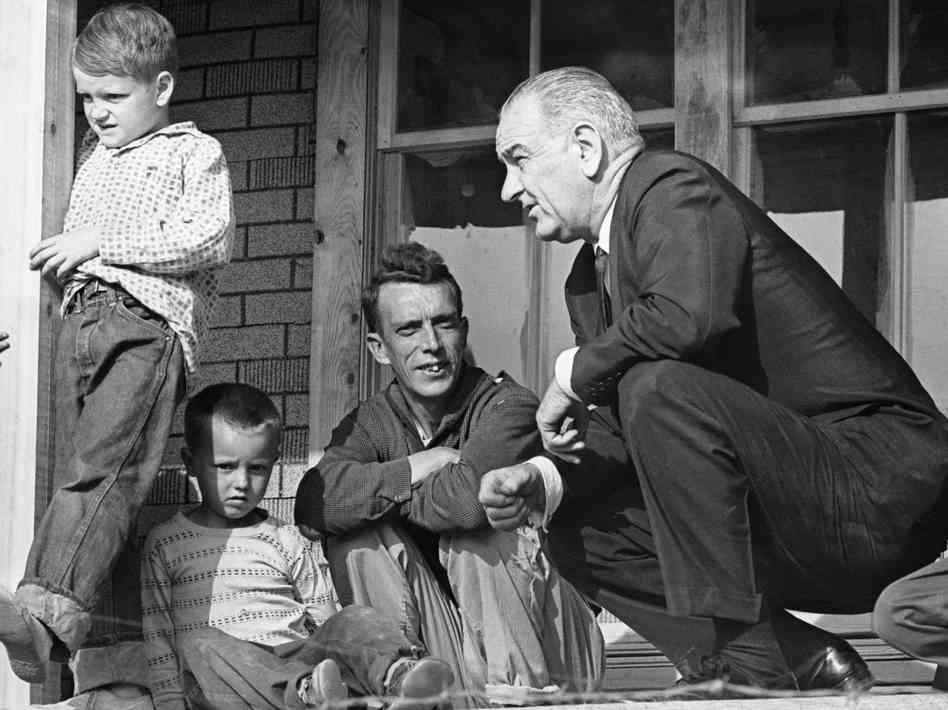
During his State of the Union address in January 1964, President Lyndon B. Johnson unveiled his plans to address the nation’s poverty, which then hovered at a rate of nineteen percent. The major legislative initiatives in what became known as the War on Poverty included the Food Stamp Act, the Social Security Act (which created Medicare and Medicaid), and the Economic Opportunity Act (which created Job Corps and the Volunteers in Service to America programs). This year marks the 50th anniversary of War on Poverty and, as with most historical anniversaries, both the media and scholars have weighed in with critiques and analyses of its legacy, often leading to statements about how we, as a nation, have lost the war on poverty.
But will any of it make a difference in how we view those in poverty? And will we continue to dismiss the real struggles of the men, women, and children living in poverty with biased and uninformed assumptions about their bad decisions, their alleged laziness, or their desire to live off the government?
Very often, stories and images of Appalachia are used to illustrate the nation’s poverty. This was the case in the 1960s and it’s still this way today. The New York Times does so with regularity. (See, for example, this article or this one.)
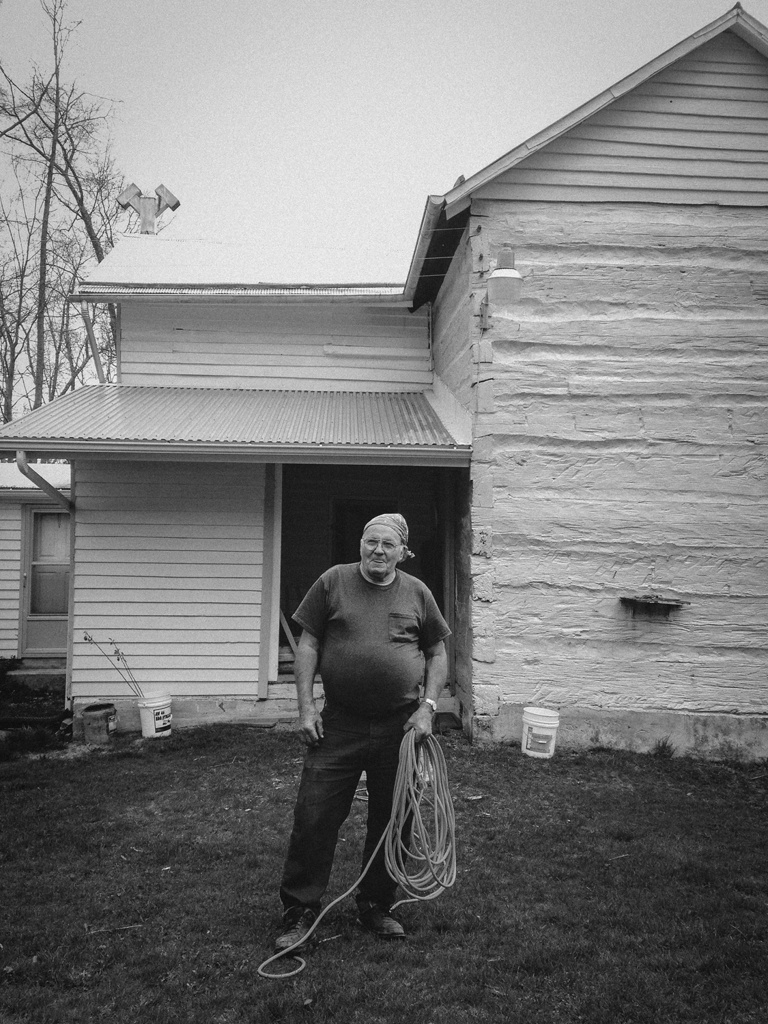
Leroy Rigman, Pendleton County, WV. Photo by Chris Jackson, April 26, 2014.
But hope abounds.
There’s a terrific documentary photography project called Looking at Appalachia that operates from a different set of assumptions. Poverty is not just about statistics, it’s about human beings. More than that, poverty is not always a choice. And as for Appalachia, despite its issues with poverty, it is also home. The images from this project reflect the beauty of the landscape and the people without succumbing to stereotype. And here is where art makes a difference.
“Many of the War on Poverty photographs, whether intentional or not, became a visual definition of Appalachia. These images have often drawn from the poorest areas and people to gain support for the intended cause, but unjustly came to represent the entirety of the region while simultaneously perpetuating stereotypes.”
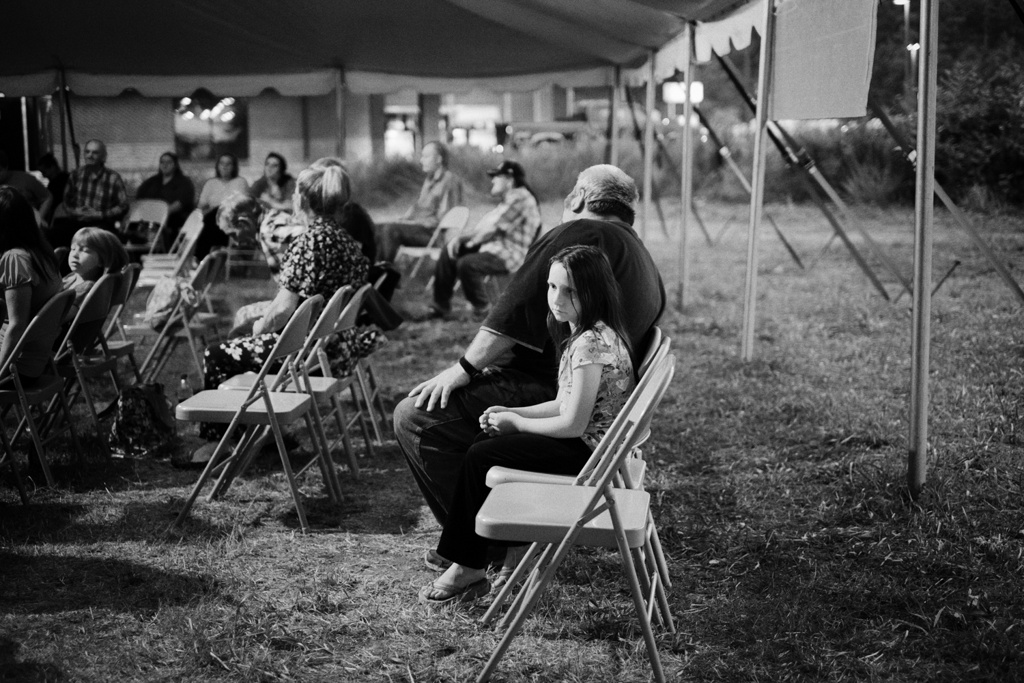
Tent revival in Pike County, KY. Photo by Roger May, July 19, 2014.
The project’s director, Roger May, is a documentary photographer from the Tug Valley region of southern West Virginia and eastern Kentucky. I asked Roger about how his project might help to dispel these stereotypes:
“Well, it’s important to realize that this project can’t or won’t single-handedly dispel decades worth of stacked myths and stereotypes. We all know how powerful images can be. We certainly didn’t get here overnight, so I don’t think we’ll reverse course that quickly either. What I like about the idea of this project is that it’s purpose isn’t to negate those pictures and ideas, but rather hopefully it’ll dilute them to a point that folks who both are, and aren’t, familiar with Appalachia will have another frame of reference for people and place. I see these photographs as added voices to a conversation that started well before the War on Poverty was declared and ones that’ll be around for a long while to come. We can’t ignore stereotypes and at the same time, we can’t deny elements of truth in them. What we can do is keep our hands to the plow of reminding folks that people are people no matter where you go. If we’re collectively willing to sit a while, listen, and try to understand on an individual level, we might surprise ourselves with what we find.”
Cullman County, Alabama. Photo by Tamara Reynolds, Jan. 4, 2014.
And what has been the impact of this project so far?
“The impact I’ve noticed from the project so far has been positive. Folks seem to be generally excited about Appalachia being shown in a different light, a more modern take on a place we all tend to see stuck in the past. Appalachia is one of those places that’s easy to romanticize and quite often the “othering” that happens there is, I think, somewhat self-induced. That’s really OK, but I think it’s important to pursue and embrace change, whatever that might look like. Traditions don’t have to be sacrificed for modernity, but let’s be truthful in our representations.”
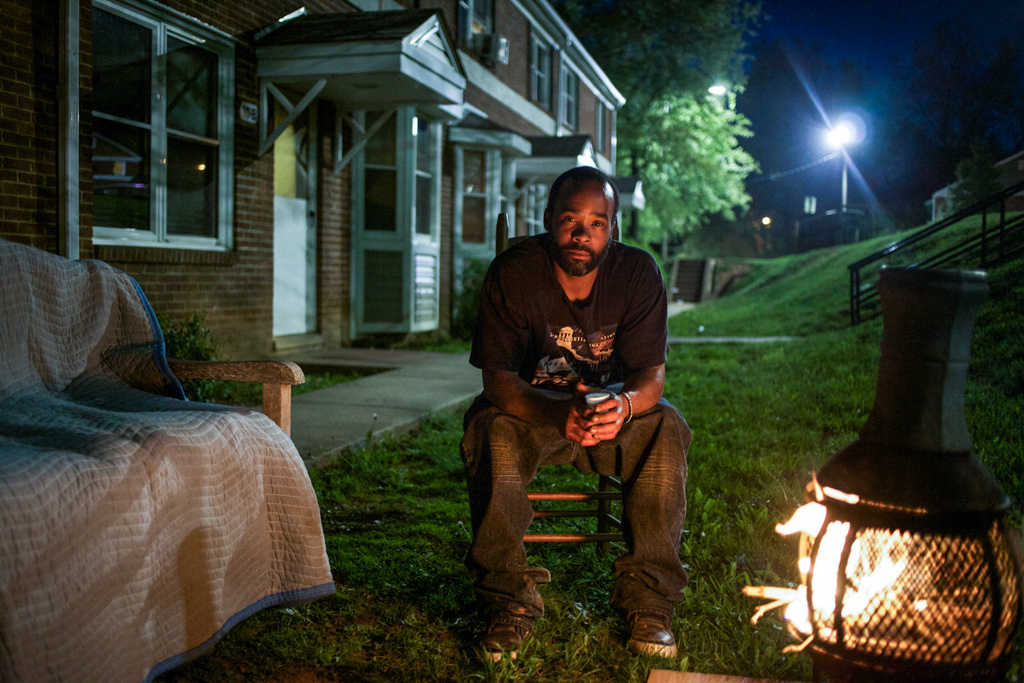
Carl Elijah Johnson, Asheville, NC. Photo by George Etheredge, May4, 2014.
Aside from the project’s website, what are your plans for extending the life of the project?
“In early 2015, I’ll be working with the project’s editorial and advisory boards to work through the online images and make selections for print. We’ll be coordinating with galleries, colleges, and universities throughout the Appalachian and outlying regions to host exhibitions of the work and would like to see it travel throughout 2015 and 2016. I’d love to see a companion catalog of work release next year as well, but funding will dictate most of this. At this point, we haven’t secured an grants or private donations. Moving forward, I plan to continue the project as long as there’s an interest and folks are willing to submit images. I’d also very much like to see a quarterly print publication evolve from this.”
Moundsville, Marshall County, WV. Photo by Rebecca Kiger, July 17, 2014
One final note from Roger: I’d just really like to take an opportunity to thank the folks who have helped so much with this project behind the scenes and who helped get it off the ground. Aaron Blum, Kate Fowler, Chris Fowler, Raymond Thompson Jr., Megan King, Susan Worsham, Pat Jarrett, John Edwin Mason, Pete Brook, Joy Salyers, Elaine McMillion Sheldon, Rob Amberg, Nic Persinger, and many, many others. This project couldn’t move forward without their help and support. And of course, all the photographers who have submitted work so far. This project belongs to everyone.
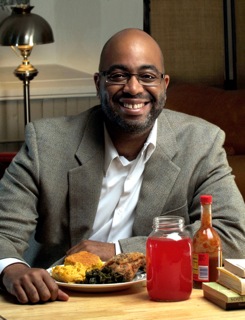
Q: You aim to explore “where Southern food ends and soul food begins.” What’s the difference between the two?
A: Inside the South, the distinctions between the two are so subtle that it almost seems meaningless. In my experience, black Southerners are just as quick to call soul food “home cooking” or “country cooking.” I found that the Southern diet, particularly after the Civil War, is demarcated more by class than race. In other words, blacks and whites of a similar socioeconomic background pretty much eat the same foods. That said, I find that soul food dishes tend to have more intensity than their counterparts in Southern cuisine. They’re sweeter, more highly spiced and tend to have a higher fat content—all the things that one would expect from a cuisine using a lot of bland starches and lesser cuts of meat. Then there are the differences in preparation. Soul food joints and home cooks tend to have more bone-in meat selections (neckbones, smothered chicken, and meaty soups) and hardcore offerings like chitlins.
Q: You’ve structured your book around the dishes that might be found in a typical soul food meal. Was it difficult to select what to include?
A: Surprisingly, it wasn’t that hard, especially after I did my national soul food tour. Once one gets out of the American South, the soul food offerings at restaurants are pretty uniform. I thought long and hard about okra. It’s such an iconic food item, but I just didn’t see it on many soul food menus in the North and West even though fried okra is popping up at many more mainstream restaurants as a standard appetizer. It’s been more challenging to tell people what makes up my representative meal. As much as I say that I endeavored to describe a general meal that a soul foodie might eat at any time and at any place in the world, they think I’m whacked because I didn’t include their family favorite. I’m sorry, but I just didn’t see a trail of smothered neckbones across the country.
Q: Who are two or three of the most important figures associated with soul food?
A: If you’re expecting me to name a famous chef or TV personality, it’s a no-go with soul food. There really isn’t a Julia Child for soul food. I’m tempted to say Edna Lewis, but she was adamant that her cooking was Southern and not soul food. There are some notable figures out of New Orleans like Leah Chase and Austin Leslie, but I think Creole cuisine is different than soul food. The only person who comes close to being a soul food icon is the recently departed Sylvia Woods of Sylvia’s Restaurant in Harlem. Thanks to her business savvy, New Yorkers and tourists from around the world have made her cooking synonymous with soul. Otherwise, soul food’s most important figures are the cooks who carried on culinary traditions by making Sunday dinner and holiday meals for their loved ones time and time again.
Q: Why are red drinks such an important component of a soul food meal?
A: Throughout our history, African Americans have made red drinks the beverage of choice for social occasions, especially big communal gatherings. There are some popular red drinks in West Africa such as bissap (known as hibiscus tea and agua de Jamaica in the U.S.), and some in the United States such as red lemonade and red soda pop. In present times, it’s hard to imagine a soul food meal without a red drink, whether it be a powdered drink, a punch, or a carbonated beverage. Walk into any soul food joint or fast food place with a primarily black clientele and you’re going to get offered a red drink. I know this is controversial, but I think that red Kool-Aid is soul food’s official drink.
Q: Are you optimistic about soul food’s future—both among home cooks and as a chef-driven cuisine?
A: I am optimistic! There’s so much interest in food now. I know a lot of people who are into watching cooking shows on television even though they will never actually cook. What’s gratifying is that more and more people are in search of and eager to explore bizarre foods, comfort foods, healthy foods, regional foods, unusual foods, and vintage foods. Soul food has all of those elements! I think this interest will move people to cooking instead of just watching TV and visiting a restaurant. The irony is that unless soul food’s stigma can be mitigated, culinary adventurers of all types may end up discovering more about what soul food has to offer than African Americans.
(Interview courtesy of Adrian Miller, author of Soul Food: The Surprising Story of an American Cuisine, One Plate at a Time, University of North Carolina Press, Fall 2013.)
During the 1970s, The Dukes of Hazzard was one of the most popular shows on American television, and while Bo and Luke Duke (played by John Schneider and Tom Wopat, respectively) were technically the stars of the show, the real star was their car. The 1969 orange Dodge Charger sped through the back roads of Georgia, leaping over hay bales, creeks, or other cars, nearly always getting “the boys” out of a jam. It was one of the most iconic vehicles ever to hit the small screen and its name was “the General Lee,” a nod to the most beloved of white Southern heroes, Robert E. Lee. And emblazoned on the roof was a large Confederate battle flag.
Well, no more.
In a new commercial for Autotrader.com, the “Duke boys” are back and so is their car. They are driving the hell out of that Dodge Charger to escape “the law,” but the car can’t seem to outrun these new police vehicles, so Luke pulls out his phone to search for a newer, faster, car on Autotrader.com.
But something is obviously missing. The “General Lee” has been stripped of its battle flag–at least the camera doesn’t allow you to see it. And the commercial lets us know that Autotrader ad execs also know that even while they wanted to use such an iconic car to advertise their business, that flag is a divisive symbol.
Who is their target audience for this commercial? According to an article on Bulldog Reporter, a website for public relations professionals, the commercial uses nostalgia to draw in people who, when they were kids, were tuned into The Dukes of Hazzard. I get that. They are also targeting consumers who like muscle cars. I get that, too. Yet, the article says nothing about the absence of the flag, which they’d just as soon not draw attention to.
In a separate Autotrader article, the writer tells the story of a how former NBA player, Jalen Rose, owned one of the many “General Lee” cars that exist. Rose, an African American, planned to sell the car at auction. As the article points out, he removed the flag “for obvious reasons.” It seems as though Autotrader doesn’t really want to discuss what those reasons are although, to save face, it does want you to know that at least one black man owned one of these cars.
So, we might think Autotrader was smart enough not to allow its brand to be tarnished by the battle flag, but has the company really fooled anyone?
Just as the car is associated with the television show, the battle flag is associated with the car–as well as having some unsavory historical ties to slavery and segregation. Fans of the show are unlikely to appreciate that the flag is hidden from view, while those who know its place in pop culture–and history–recognize that it’s gone missing.
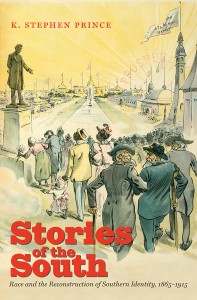
Pop South interviews Stephen Prince, Assistant Professor of History at the University of South Florida, about his new book Stories of the South: Race and the Reconstruction of Southern Identity, 1865-1915, published by UNC Press in April.
PS: The main title of your book is “Stories of the South.” Since this is a history book and not a book of literature, please tell readers of Pop South about the kind of stories your book examines.
I use the term “stories” fairly loosely. Though I do analyze literary texts, I find stories about the South in a variety of other places: congressional debates, newspaper editorials, travel narratives, speeches, sermons, visual art, popular theater, songs, promotional material, writings on the “race problem,” political cartoons, and scholarly treatises. I cast my net pretty wide in order to capture the range of sites at which people grappled with the nature of the South in the fifty years after the Civil War.
PS: The subtitle of your book is “Race and the Reconstruction of Southern Identity.” When you write about “southern identity” between the Civil War and World War I, specifically whose identity are you concerned with? Whites? Blacks? Men? Women?
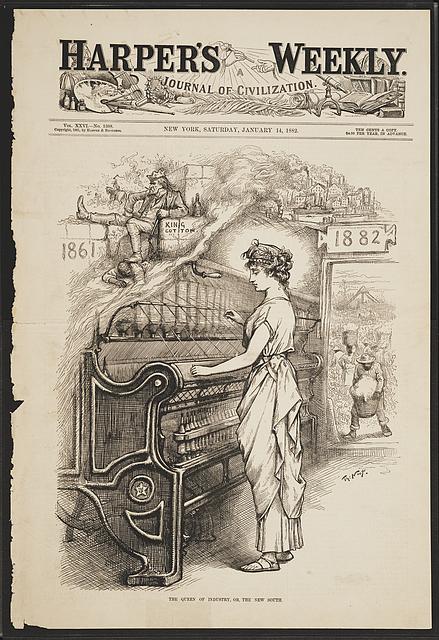
Thomas Nast’s illustration of the New South. Image courtesy of Library of Congress
The book starts from a fairly simple premise. In the aftermath of the Civil War, the meaning of the South – defined as a region, a people, a civilization – was an open question. “The South,” as it had been, had ceased to be. The question was what the region would become. Over the next fifty years, Americans – northern and southern, male and female, black and white – debated the nature of the South. I use these conversations to chart a course from the racial egalitarianism of Reconstruction to the nightmare of Jim Crow.
That said, I’m not particularly attuned to the ways that individual southerners understood their “southern-ness” on a private, personal level. I’m much more interested in popular, public discussions of the South. References to “the Southern Question” were extraordinarily common in the late 19th and early 20th centuries. Northerners played an important role in these discussions, before and after the oft-cited “end” of Reconstruction in 1877. I argue that the South was re-defined in conversation between the sections. The ability to define the South carried with it enormous political power. To tell the story of the South was to control the South.
PS: Your book relies on sources of popular culture as a way to better understand the region. What types of sources did you use and was there a consistent message among those sources regarding the American South?
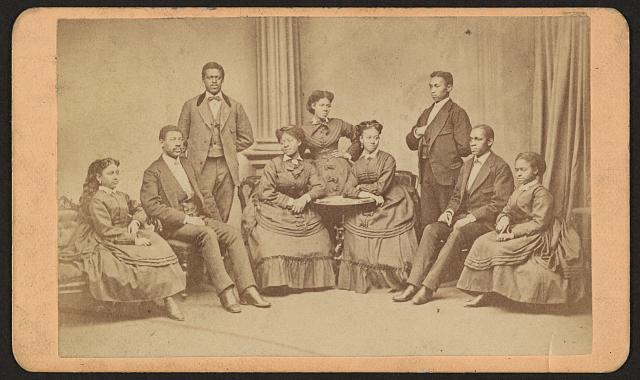
Fisk University Jubilee Singers, ca. 1871. Image courtesy of Library of Congress.
The message is definitely not consistent! Contestation and debate were the only constants. One of my goals was to bring cultural history to the study of the postwar U.S. South. Political and social history still dominate the literature on Reconstruction and its aftermath. Debates over the future of the South certainly occurred in the halls of Congress and on individual southern farms and plantations, but there was a much wider cultural universe in which the nature of the region was discussed. In order to understand the retreat from Reconstruction and the rise of Jim Crow, we need to pay attention to the larger cultural context in which political change occurred. Viewed from this perspective, a fantastic and phantasmagoric* pamphlet on the Ku Klux Klan is not just ephemera, it’s an important part of the cultural landscape in which power was won and contested. The same is true of the New South’s city boosting literature, Thomas Nelson Page’s plantation fiction, and the songs of the Fisk Jubilee Singers. Culture matters. Without understanding the stories that Americans told themselves about the South, we can’t understand the history of the South.
PS: One of your main arguments is that cultural production—particularly popular culture—is as important to understanding what shaped the South in the post-Civil War era as are political and economic changes. What role did popular culture play in shaping contemporary ideas about the South in the 19thc.?
Though I try to avoid simplistic cause-and-effect analysis, a large-scale change-over-time argument structures much of the book. In the first years of Reconstruction, northerners seized the power to re-imagine the South. By the 1880s, however, conservative white southerners had realized the significance of what we might call the cultural front in the war on Reconstruction. By the early twentieth century, northerners were largely content to defer to white southerners on matters relating to the South, particularly where race was involved. Throughout, African-Americans told their own tales of the South. In the process, they offered eloquent testimony to the power of culture and public opinion. Go read Frederick Douglass’s last speech on lynching or the cakewalk scene in Charles Chesnutt’s The Marrow of Tradition. As Douglass put it, “words are things.” The way that people described affairs in the South – the words they used, the stories they told – mattered deeply.
PS: Last, but not least, what about your newest research project might interest readers of Pop South?
Historian Stephen Prince
I’m now writing a book about the 1900 New Orleans riot, tentatively titled The Ballad of Robert Charles: Race, Violence, and Memory in the Jim Crow South. The riot has a place in all the big books on the rise of Jim Crow, but no one has attempted a full scholarly study since William Ivy Hair’s 1976 Carnival of Fury. The violence in New Orleans started when a black man named Robert Charles shot and killed several white police officers. Over the new few days, white New Orleanians took their revenge on the city’s African American residents, killing at least five and wounding dozens more. When the authorities finally located Charles, an enormous gunfight broke out. Trapped in a second story loft, Charles shot several more white people before he was killed. The riot quickly became a national story, spawning extensive newspaper coverage and becoming the subject of Ida B. Wells-Barnett’s pamphlet Mob Rule in New Orleans. Though white and black elites did their best to eradicate the memory of Robert Charles, evidence suggests that he lived on as something of a folk hero among working-class African Americans in New Orleans and beyond.
The book’s title – The Ballad of Robert Charles – comes from a 1938 interview that folklorist Alan Lomax recorded with jazz legend and New Orleans native Jelly Roll Morton. “They had a song out on Robert Charles,” Morton recalled. “I used to know the song, but I found it was best for me to forget it. And that I did, in order to go along with the world on the peaceful side.” The ballad of Robert Charles was too explosive to remember, too dangerous to sing. Following Morton’s lead, I hope my book will be much more than a story about Jim Crow New Orleans. It will also be an exploration of memory, forgetting, historical silences, and the power of the past.
It happened again last week. Another journalist took a swipe at my beloved Appalachia. Yet it’s difficult to stand tall against national media outlets like the New York Times. Even I know this. As someone who has published op-eds in the Times, I am very familiar with its impact.
Right now, Annie Lowery’s email box is probably filling up with reactions to her piece “What’s the Matter With Eastern Kentucky“. She’s also feeling the wrath of Appalachian writers decrying Lowery’s “urban condescension,” as the essayist and playwright Anne Shelby put it. Shelby lives in Clay County, Kentucky, the county that, according to Lowery, has the distinction of being dead last in the country for “quality of life.”
At least that’s case based on statistics drawn from metrics a Times “data-analysis venture” calculated. I can get down with statistics. I can even agree with them. But where’s the broader context and where are the people in this story?
Shelby is spot on when she calls Lowery out for “urban condescension,” because that’s what it amounts to. Lowery and other journalists often fall into the trap of treating urban living as “better” than rural living. There’s also some regional condescension going on as well when she refers to the Deep South and Appalachia as “the smudge of the country between New Orleans and Pittsburgh.” The “smudge?” Really?
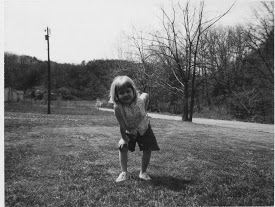
Pre-blogging days in the country just outside of Huntington, WV, ca. 1966.
We also get a lot of rhetoric about where the folks from Eastern Kentucky should move if they want a better quality of life, but what’s missing is an understanding that, despite its poverty, Appalachia is their home. I have lived in the South all of my life. I was born in West Virginia and when asked I will always claim it as where I’m from.
Sadly, many people have left the region to pursue jobs or an education elsewhere, so Lowery’s point about declining populations in Appalachia is well taken. And yet the stereotypes implicit in Lowery’s piece, and others that take patronizing aim at the region’s poverty, do absolutely nothing to better our understanding of the people or the place.
Thankfully, there are writers like Anne Shelby and Silas House who speak the truth about Appalachia. And, then there’s this wonderful guy named Roger May, a photographer who is directing a project called “Looking at Appalachia” that takes direct aim at the negative ways that the War on Poverty has visually defined the region for more than two generations.
He knows, and I know, there is beauty in those hills and hollers, and it includes the people who live there. And that’s no statistic.
Followers of Pop South should check out this blog on music and pop culture called “The Immortal Jukebox.” Here’s a post on a fellow West Virginian, Bill Withers.
‘A good man out of the treasure of his heart bringeth forth good things’ (Matthew)
‘Lean on me when you’re not strong and I’ll help you to carry on’ (BIll Withers)
Bill Withers stuttered painfully as a boy and young man which meant he didn’t say much. What he did do was listen carefully and thoughtfully to the people around him in his family and his community. Bill was born and brought up in poor blue collar West Virginia mining communities where every day was a struggle with the constant background threat of injury and disaster.
In such communities loyalty, mutual reliance and co-operation were not painted storybook virtues but living realities. People worked with and for each other so that everyones burden would be a little lighter and thus more bearable. Bill was and is a proud working man who knows the labourer…
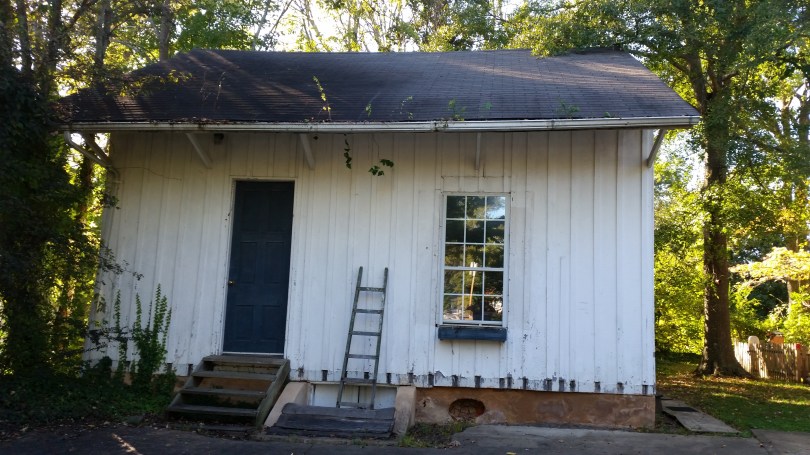

 Hugh Craft, Big House, 1851
  Slave Cabin/Kitchen House, Hugh Craft House, 1851











 Pop South