Snake Salvation: Praise the Lord and Pass the Snakes

Snakes alive.  We’ve got us another southern-based reality television show.  “Snake Salvation” focuses on a small Pentecostal sect in Appalachia that takes the Gospel of Mark 16:18 to heart: “They shall take up serpents; and if they drink any deadly thing, it shall not hurt them; they shall lay hands on the sick, and they shall recover.”  Essentially, they prove their faith in God by handling poisonous snakes–mostly rattlers–and if they’re bitten, they believe in the healing power of their Lord to keep them alive.  They also believe that if they don’t handle snakes, well, hello Hell!
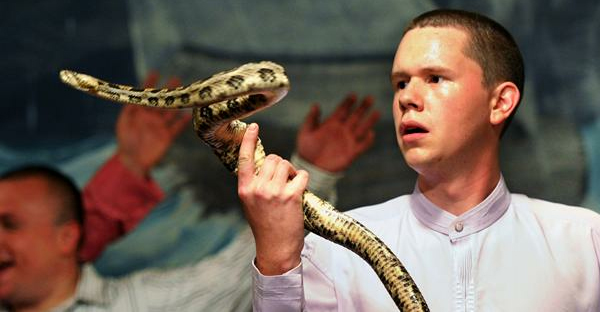
Pastor Andrew Hamblin is one among a new generation of snake-handling ministers.

The show, which premieres on National Geographic on September 10th, features Jamie Coots (did they have to choose a man named “Coots?”) of Full Gospel Tabernacle in Jesus Name church of Middlesboro, Ky. and Andrew Hamblin of Tabernacle Church of God in LaFollette, Tenn.  According to the show’s description, “Hunting the surrounding mountains for deadly serpents and maintaining their church’s snake collection is a way of life for both men.” Not many churches can say they have a snake collection.

The earliest years of my life, just to age 6, were spent at the Rock of Ages Church in Huntington, West Virginia.  When I watch the video below, I recognize a similar type of preaching and inflection among the snake-handlers that I witnessed as a young child. They minister to their flock using a singsong kind of expression. “I belieeeeve-ha. In Jesus Chriiiiist-ha.” That sort of thing.  At Rock of Ages, I didn’t have to fear snakes, just that giant portrait of Jesus wearing a thorny crown with blood dribbling down his forehead. THAT terrified me.

I do remember, though, my Maw Maw Cox telling me about some snake handlers that showed up at the funeral home where my Uncle Roger worked. As it turns out, one of the members of the snake-handling church had died and when it came time for visitation the church members came to pay their respects, but they weren’t alone. They brought their snakes with them and asked to slip a few into the coffin.  This caused the staff at the funeral home to scatter, and eventually, the police arrived and forced them to take the snakes away.

Rev. Coots and Rev.Hamblin hope that the show will allow the public to see that their lives revolve around more than hunting and handling snakes, though I’m not so sure viewers will notice much more.

I’m going to try to reserve judgement until I’ve seen the show, but I can’t help but wonder about this latest attempt to examine the white underbelly of the South. And I emphasize white, because nearly all southern-based reality shows focus on whites who are generally, from the lower class or outright poor.  In fact, Andrew Hamblin falls into this category. According to an article in the Christian Posthe is struggling to support his wife and five children and is doing the show to attract more followers.  It will be interesting to see if the show takes off or simply slithers away.

(Note: If people really want to understand this particular religious group and their beliefs in a serious way, I’d recommend reading Dennis Covington’s book, Salvation on Sand Mountain: Snake Handling and Redemption in Southern Appalachia.)
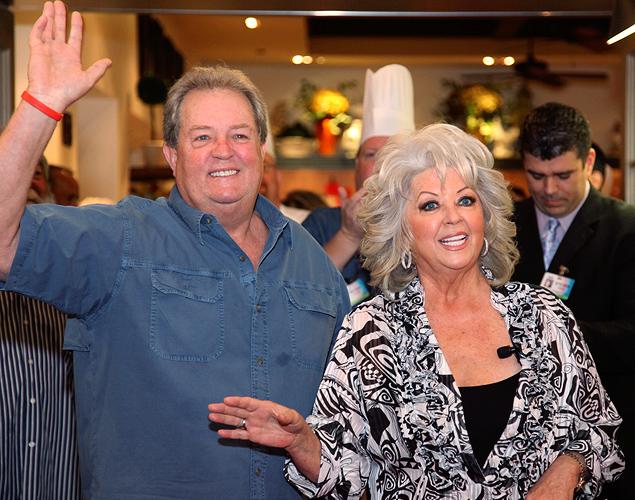
Paula Deen, Uncle Bubba, and the Silence Over Sexual Harassment

Paula Deen with her brother Bubba Hiers, co-owners of Uncle Bubba's Oyster House.
Paula Deen with her brother Bubba Hiers, co-owners of Uncle Bubba’s Oyster House.

The Paula Deen fiasco that has unraveled over the past several days has me thinking about her brother Earl “Bubba” Hiers.  Specifically, where the hell is Uncle Bubba?  Because if you take a look at the original lawsuit, he is the one who needs his ass kicked all the way to Tybee Island for the hostile work environment created at the restaurant that carries his name.

To be clear, I still believe Paula Deen needs to be held accountable.  And for sure, she needs to offer a more sincere apology–one that doesn’t suggest that it’s about someone who wants what she has.  (See the the analysis of her Today Show interview.)  That may be true, but it doesn’t let Deen off the hook for her own racial missteps.

What boggles my mind, though, is the extent to which Paula Deen goes to cover for the men in her life, especially her brother.

In the lawsuit, we learn that her companies and her restaurant Lady & Sons is essentially a “Boys Club.”  And the boys, it turns out, behave badly.  Especially Uncle Bubba.

The lawsuit, moreover, isn’t just about a work environment damaged by racial slurs.  It’s very much about the ways that sexual harassment created a hostile work environment for women.

First, it is abundantly clear from the allegations that Uncle Bubba is the primary culprit for making racial slurs.  Yet what is also clear is that he regularly engaged in inappropriate workplace behavior and often used foul language when speaking to women or about women.

According to the lawsuit:

–Karl Schumacher, who is in charge of compensation for employees allegedly said that “women are stupid because they think they can work and have babies and get everything done.”

–Bubba Hiers allegedly either brought pornography to the restaurant or openly watched pornography “on the kitchen computer” where it was visible to several employees;

–Bubba Hiers allegedly made several sexual jokes in the workplace, criticized the “fat girls” who worked in the restaurant, told Lisa Jackson she had “nice legs” and to bring in photos of herself from when she was younger; and suggested that the restaurant staff be replaced with “Hooter’s girls.”;

–Lisa Jackson also alleges that Bubba Hiers “[grabbed] her face and [kissed] her and [spit] on her;”

And on, and on.

So, what’s much more clear now from Paula Deen’s deposition is that while she used a racial slur herself, she enabled the men who worked for her to continue their behavior by either ignoring the complaints brought to her attention, being willfully unaware of how her restaurants operated, and now, covering their asses–especially her brother Bubba.  This pisses me off, because while Deen is apologetic about the racial slurs, she hasn’t offered one apology for the sexual harassment.

But then, the media has ignored this aspect of the lawsuit as well as “Uncle Bubba’s” behavior.

Fortunately, we have reached a point in our society where many of us can rise up (and have) to say “no” to racism.  But we have NOT reached that point when it comes to sexual harassment.  In the public trial of Paula Deen, everyone’s been silent on this point. The media, Paula Deen, and her sons. Of course, Uncle Bubba has been silent about everything and is hiding behind his sister’s imaginary hoop skirt.

I, for one, think Earl “Bubba” Hiers needs to be held responsible for his behavior.  He should be dragged through the court of public opinion, too. The fact of the matter is that he’s gotten off easy.

If Deen’s use of a racial slur has proven there are consequences for doing so, then why not the same when it comes to sexual harassment?  There needs to be consequences for that, too.

That day can’t come soon enough.

The Death of Shain Gandee and MTV’s Cancellation of “Buckwild”

gandeeOn April 1st, Shain Gandee, one of the breakout stars of MTV’s “Buckwild” died along with his uncle and a friend. After going mudding, Shain’s truck became stuck in the mud so deep that the tailpipe on the muffler became clogged.  Because it was cold that evening (and perhaps they had been drinking), the three men probably turned on the heat and fell asleep, and subsequently died of carbon monoxide poisoning.

The show was controversial for its negative representations of West Virginia, even drawing ire from Senator Joe Manchin. But during its first season “Buckwild” attracted an audience of 3 million viewers per episode.  And what did the young folks who were being exploited by MTV earn?  A measly $1,000 per episode.  That’s right.  All of you people out there who think reality television stars are making money hand over fist (because they know what they’ve gotten themselves into) need to read this again carefully:  $1,000 an episode.  Viacom-owned MTV on the other hand, reaped some handsome profits.

Now, in the wake of Shain’s death, MTV has canceled the show.  Why? In a press release, the network reasoned that the show could not go on “given Shain’s tragic passing and essential presence on the show.” In effect, his “essential presence” meant that “Buckwild” without Shain Gandee affected Viacom’s profit margin, but nothing near what they made off of this young man’s life.

The kicker is that the producer is furious about the cancellation.  According to an interview featured on HuffPost TV, J. P. Williams (who plays up West Virginia as his birthplace) is determined to save the show, going so far as to say that “My job is to protect these kids.”  Say what? He exploited them to line his own pockets and not even the death of one of them is enough to keep him from being self-righteous (or being worried about his own bank account).

I was in West Virginia last week visiting with family and learned that MTV had NOT offered to assist Gandee’s parents with funeral expenses.  Instead, fellow West Virginians stepped up to the plate and held a “Shain Gandee Memorial Mud Run” to help the family.  Meanwhile, the network is going to have a memorial special to honor Shain, which will likely have a large audience and squeeze a few more dollars of profit from this poor soul.

All I have say about that is shame on you, MTV.

Correction:  J. P. Williams’ company did pay funeral costs.  However, this was after it was reported that the family didn’t have the money to pay for the funeral.

Double Divas or Our Cups Runneth Over with Southern-based Reality TV

As I’ve said many times, the explosion of southern-based reality television series make it difficult for me to keep up.  One of the more recent is Lifetime‘s Double Divas, starring Molly Hopkins and Cynthia Richards, owners of LiviRae Lingerie in Kennesaw, Georgia. Lifetime may refer to it as a “docu-series,” but that’s just a highfalutin term for reality show.

The premise of Double Divas is that Molly and Cynthia are out to help women, one bra at a time, who’ve been frustrated in their effort to find one that fits.  Their motto “no bust too big or too small” is the premise of their business, although there’s nothing particularly southern about that. Women from all over the country can appreciate a well-fitted bra.

While Lifetime describes the show as one that brings “southern charm and hospitality,” a claim made by many southern-based reality shows, what makes it “southern,” in my opinion, are Molly and Cynthia’s accents.  Having grown up in the South, I truly appreciate a southern accent, of which there are several variations.  Yet sometimes it seems that Cynthia lays it on a bit thick with hers, almost to the point where I have to hit the mute button.  Still, I can’t help but wonder if the production company is behind the exaggeration.

NorthSouth productions, with offices in New York, Los Angeles, (and Knoxville?), produces this show and others in the greater Atlanta area, including Say Yes to the Dress, where a strong southern accent seems to be a requirement. The company also produced You Don’t Know Dixie, a show that promoted southern stereotypes, as I’ve written about previously.

Despite the exaggerated accents, there is something very likeable about Molly who seems genuinely interested in helping women find a bra that boosts their confidence as well as their breasts.  And while Cynthia’s accent can get on my last nerve she, too, seems to really want to help women by creating the right bra for them.

I think women are watching this show (and heading to LiviRae Lingerie in droves) because so many of us are eager to get a bra that fits. That’s no joke. Even I might make the trip to LiviRae for that reason.  Still, you don’t really need a southern accent or characters to sell you on that simple truth, but in the world of reality TV it’s a big part of what sells the show.

In Defense of Honey Boo Boo

This is an excellent guest post by Abigail Gautreau for Katie Stringer’s blog entitled “Something Old, Something New.”  I suggest you read it and reconsider your views on Honey Boo Boo and the Thompson Family.  Thanks, Pop South

In Defense of Honey Boo Boo

Alana and her family


Dear Jon: Let’s Talk “The South” when you’re in Charlotte

If you’re breathing, there’s a good chance you know that Charlotte, North Carolina, is hosting the Democratic National Convention (DNC).  This is an exciting time for the Queen City as we play host to conventioneers, politicians, and journalists.  There will also be a lot of kvetching over traffic and street closures, but I for one am very thrilled to see that The Daily Show with Jon Stewart will be setting up shop at Imaginon, home to the city’s Children’s Theatre and Library.

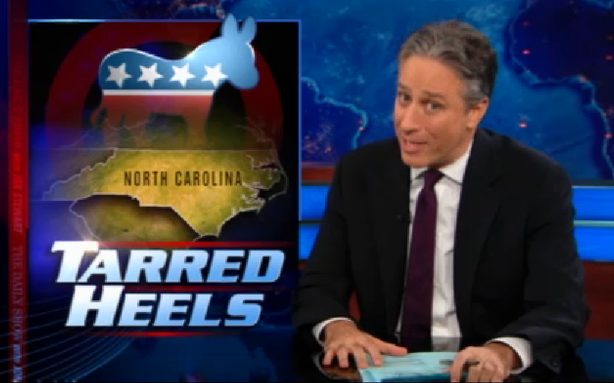
In fact, I’d really like to be on the show to discuss the media and its southern stereotypes.  I’ve written about it before here on Pop South (See posts on DNC Announcement and the one on Martin Bashir over at MSNBC), and I’m certainly scouting out other journalistic blunders on this score, but right now I am waging a campaign to be a guest on the Daily Show to talk about the subject.  And why not?  The Daily Show has numerous reports that have been tagged “the South.”  The earliest one, on Strom Thurmond, dates to 1999.  And the most recent?  On Chick fil A, of course.  I suppose the region is a gift that keeps on giving, as seen in the report on “Tarred Heels” (below), which led Jon Stewart to conclude that North Carolina is the Democrat’s “South Carolina.”  Ouch!

The Daily Show with Jon Stewart Mon – Thurs 11p / 10c
Tarred Heels
www.thedailyshow.com
Daily Show Full Episodes Political Humor & Satire Blog The Daily Show on Facebook
Tarred Heels (watch video above)

So, Jon, if you’re listening, I’ve got a book on the topic of the South in popular culture, this here blog, and hell, I’ve even written an op-ed for the New York Times. I’m also a fan of the show, if that helps.  And, I’d love to talk “the South” with you while you’re in Charlotte.

Pop South readers: Join me in my campaign and tweet to get @Sassyprof on the air.  Tweet this message:  Give @Sassyprof a guest slot to discuss the South and the media @TheDailyShow #CharlotteDNC

Here Comes Honey Boo Boo, and There Goes TLC

The Learning Channel (TLC) recently announced the upcoming premiere of its new series “Here Comes Honey Boo Boo,” featuring Alana, the “breakout star” of “Toddlers & Tiaras.” Alana, as some viewers will recall, is the little pageant queen whose mother June gives her “go-go juice,” a mixture of Mountain Dew and Red Bull, to give her that special energy she needs to perform.  Doing so brought June severe criticism, but that hasn’t stopped her from placing her entire family in front of the camera for what TLC describes as “the unapologetically outrageous family life of the Honey Boo Boo clan,” from rural Georgia.  Here’s a taste of what’s to come:

A quick read of the TLC press release lets me know that the most unapologetic people involved with this series, debuting in August, are the producers at Los Angeles-based Authentic Entertainment who developed the show, and The Learning Channel, its distributor.  TLC, owned by Discovery Communications, claims it “celebrates extraordinary people.”  So, the company is “celebrating” Alana and her family, is it?

What the folks at TLC are celebrating in this tragic production is that a ripe plum for exploitation fell right into their laps.  It has all the elements of the depraved South, which production companies like Authentic Entertainment create for public consumption and profit.  Rural Georgia? Check. Rednecks? Check. Do they roll around in the mud? Check. Are there people with nicknames (besides “Honey Boo Boo,” there’s “Sugar Bear,” “Pumpkin,” “Chickadee,” and “Chubb”)? Check, check, check, and check.

The kicker is this line in the press release, which says as much about the producers as it does the family:  “When she’s not chasing after crowns, Alana’s with her family in rural Georgia doing what her family does best: four-wheeling through mud pits and picking up road kill for the family cookout.” Really, this is what they do best?  And how about Authentic Entertainment and TLC?

“Here Comes Honey Boo Boo” is an unabashedly shameless series that scrapes the bottom of the reality television barrel, and it is unsurprising that the rural South is used to make it happen.  Videos that parody this little girl and her mother already populate YouTube, an indication that the show may do well for TLC.  Yet those parodies suggest something worse going on here, as they predict that Alana grows up to be a pathetic, drug-addicted adult.  One can’t help but find a kernel of truth in this, and she may well have TLC to thank.  I am not suggesting that Alana’s mother June get a pass for exploiting her child, but neither should TLC or its partner in crime, Authentic Entertainment.

Andy Griffith and the South of Mayberry

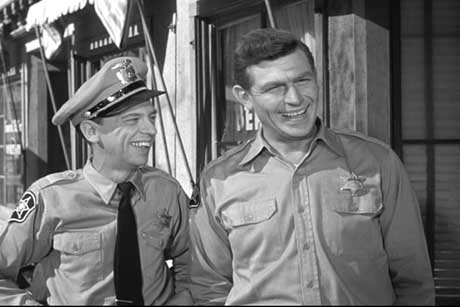
The passing of Andy Griffith last week prompted an outpouring of love and respect for the man and his life’s work in movies, television, and even gospel music.  Yet it was his role as Sheriff Andy Taylor in The Andy Griffith Show (TAGS), which received the greatest response from media writers and fans alike.  And how could it not?  Andy Taylor was such an iconic television character it was as if Taylor and Griffith were one.  Even if Griffith disagreed with that assessment, which he did on several occasions, it is what fans of the show believe.

Fans also want to believe that Griffith’s hometown of Mt. Airy, North Carolina, was the setting for the show.  Certainly, there are numerous references to Mt. Airy and other towns in North Carolina.   Yet whether it was or wasn’t doesn’t matter much, because diehard fans of TAGS believe it to be true.  Mayberry is Mt. Airy and Mt. Airy is Mayberry.

A radio talk show host recently asked whether the show’s portrayal of the region was realistic or accurate.  My response is that in some ways this question does not matter.  Television is meant to entertain people, which TAGS did very successfully.  But if we are going to go there, we can think about this from two different angles:  one is Griffith’s, the other is about the reality that existed in Mt. Airy, upon which it is believed the show is based.

Most people associated with TAGS acknowledge that the show reflected Andy Griffith’s vision, which he has repeatedly said was to tell universal stories about goodness that reflected the values he grew up with.  So, who are we to argue that what he presented was not an accurate representation of his own experience?

Then there is Mayberry, the setting for the show.  Was it realistic in presenting a small southern town like Mt. Airy?  Here, one could argue both for and against realism.  On the one hand, it appears there are no African Americans living in Mayberry.  Oprah Winfrey, a self-confessed fan of the show, once asked “Where are the black people?” Historically, Mt. Airy has had a black population, albeit a small one.  Therefore, one could argue against realism.  Yet it could be that Andy Griffith chose to write about the nostalgic South of his youth, in which he grew up in a primarily white community.  If so, then one could say the show was realistic.

This map of Mayberry suggests it could be a real place. Note Andy’s residence on the map. Other places marked can be found on iMayberry.com. Courtesy, iMayberry.com

What we might all agree on is that Mayberry did not represent the South of the 1960s. Throughout its run on television, The Andy Griffith Show regularly ranked among the top ten most watched shows.  It offered a nostalgic portrayal of the region—one that countered the negative images of the region present in the civil rights coverage also being watched by millions on the evening news.   The sit-in movement began in Greensboro, North Carolina, just down the road from Mt. Airy. And in Mayberry, the worst thing to happen might be a prisoner on the loose from the state penitentiary who, by the end of the show, will be caught by Andy Taylor.

The point is that it was Andy Griffith’s intention to entertain people through the stories and characters who lived in Mayberry—not make a political statement about civil rights.  Moreover, many of its fans, like Oprah Winfrey, are African American.  The fact is, the show has universal appeal.

More importantly, especially given today’s reality television programs (a large number of which are set in the South), The Andy Griffith Show didn’t trade in negative stereotypes about the region or southerners.  When there were hillbillies on the show, like the Darlings or Ernest T. Bass, they were fully developed characters with endearing, and likeable qualities.  Female characters, particularly Andy’s girlfriends Ellie Walker and, later, Helen Crump were educated professional women who had their own homes.  In some episodes, their dialogue suggests that they were well aware of the feminist movement of their day.

Television coverage of Griffith’s passing inevitably included interviews with residents of Mt. Airy, still a small southern town.  Interestingly, one woman interviewed by a local station here in Charlotte was from New Jersey.  She told the reporter that she loved TAGS so much that after attending Mayberry Days—the town’s annual celebration of the show—she moved to Mt. Airy so she could live in a place where people still maintained good values and looked after one another.   What this woman sought via her love of The Andy Griffith Show was to return to a different time and place.  It is a nostalgic craving for a bygone America, but as it turns out, it is in the South of Mayberry where she thinks it still exists.