Folks who write about the South, think about its history and culture, and bristle at negative assumptions about the region from those who really don’t know diddly about it, will likely enjoy a new online magazine called The Bitter Southerner. This isn’t the fluff you’ll find in Southern Living or Our State, though certainly there’s a considerable readership for nostalgia illustrated with Bob Timberlake paintings and photographs of iced tea in mason jars.
No, this is a weekly online magazine that offers thoughtful, erudite articles that consider the South in its complexity. It also does what I’ve sought to do with some of my posts on Pop South, which is to enlighten the ill-informed by showcasing a region that is far more nuanced than it is often presented in popular culture.
The Bitter Southerner comes to us from Atlanta and to date has begun a series on original southern cocktails (The B.S. Cocktail Series) and published an essay by Patterson Hood of the Drive-By Truckers. This week the magazine hands over the reins to Ray Glier who has recently published a book on the SEC‘s dominance in college football.
Chuck Reece, the editor-in-chief, talked about the magazine in a recent radio interview and of how quickly word has spread about “The BS.” Apparently, dozens of people from across the country (many of them ex-pat southerners) have “come out of the woodwork” offering to write essays, and for good reason. The Bitter Southerner is a smart magazine that appeals to the readers’ intelligence. So far, it recognizes that stereotypes, positive or negative, are not necessary in order to have a conversation about the South. That being said, it will be interesting to watch the direction the magazine takes in the coming weeks and to see how well it covers the region’s diversity.
New essays are published every Tuesday. I recommend you give it a try. And, if Chuck Reece is reading this, I’m available.
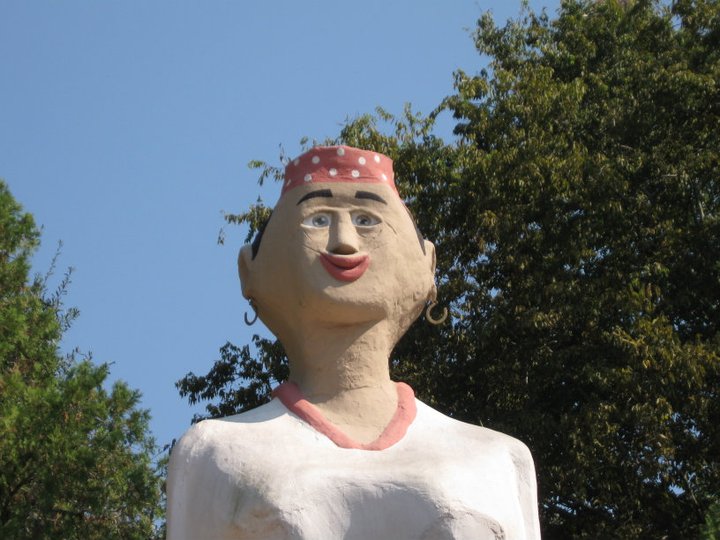
Visitors who travel to Natchez, Mississippi, by way of Highway 61 will be able to see an interesting relic of roadside architecture known as Mammy’s Cupboard. While some visitors just want to stop and photograph the building, locals go there because it’s a great place to get a meat and three and a slice of banana caramel pie that by itself is worth the five-mile drive from town. For others, the building’s association with a “southern mammy” is enough for them to keep on driving.
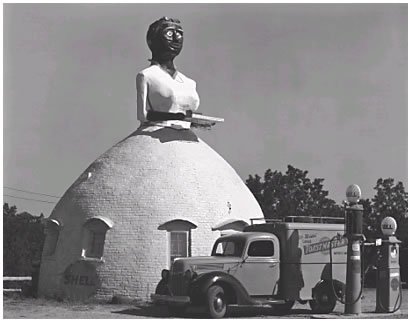
Built in 1940, Mammy’s Cupboard originally operated as a family-owned Shell Gas station and convenience store. It was a good investment at the time. The Natchez Pilgrimage, the spring tour of the town’s antebellum mansions, had grown exponentially since it began in 1932. Tourism to the town exploded following the enormous success of Gone with the Wind, which premiered in 1939. Many Americans who saw the film later went in search of houses like Tara;Natchez offered them that and more.
Today, the gas pumps at Mammy’s have been closed off, but it remains a family-owned restaurant that is primarily open for lunch.
White tourists, of course, were drawn to the Natchez mammy from the beginning. By 1940, Aunt Jemima–a marketing figure based on a southern mammy–was already the most recognizable advertising icon in the country. She reminded whites that this kind of happy servitude was still within reach. For African Americans, mammy icons were a reminder of their second-class status.
Former Howard University Professor Sterling Brown wrote about the figure while traveling through the region in the early 1940s. In A Negro Looks at the South, he observed:
Edward Weston’s photo, 1941.
“Outside of Natchez, as a come-on for tourists, is the Mammy Gas Station and Barbecue Stand. With clean-cut features, a trim waist, and an elegant hoopskirt, a tall erect statue of a Mammy stands there, fronting the highway so proudly that her bandana seems out of place. My host explained why: the yarn goes that she was intended to be a Southern belle, but when the bodice was poured, the bust filled past all planning. Natchez objected to the breasts being so pendulous, and the statue’s complexion was colored to a deep chocolate. Hoopskirt and waist and features still belong to the belle, but it is a colored girl, Egyptian-like, who welcomes the tourists to Natchez and invites the white natives to barbecue.”
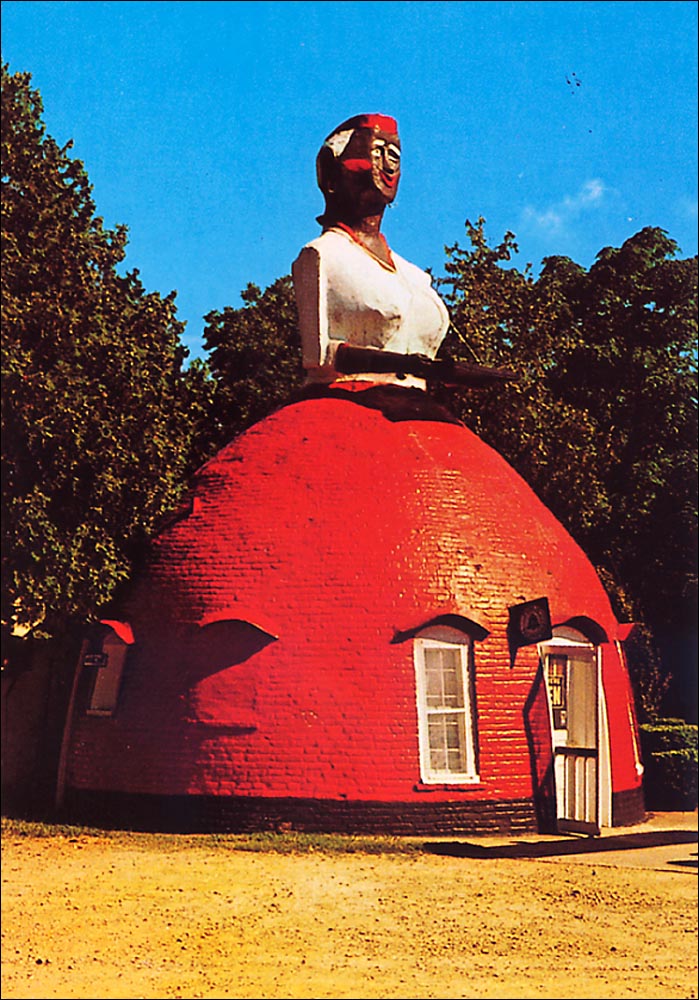
In the more than seventy years that Mammy’s has been open, her skin tone has grown lighter in appearance–more white than black. She was still rather dark in the early 1990s, but has since become very fair–perhaps a tacit acknowledgement by the owners that the dark skin was at best inappropriate, and worse, an offensive reminder of the not-too-distant past.
Postcard, 2013
Yet if you were to stop by Mammy’s Cupboard today, you’d still be able to get a postcard of the restaurant from the days when she was still dark. It’s a small reminder of William Faulkner‘s oft-quoted line from Requiem for a Nun. “The past is never dead. It’s not even past.”
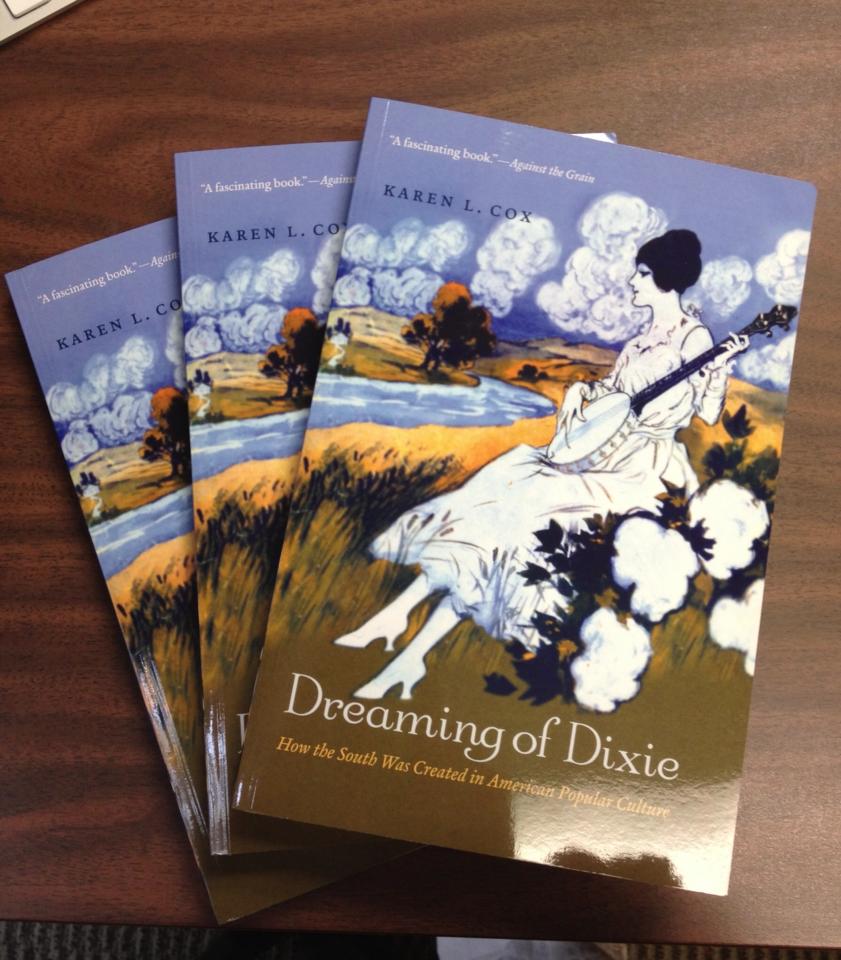
Well, that didn’t take too long. Dreaming of Dixie, the paperback version, is now available from online bookstores and through the publisher, the University of North Carolina Press. In fact, if it weren’t for the press, there’d probably be no Pop South.
Facebook and Twitter were all aflutter this week about Vicco, Kentucky, thanks to a wonderful segment on The Colbert Report about “People Who Are Destroying America.” The segment zeroed in on Mayor Johnny Cummings, the openly gay major of Vicco, which also happens to be the smallest town in the country to pass an LGBT fairness ordinance. In typical Colbert fashion, the segment exposes the hypocrisy of the idea that if the LGBT community is offered any kind of equality then we are all going to hell in a handbasket.
One would assume that Vicco, a coal-mining town in eastern Kentucky, would be repressive on such issues. It’s in a conservative southern state and we all know that gays and lesbians cannot possibly live openly in the South–at least that’s what mainstream media usually tells us. But as I argued in an op-ed in the New York Times last October, the South is far more nuanced about LGBT issues than its often given credit for. A few months later, the Times concurred with its own piece on Vicco from which the Colbert Report probably got the idea.
This is not to say there isn’t room for improvement. Here, in North Carolina, citizens voted to amend the state constitution to make doubly sure that there would be no such thing as gay marriage in the Tarheel State. It was already illegal, but conservatives felt the need to batten down the hatches in order to protect traditional marriage.
And yet, today marks the beginning of Charlotte Pride Week celebrating all things LGBT. It will culminate with a two-day festival in Uptown, which last year attracted more than 20,000 people and is increasing its number of corporate sponsors. This South exists, too.
We could all learn something from Johnny Cummings, his friends, and the town of Vicco–namely, that the South is not a monolith and while religious, right-wing zealots within the region may push their own agendas, they don’t always win.
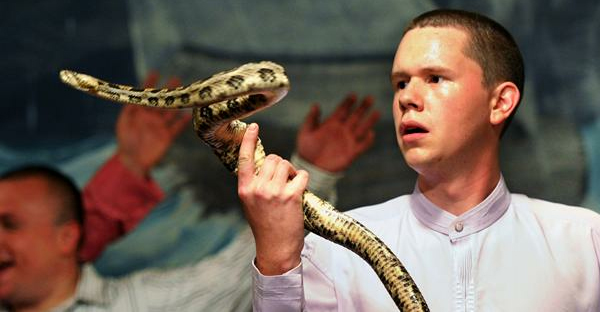
Snakes alive. We’ve got us another southern-based reality television show. “Snake Salvation” focuses on a small Pentecostal sect in Appalachia that takes the Gospel of Mark 16:18 to heart: “They shall take up serpents; and if they drink any deadly thing, it shall not hurt them; they shall lay hands on the sick, and they shall recover.” Essentially, they prove their faith in God by handling poisonous snakes–mostly rattlers–and if they’re bitten, they believe in the healing power of their Lord to keep them alive. They also believe that if they don’t handle snakes, well, hello Hell!
Pastor Andrew Hamblin is one among a new generation of snake-handling ministers.
The show, which premieres on National Geographic on September 10th, features Jamie Coots (did they have to choose a man named “Coots?”) of Full Gospel Tabernacle in Jesus Name church of Middlesboro, Ky. and Andrew Hamblin of Tabernacle Church of God in LaFollette, Tenn. According to the show’s description, “Hunting the surrounding mountains for deadly serpents and maintaining their church’s snake collection is a way of life for both men.” Not many churches can say they have a snake collection.
The earliest years of my life, just to age 6, were spent at the Rock of Ages Church in Huntington, West Virginia. When I watch the video below, I recognize a similar type of preaching and inflection among the snake-handlers that I witnessed as a young child. They minister to their flock using a singsong kind of expression. “I belieeeeve-ha. In Jesus Chriiiiist-ha.” That sort of thing. At Rock of Ages, I didn’t have to fear snakes, just that giant portrait of Jesus wearing a thorny crown with blood dribbling down his forehead. THAT terrified me.
I do remember, though, my Maw Maw Cox telling me about some snake handlers that showed up at the funeral home where my Uncle Roger worked. As it turns out, one of the members of the snake-handling church had died and when it came time for visitation the church members came to pay their respects, but they weren’t alone. They brought their snakes with them and asked to slip a few into the coffin. This caused the staff at the funeral home to scatter, and eventually, the police arrived and forced them to take the snakes away.
Rev. Coots and Rev.Hamblin hope that the show will allow the public to see that their lives revolve around more than hunting and handling snakes, though I’m not so sure viewers will notice much more.
I’m going to try to reserve judgement until I’ve seen the show, but I can’t help but wonder about this latest attempt to examine the white underbelly of the South. And I emphasize white, because nearly all southern-based reality shows focus on whites who are generally, from the lower class or outright poor. In fact, Andrew Hamblin falls into this category. According to an article in the Christian Post, he is struggling to support his wife and five children and is doing the show to attract more followers. It will be interesting to see if the show takes off or simply slithers away.
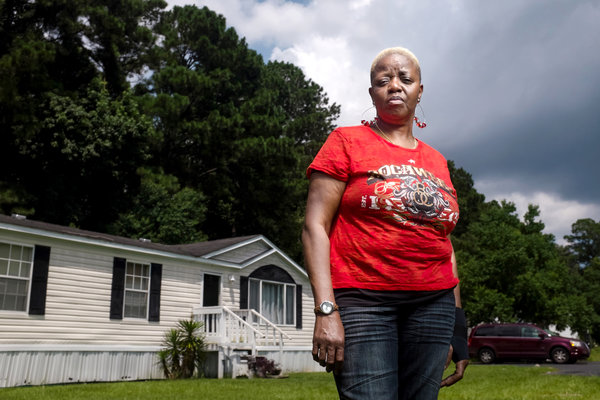
Dora Parker, the woman Paula Deen called her “soul sister.” Photo credit: New York Times.
I encourage readers of Pop South to read today’s New York Times op-ed by Rebecca Sharpless providing historical perspective on Dora Charles, the woman Paula Deen called her “soul sister.”
Ms. Charles, who helped open Deen’s restaurant Lady & Sons as well as train other cooks who worked there, was recently interviewed by the Times about her relationship with Deen. That interview is, in many ways, even more revealing about who Paula Deen is than the deposition she gave in the lawsuit brought against her by a white woman, Lisa Jackson.
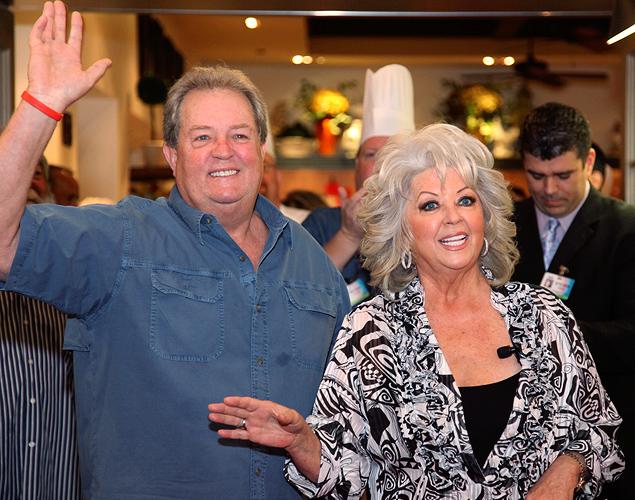
Paula Deen with her brother Bubba Hiers, co-owners of Uncle Bubba’s Oyster House.
The Paula Deen fiasco that has unraveled over the past several days has me thinking about her brother Earl “Bubba” Hiers. Specifically, where the hell is Uncle Bubba? Because if you take a look at the original lawsuit, he is the one who needs his ass kicked all the way to Tybee Island for the hostile work environment created at the restaurant that carries his name.
To be clear, I still believe Paula Deen needs to be held accountable. And for sure, she needs to offer a more sincere apology–one that doesn’t suggest that it’s about someone who wants what she has. (See the the analysis of her Today Showinterview.) That may be true, but it doesn’t let Deen off the hook for her own racial missteps.
What boggles my mind, though, is the extent to which Paula Deen goes to cover for the men in her life, especially her brother.
In the lawsuit, we learn that her companies and her restaurant Lady & Sons is essentially a “Boys Club.” And the boys, it turns out, behave badly. Especially Uncle Bubba.
The lawsuit, moreover, isn’t just about a work environment damaged by racial slurs. It’s very much about the ways that sexual harassment created a hostile work environment for women.
First, it is abundantly clear from the allegations that Uncle Bubba is the primary culprit for making racial slurs. Yet what is also clear is that he regularly engaged in inappropriate workplace behavior and often used foul language when speaking to women or about women.
According to the lawsuit:
–Karl Schumacher, who is in charge of compensation for employees allegedly said that “women are stupid because they think they can work and have babies and get everything done.”
–Bubba Hiers allegedly either brought pornography to the restaurant or openly watched pornography “on the kitchen computer” where it was visible to several employees;
–Bubba Hiers allegedly made several sexual jokes in the workplace, criticized the “fat girls” who worked in the restaurant, told Lisa Jackson she had “nice legs” and to bring in photos of herself from when she was younger; and suggested that the restaurant staff be replaced with “Hooter’s girls.”;
–Lisa Jackson also alleges that Bubba Hiers “[grabbed] her face and [kissed] her and [spit] on her;”
And on, and on.
So, what’s much more clear now from Paula Deen’s deposition is that while she used a racial slur herself, she enabled the men who worked for her to continue their behavior by either ignoring the complaints brought to her attention, being willfully unaware of how her restaurants operated, and now, covering their asses–especially her brother Bubba. This pisses me off, because while Deen is apologetic about the racial slurs, she hasn’t offered one apology for the sexual harassment.
But then, the media has ignored this aspect of the lawsuit as well as “Uncle Bubba’s” behavior.
Fortunately, we have reached a point in our society where many of us can rise up (and have) to say “no” to racism. But we have NOT reached that point when it comes to sexual harassment. In the public trial of Paula Deen, everyone’s been silent on this point. The media, Paula Deen, and her sons. Of course, Uncle Bubba has been silent about everything and is hiding behind his sister’s imaginary hoop skirt.
I, for one, think Earl “Bubba” Hiers needs to be held responsible for his behavior. He should be dragged through the court of public opinion, too. The fact of the matter is that he’s gotten off easy.
If Deen’s use of a racial slur has proven there are consequences for doing so, then why not the same when it comes to sexual harassment? There needs to be consequences for that, too.
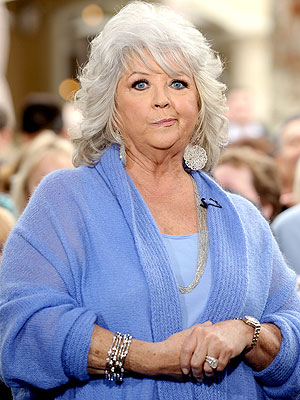
There’s not enough butter to cover up or improve the bad taste that Paula Deen has left in people’s mouths since they learned that the South’s most famous cook admitted to using the “N-word” as well as making other racially insensitive remarks. Twitter lit up with fake recipe titles attached to the hashtag #paulasbestdishes, skewering Deen for her racial insensitivity. “We Shall Over-Crumb Cake” and “Massa-roni and Cheese” are just two (and, frankly, kind) of hundreds of examples.
Her comments came under oath as she was being deposed by attorneys for Lisa Jackson, a former employee who is suing Deen and her brother Earl “Bubba” Hiers, along with Deen’s company, for alleged “violent, racist, and sexist behavior.” The full details of the complaint, in fact, are much more alarming and disturbing and go well beyond racial epithets. Yet for now, the focus is on Paula Deen’s racist comments, and for good reason.
Deen has presented herself and has been marketed as the “face of southern cooking.” Her shows on the Food Network, her cookbooks, magazines, and product endorsements have made her a household name and a multimillionaire. She is a very public figure and has to know that what she says and does will be publicly scrutinized. And if she didn’t, she certainly knows it now.
So what did she say? Under oath, she admitted to using the “N-word.” She also said she wanted to plan a “really southern plantation wedding” for her brother Bubba Hiers. Her inspiration came while visiting another southern restaurant where black men wore white jackets and black bow ties. She was impressed, she said, because “that restaurant represented a certain era in America.” And when Jackson was brought in to assist the famed southern cook with preparation for Hiers wedding, she alleges that the following conversation with Deen occurred:
“Well what I would really like is a bunch of little niggers to wear long-sleeve white shirts, black shorts and black bow ties, you know in the Shirley Temple days, they used to tap dance around. . . Now that would be a true southern wedding, wouldn’t it? But we can’t do that because the media would be on me about that.” (courtesy of Talking Points Memo)
The media is on her, alright. And so are a lot of Americans who have taken to social media to let her know just what they think of her comments and her, personally.
Yet what I’m interested in here, as someone who blogs about the South in popular culture, is Deen’s supposed naiveté about the use of the N-word and her misinformed (to say nothing of outdated) view of what she believes represents a “really southern plantation wedding.”
First, there’s her use of the term “nigger.” Deen, who is 66 years-old and grew up in southwest Georgia, knows exactly what the term means and knows full well that historically, it’s been used as a pejorative. In fact, she admits to as much under oath, saying “things have changed since the ’60s in the South. And my children and my brother object to that word being used in any cruel or mean behavior.” Though, apparently, it’s okay to use in a joke. Well, now that she’s been caught using it, she’s being forced to consider that it’s not a laughing matter, y’all.
I have a sneaking suspicion that given the power she wields because of her wealth and celebrity, she didn’t think that using that term around one of her employees would matter, especially when that employee’s job depended on it. Based on her responses to attorneys’ questions, it appears as though Deen felt she only used the n-word to describe, not hurt. She seems to believe that what she said was innocuous, and it didn’t even occur to her that a fellow white southerner might have a problem with it. As it turns out, not only is Lisa Jackson white, she has biracial nieces.
Deen’s idea of a southern plantation is straight out of a Hollywood movie from the 1930s. Pictured: Bill Robinson with Shirley Temple in The Little Colonel (1935)
Deen’s desire to give her brother a “really southern plantation wedding” is also problematic, because she’s out of touch with reality to say nothing of southern history. What she described, according to the complaint, was essentially Hollywood’s version of a southern plantation from movies of the 1930s. Her reference to Shirley Temple films was a dead giveaway. In 1935, Temple starred in two films set in the Old South, The Little Colonel and The Littlest Rebel. In both, her co-star was Bill “BoJangles” Robinson who, like in Paula Deen’s image of the South “of a certain era,” is seen wearing jacket and bow tie.
The “certain era” she recalls, of course, isn’t the plantation South at all. As one of my peers rightly noted: “As a southern historian I’ve seen a great many 19th century slave photos and none included tuxedo clad slave waiters.” Indeed. What Deen described in her testimony is a 1930s pop culture version. In essence, what she hoped to recreate for her brother Bubba was a wedding scene straight out of a Jim Crow era film.
According to her attorney, Paula Deen “does not condone or find the use of racial epithets acceptable.” Such a statement is to be expected now that her own use of racial epithets has been exposed, because her southern cooking empire is very likely in jeopardy as a result.
Deen’s experience is a lesson to us all that we do not live in a post-racial America. At the same time, we should not assume that racism is simply a “southern” problem. Unfortunately, given Deen’s association with the region, the popular perception of a monolithic, racist white South rears its ugly head. Yet, what I hope doesn’t get lost in all of this is that while Deen feigns to represent the South, she is not representative of the entire region. Another southern white woman, after all, is responsible for calling her out and holding her feet to the fire.
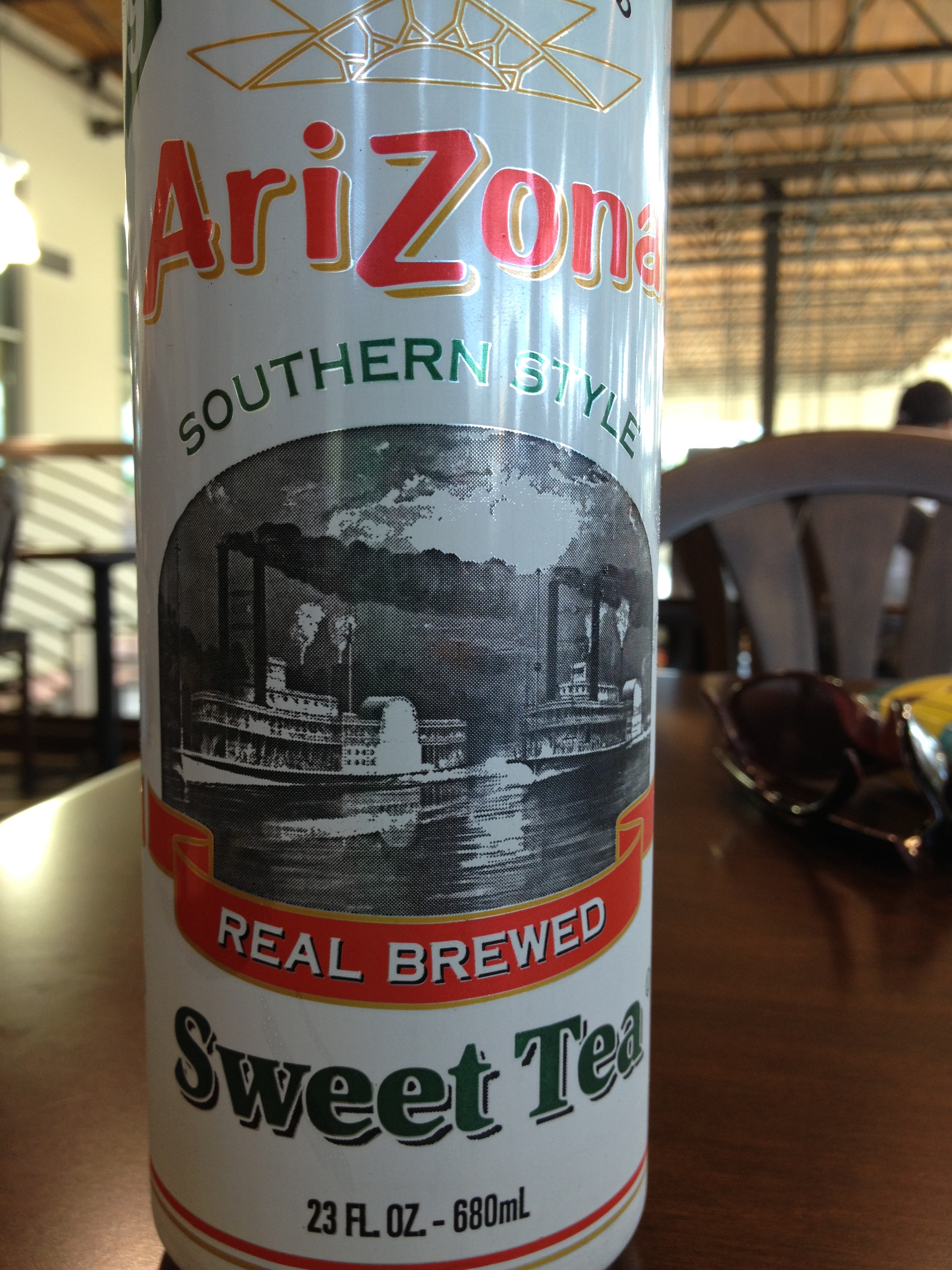
My friend’s Southern Style Sweet Tea from AriZona by way of Brooklyn, NY.
Recently, a friend and I were having lunch when I noticed an image on the side of her AriZona “Southern Style” sweet tea. It caught my attention because of the image used to brand this tea as southern–19th century steamboats on what we can probably assume is the Mississippi River.
I find it interesting that in 2013 that a company determined that it would associate “southern” with antebellum paddle-wheelers that were used to not only carry travelers, but tons of cotton cultivated by thousands of slaves. That’s when I did my research and discovered that AriZona had originally used an even more offensive image to suggest “southern style” when the product came out in 2008.
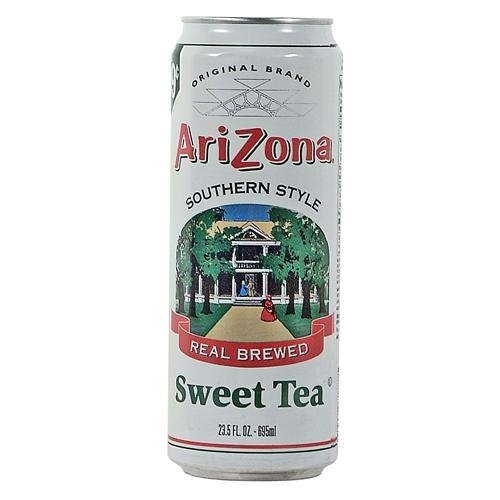
Back then, the tea was branded with the image
The original image of AriZona’s Southern Style Sweet Tea featured an antebellum plantation.
of the “big house” of a southern plantation, with a southern belle in the foreground. It was reminiscent of early advertising that incorporated images of the Old South–advertising tropes that are more than a century old. The original can rightly drew the ire of consumers for promoting an image of the Old South and the slavery that’s associated with plantations. It forced the company to change the image and make a public apology.
But why did the company approve the image of a plantation in the first place? Why did they follow it up with another image from the same era? I’d argue that it’s because the company, founded by two guys from Brooklyn, have no sense of American history nor do those in charge of its marketing understand modern southern culture. Rather, they rely on the same tired tropes of the South. Clearly, there’s some sense that the South not only hasn’t made it into the 21st century; it never made it into the 20th!
So, to marketing firms above the Mason-Dixon I say this: Come visit and quit relying on tired stereotypes. You’ll thank yourself and you won’t make stupid mistakes like AriZona.
As I sang and danced to the 1983 Culture Club hit “Karma Chameleon,” I was completely unaware of the Pop South associations that I would totally get today if the song were new. Recently, I watched the YouTube clip of the music video “Karma Chameleon” and was astounded when I saw “Mississippi–1870″ claimed as the video’s setting. Clearly, I hadn’t paid attention when it was shown on MTV. That is, when MTV really meant “music television.”
Filmed in Weybridge, England, the video features blacks and whites dancing together (not possible in 1870s Mississippi) dressed in all manner of costumes that are not necessarily of the period. The Chameleon, in this case, was a Mississippi gambling boat souped up to look like a nineteenth-century steamboat. Of course, Boy George looks like he always did, like Boy George–in makeup, colorful clothes, braids,and his signature hat. About the only thing reminiscent of the South might be the harmonica riffs, yet even those are far from bluesy.
It’s just a small reminder that what passes as “southern” has long been a favorite trope for the producers of popular culture. It was also fun to watch again.

 Folks who write about the South, think about its history and culture, and bristle at negative assumptions about the region from those who really don’t know diddly about it, will likely enjoy a new online magazine called The Bitter Southerner. This isn’t the fluff you’ll find in Southern Living or Our State, though certainly there’s a considerable readership for nostalgia illustrated with Bob Timberlake paintings and photographs of iced tea in mason jars.

 Pop South